
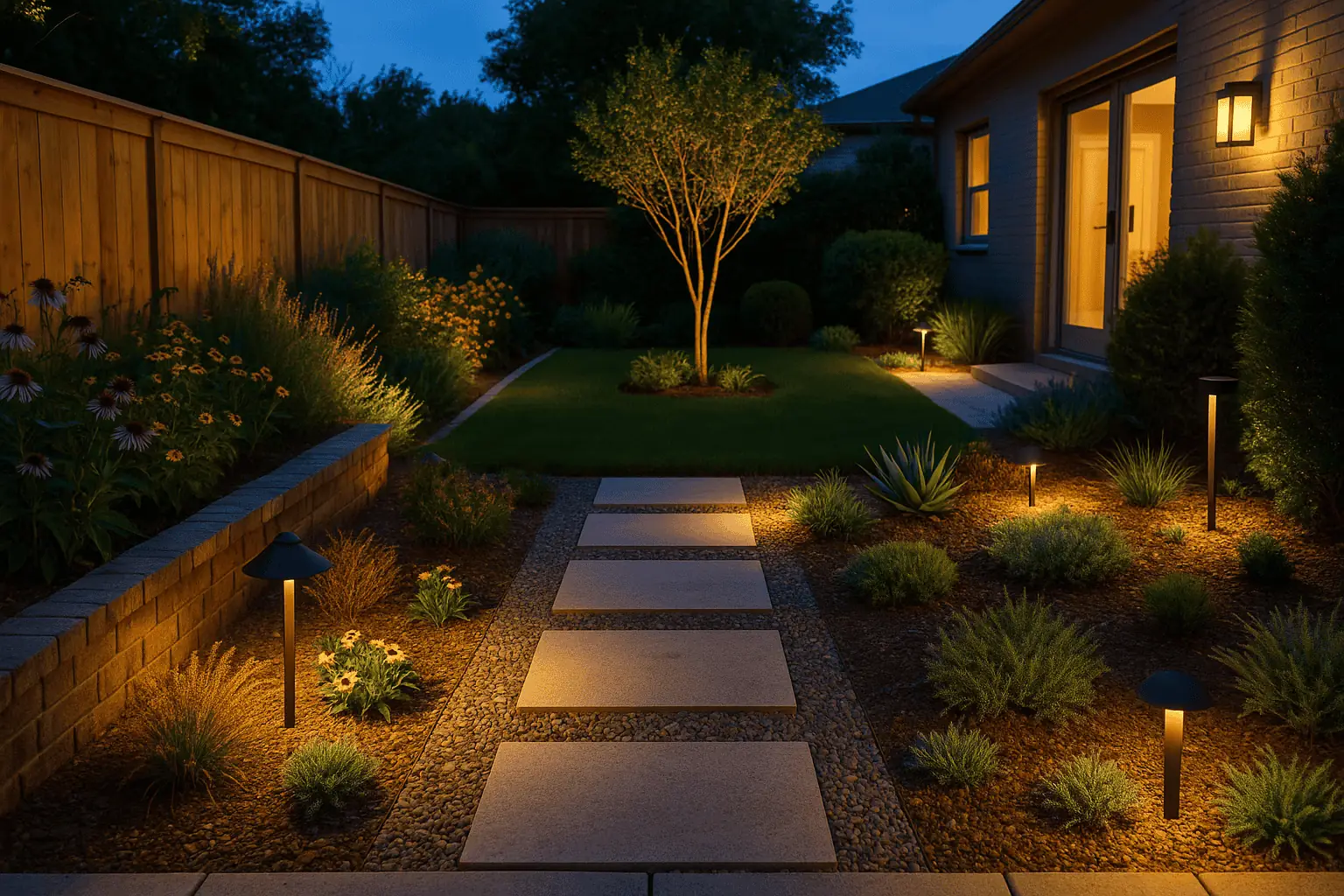
Low voltage landscape lighting installation is one of the more approachable outdoor electrical jobs. A transformer plugs into a GFCI-protected outdoor outlet and steps 120-volt household power down to 12 volts. Cable then runs from the transformer to each fixture. The work comes down to four tasks: size the transformer, choose the cable, connect and test the lights at night, then bury the cable.
This guide explains how the system works, how to size the transformer and pick the wire gauge, and the install in order. It starts with the safety rules, because they come first on the job too.
Safety first
Low voltage is safer to work with than household current, but the transformer still plugs into a 120-volt outlet, and digging can hit buried lines. Before you start:
- Follow the instructions. Follow the fixture and transformer maker's instructions and your local electrical codes. Where they differ from a general guide like this one, they win.
- Use a GFCI outlet. This Old House says the transformer must plug into a GFCI-protected outdoor outlet, with a "while-in-use" cover that keeps rain off the plug.
- No outlet, no shortcut. If there is no GFCI outlet where the transformer will go, a licensed electrician should add one. Any work on 120-volt wiring belongs to an electrician.
- Call 811 before you dig. Contact 811 a few business days before digging. The national before-you-dig service is free and arranges for buried utility lines to be marked.
- Keep away from water. This Old House advises placing no fixtures within 10 feet of pools, spas, fountains or other water features.
- Unplug while you wire the transformer. Keep it unplugged while you strip cable and fasten it to the transformer's terminals.
How low voltage landscape lighting works
A low voltage system has three parts:
- Transformer. It mounts near the outlet and lowers the voltage for the lights. Many have more than one output, called a tap. Kichler notes that tap voltage varies by transformer and can be 12, 13, 14 or 15 volts.
- Cable. Two-wire landscape cable carries power from the transformer to the fixtures. It is sold by gauge: the lower the number, the thicker the wire.
- Fixtures. Path lights, spotlights, well lights and step lights, each with a power rating listed on its spec sheet.
Most transformers can switch the lights on their own. Kichler describes a photocell for lights that come on at dusk and off at dawn, and a mechanical or digital timer for set hours.
The one idea worth understanding before you buy is voltage drop. Power is lost along the cable, so the farther a fixture sits from the transformer, and the more fixtures share a run, the less voltage it gets. Lights at the far end of an overloaded run look dim. Transformer size, cable gauge and the layout of runs all work against it.
Low voltage transformer sizing
Kichler's rule is simple. Add up the VA (volt-amperes) of every fixture to get the total for the system. The total VA should not exceed the transformer's wattage rating. The VA for each fixture is listed in its product specs. Kichler's example: a system totaling 300 VA should use a transformer rated for at least 300 watts.
Here is how the sum works on a made-up front yard. The VA numbers are examples only. Use the real ratings of the fixtures you buy.
| Fixtures | Count | VA each (example) | Total VA |
|---|---|---|---|
| Path lights along the walk | 8 | 4 | 32 |
| Uplights on a front tree | 2 | 7 | 14 |
| Step lights at the stoop | 3 | 2 | 6 |
| System total | 13 | 52 |
This yard needs a transformer rated for at least 52 watts. Choosing one with spare capacity leaves room to add lights later without buying a second transformer.
Landscape lighting wire gauge
Kichler recommends starting with 12-gauge cable and moving to a larger cable if the numbers call for it. The check is a voltage drop sum, done for each cable run:
- Voltage drop = (2 x cable length in feet x total VA on the run) divided by the cable constant.
- End fixture voltage = transformer tap voltage minus the voltage drop.
The cable constant is a fixed value for each wire gauge, listed in the cable or fixture maker's chart. Kichler says the end fixture voltage should be greater than 10 volts, and that every fixture on a run should operate within the 9 to 15 volt range. It also recommends checking with a voltmeter, not relying on the sum alone.
If the far end comes out too low, Kichler gives three fixes:
- Move the run to the next higher voltage tap, if the transformer has one, and recalculate.
- Take some fixtures off that run and recalculate.
- Use a heavier wire gauge and recalculate.
Layout helps too. Family Handyman suggests creating a tee, so one long run becomes two shorter ones fed from the middle.
How to install low voltage landscape lighting
This is the usual order for DIY landscape lighting with a plug-in transformer. Check each step against the instructions for your own fixtures.
- Plan the lights. Sketch the yard, mark each fixture and measure each cable run. Our guides to path lighting spacing and uplighting trees help with placement.
- Call 811. Do it a few business days before digging, and wait for the lines to be marked.
- Mount the transformer. This Old House mounts it on a stake or an outside wall, with the bottom at least 1 foot off the ground and within 2 feet of the outlet.
- Lay out fixtures and cable. Set each fixture where it will go and run cable along the line. This Old House places the first fixture at least 10 feet from the transformer and routes cable under or around obstacles.
- Connect the fixtures. Many fixtures use press-together connectors with prongs that pierce the cable insulation. Family Handyman prefers weatherproof wire connectors. Use what the maker supplies or recommends.
- Test at night. Plug in the transformer and look at every light after dark. Adjust aim and position, and check voltage at the far fixtures with a voltmeter.
- Bury the cable. Do this last, after testing. Leave a little slack at each fixture so it can be moved later.
- Set the controls. Program the timer or aim the photocell, and check the lights come on as planned.
How deep to bury the cable
Published guides differ, so follow the cable maker's instructions and local code. Family Handyman says to bury cable at least 6 inches deep under lawn, so it is not damaged when the lawn is aerated. In protected planting beds, it says the cable can simply be covered by mulch or soil. The This Old House install guide uses a shallow trench under a lifted flap of sod, no more than 3 inches deep, so fixtures are easy to connect later. Another This Old House guide says at least 6 inches.
DIY landscape lighting or hire a pro?
A small plug-in system is a common weekend project. Hiring help makes sense when:
- there is no GFCI-protected outdoor outlet in the right spot, or any 120-volt work is needed;
- the design is large, with many fixtures, long runs or several zones;
- lights must be mounted high in trees or on the house;
- you are unsure about local codes or permits.
Troubleshooting
| Problem | Likely cause | What to try |
|---|---|---|
| Lights dim at the far end | Voltage drop on a long or overloaded run | Higher tap, fewer fixtures on the run, or heavier cable (Kichler) |
| Lights flicker | Loose connections or voltage issues (This Old House) | Check and remake each connection |
| One fixture is out | A connector not fully seated | Disconnect and reconnect it, as This Old House advises |
| Nothing lights | Power, timer or photocell | Check the GFCI outlet, the transformer and the timer or photocell settings |
For the design side, including layers, color temperature and brightness, see Landscape Lighting Design.
More guides on Yard and Soil
- Landscape Lighting Design: how to plan every layer of light in the yard.
- Path Lighting Ideas: spacing, height and fixtures for the front walk.
- Uplighting Trees: fixture placement and moonlighting for trees of every size.
- Outdoor Lighting for Curb Appeal: how light helps the front of a home look its best.
Sources
- Kichler, Choosing the Right Landscape Transformer (VA total and transformer rating, tap voltages, voltage drop formula, 12-gauge starting point, end fixture voltage, photocell and timer).
- Kichler, Calculating Your Project Load Size (300 VA example, 9 to 15 volt range, fixes for low voltage, voltmeter check).
- Joseph Truini, This Old House, How To Put in Landscape Lighting (GFCI outlet and cover, transformer mounting, first fixture distance, water features, connectors, shallow trench).
- Jim Gorman, This Old House, All About Landscape Lighting (120 to 12 volts, 6-inch burial, flickering lights).
- Family Handyman, Low-Voltage Outdoor Lighting (6-inch burial under lawn, mulch in beds, weatherproof connectors, tee layout).
- 811, 811 Before You Dig (contact 811 a few business days before digging; the service is free).