
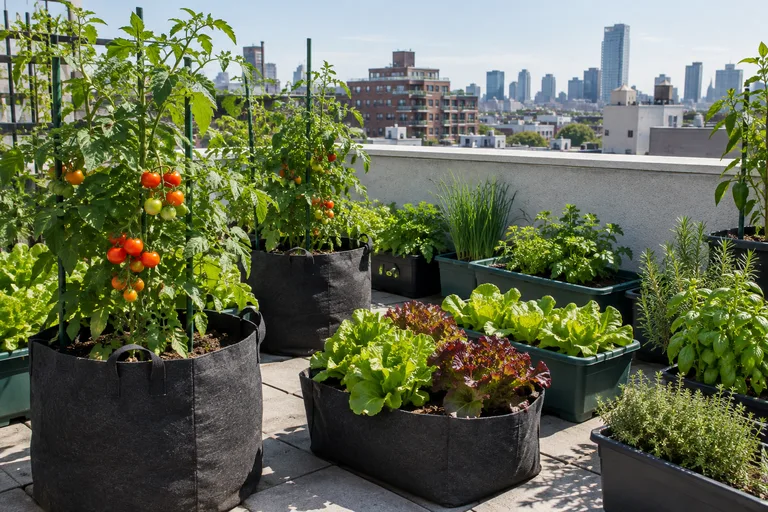
A rooftop vegetable garden can grow a real harvest in a city, but the roof comes before the plants. Before you carry up a single pot, have a structural engineer or the building owner confirm how much weight the roof can hold. Then use light containers and potting mix, plan for wind and heat, water often and choose compact crops.
Why grow on a roof, and the trade-offs
A roof can turn unused space into a garden. Senga Lindsay's BC Living article lists some real advantages for edible rooftop gardens:
- Fewer pest and disease problems than at ground level.
- Fewer weeds.
- Fewer visits from animals such as rabbits, raccoons and deer.
The trade-offs are just as real. Weight is limited by the structure. Wind is often stronger. Every pot, bag of mix and can of water has to be carried up. A roof garden works best when it starts small and grows only as far as the roof, the water supply and your time allow.
Rooftop garden weight limits: check the load first
Weight is the one mistake on a roof that can hurt people and the building. Soil is heavy, and wet soil is heavier still. University of Maryland Extension gives one real example: a 20-inch container filled with moist growing mix and plants can weigh 100 pounds.
A few of those pots, plus people and water, add up quickly. Only a structural engineer or the building owner can say what your roof can safely carry. Do not guess from the look of the roof, and do not rely on a number from a website, including this one.
What adds weight to a rooftop garden
Senga Lindsay, writing in BC Living, lists what a roof must be checked for before an edible garden goes up:
- Wet soil, not dry soil.
- Stored water, such as rain barrels or tanks.
- The weight of mature crops.
- Equipment such as planters, trellises and furniture.
- People working or sitting in the garden.
- Snow, where winters bring it.
She calls a structural engineer essential, and her own example garden sits on a garage roof that was structurally reinforced first.
Questions to ask the engineer or building owner
- How much weight can this roof carry, and does that differ from one area to another?
- Where should heavy containers go?
- Can the roof surface take people walking on it and containers sitting on it?
- Where are the drains, and how must they be kept clear?
- Are there building rules, permits or lease terms that apply?
- How must railings, trellises and windbreaks be fixed down?
Write the answers down and plan the garden around them, not the other way around. If you rent, the landlord's written permission comes first.
Choose light containers and a light mix
Once you know the limit, every pound you save means more room to grow. Most of the weight is in what fills the pot.
| Material | Weight | Use on a roof |
|---|---|---|
| Soilless potting mix (peat or coir, perlite, vermiculite, bark, compost) | Light (University of Maryland Extension) | The main fill for rooftop containers |
| Garden soil or topsoil | Dense | University of Maryland Extension says it is too dense for containers and can drown roots. Use it only in very large containers, at 5 to 10% of the volume or less |
| Coarse sand | Heavy | Improves drainage but adds weight. Use sparingly, if at all |
The same extension service lists what a good soilless mix holds. Typical parts are sphagnum peat moss, perlite, vermiculite, composted bark, compost or coconut coir, plus a little lime and fertilizer. It notes these mixes repel water at first, so wet them thoroughly by hand before planting.
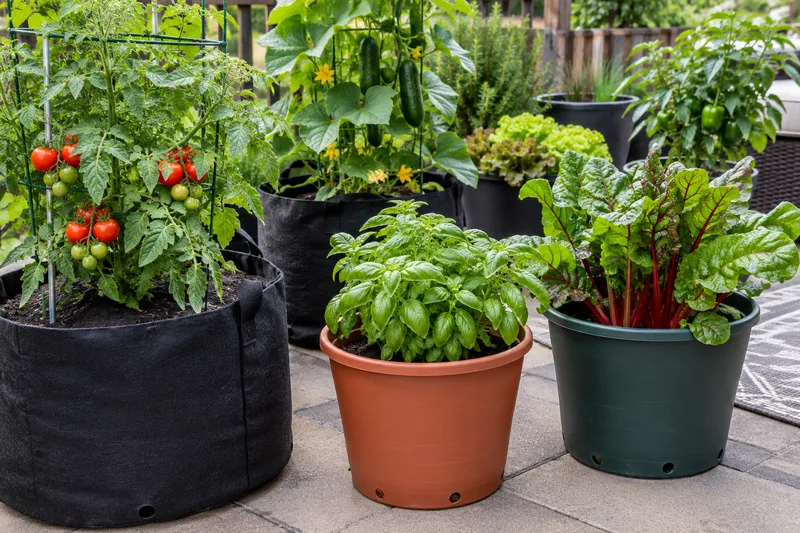
Container materials
- Plastic and metal hold moisture longer than porous pots, according to University of Maryland Extension.
- Clay, ceramic, concrete and wood dry out faster. Concrete and ceramic are also heavy.
- Dark colors absorb more heat, which can injure young roots. On a hot roof, lighter colors are the safer choice.
- Indoor plastic not made for outdoor use can turn brittle in the sun.
- Drainage holes are needed in every container except self-watering types. Raise pots on pot feet so water drains away.
Rooftop container vegetables: what to grow
A roof often has open sky, but nearby towers, parapet walls and water tanks can still cast shade. Track the sun before you choose crops. University of Maryland Extension gives these needs:
- Warm-season fruiting crops (tomatoes, peppers, eggplant, squash): 6 to 8 hours of direct sun.
- Cool-season leafy crops (lettuce, spinach, Asian greens): 3 to 5 hours.
Match the container to the crop. These are the University of Maryland Extension minimums:
| Crop | Minimum container | Direct sun |
|---|---|---|
| Lettuce, spinach, salad greens | 1 to 3 gallons, 4 to 6 inches deep | 3 to 5 hours |
| Radishes, scallions, peas | 1 to 3 gallons, 4 to 6 inches deep | Check the seed packet |
| Beans, beets, carrots, summer squash | 4 to 6 gallons, 8 to 12 inches deep | Summer squash: 6 to 8 hours |
| Tomatoes, peppers, eggplant, cucumbers | 8 to 10 gallons, 12 to 16 inches deep, one plant per pot | Tomatoes, peppers, eggplant: 6 to 8 hours |
Choose "bush" or "dwarf" varieties where you can, as University of Maryland Extension suggests. They stay shorter, which also helps in wind. The same guide calls melons, corn, potatoes and sweet potatoes more challenging in containers.
Wind on rooftop gardens
Wind is often stronger on a roof than at ground level, Senga Lindsay notes in BC Living. She adds that rooftop windbreaks must be designed into the building frame and built to withstand wind loads. That is a job for the engineer, not a weekend project.
Within the limits the engineer sets, these habits lower the risk:
- Keep tall plants low and wide. Put tomatoes and trellised crops in wide, stable containers.
- Fix trellises down. A loose trellis acts like a sail. Attach supports only as the engineer or owner approves.
- Group containers. A tight group is easier to shelter behind one approved windbreak, and easier to water.
- Nothing loose near the edge. Keep light pots, tools, bags and cushions away from the roof edge and tie down or store them.
- Close umbrellas. Fold shade umbrellas whenever the garden is empty.
- Water more often. Wind dries soil and leaves faster, so check containers more often on windy days.
Heat, water and drainage
Roofs are surrounded by hard surfaces. University of Maryland Extension warns about heat from brick, concrete and reflective surfaces near containers.
- Check every day in summer. The same guide says some containers need watering every day in hot, dry weather. Press a finger into the mix and water when it feels dry.
- Water deeply. University of Maryland Extension says one long watering works far better than several shallow ones.
- Use drip lines if you can. Utah State University Extension calls drip or trickle irrigation the most efficient way to water, compared with sprinklers.
- Try self-watering containers. They hold a reserve of water and catch runoff that can stain roof decking.
- Keep drains clear. Leaves, soil and pots must never block roof drains. Standing water adds weight and can damage the roof.
- Plan the water supply. Carrying water up stairs is heavy work. Ask the owner whether there is a tap on the roof.
Planning the layout
Lay the garden out on paper before anything goes up. Work from the engineer's notes, then add the plants.
- Heavy pots where the engineer says. Mark the areas cleared for weight and keep the largest containers there.
- Clear routes to drains and exits. Leave paths wide enough to walk and carry a watering can.
- Tall crops where their shade does no harm. Put trellised and staked crops on the north side, so they do not shade shorter plants.
- Sun-lovers in the brightest spot. Tomatoes and peppers get the area with 6 to 8 hours of sun. Greens can take the shadier corners.
- Storage for tools and mix. Keep bags and tools in a closed box so the wind cannot move them.
Feeding rooftop vegetables
Frequent watering washes nutrients out of containers. University of Maryland Extension says long-season crops such as tomatoes, cucumbers, eggplant and peppers may need a light feeding every 2 weeks. Fertilizer already mixed into potting soil lasts only a few weeks. Follow the label so you do not burn the plants.
At the end of the season, the same extension service suggests mixing last year's growing media 50:50 with fresh mix or compost, rather than reusing it as it is. Do not reuse it if root diseases were a problem.
A rooftop setup checklist
- Get written permission from the building owner or landlord.
- Have a structural engineer or the building owner confirm the roof load and where weight can go.
- Mark the drains and keep a clear path to each one.
- Track sun and shade through a full day.
- Choose light-colored, light containers with drainage holes.
- Fill with soilless potting mix and a little compost.
- Start with a few compact crops: salad greens, herbs, a bush tomato or a pepper.
- Set up watering: a nearby tap, drip lines or self-watering pots.
- Secure anything the wind could move.
Questions about rooftop vegetable gardens
How heavy is a rooftop container garden?
It depends on the containers, the mix and how wet it is. As one example, University of Maryland Extension says a 20-inch container with moist mix and plants can weigh 100 pounds. A structural engineer or the building owner must confirm what your roof can hold.
Can I build raised beds on a roof?
Only if the engineer approves it. Raised beds hold far more soil than pots, so they put much more weight in one place. The rooftop garden in Senga Lindsay's BC Living article uses planters with about 10 inches of soil, on a roof that was reinforced first.
What is the easiest crop for a rooftop?
Salad greens. They need the smallest containers, 1 to 3 gallons, and only 3 to 5 hours of direct sun, according to University of Maryland Extension.
Do I need permission for a rooftop garden?
If you do not own the building, the owner or landlord has to agree. Local building rules or permits may also apply, so ask the building owner or your city before you buy anything.
For more ways to grow food in a city, see the Urban Vegetable Gardening guide. Edible Container Gardens covers vegetables in pots, and Balcony Garden Ideas for Urban Spaces has layouts for smaller outdoor spaces.
Sources
- University of Maryland Extension, Growing Vegetables in Containers, Types of Containers for Growing Vegetables, Growing Media (Potting Soil) for Containers and Maintaining Container Grown Vegetables.
- Utah State University Extension, Raised Bed Gardening.
- Senga Lindsay, BC Living, Design a Green Roof (May 26, 2011).