
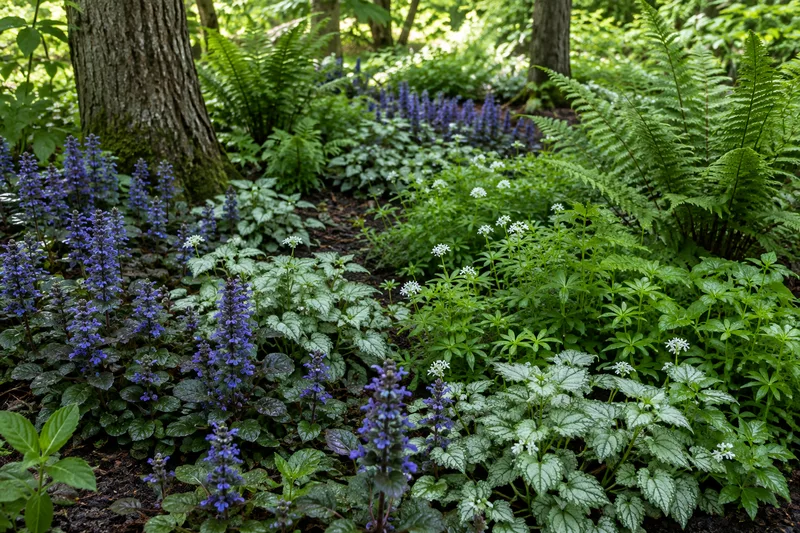
Dry shade plants are plants that cope with low light and dry soil at the same time, the conditions under most mature trees. Barrenwort, bigroot geranium, Christmas fern, Pennsylvania sedge, white wood aster and Lenten rose are among the most reliable. Even these tough plants need regular water through their first year, until their roots are established.
Below you will find why the ground under trees is so hard to plant and a table of proven choices with sizes and USDA zones. After that come ground covers, ferns and shrubs, a planting method that protects the tree, and plants to skip.
Why the ground under trees is so dry
A dense tree canopy works like an umbrella. Light rain never reaches the soil, and the tree's roots take most of the water that does. The University of Minnesota Extension notes that tree and shrub feeder roots sit in the top 18 to 20 inches of soil, where they compete with smaller plants for water and nutrients. House eaves, overhangs and foundations create the same problem next to buildings.
Utah State University Extension describes the core difficulty well: the traits that help a plant handle shade can make it less able to handle drought. That is why the list of true dry shade plants is short, and why plant choice matters so much here.
Dry shade plants at a glance
Sizes, light and zones below come from the Missouri Botanical Garden Plant Finder unless noted. Check your zone on the USDA Plant Hardiness Zone Map before you buy.
| Plant | Type | Height | USDA zones | Light | Bloom or feature |
|---|---|---|---|---|---|
| Barrenwort (Epimedium x versicolor 'Sulphureum') | Perennial ground cover | 9 to 12 in | 5 to 9 | Part to full shade | Yellow flowers in April |
| Bigroot geranium (Geranium macrorrhizum) | Perennial | 1 to 1.5 ft | 4 to 8 | Full sun to part shade | Purple-pink, May to July |
| Christmas fern (Polystichum acrostichoides) | Fern | 1 to 2 ft | 3 to 9 | Part to full shade | Fronds all year |
| Pennsylvania sedge (Carex pensylvanica) | Grass-like ground cover | 6 to 12 in | 3 to 8 | Part to full shade | Fine, low foliage |
| White wood aster (Eurybia divaricata) | Perennial | 1 to 2.5 ft | 3 to 8 | Part to full shade | White, August to September |
| Lenten rose (Helleborus orientalis) | Perennial | 1 to 1.5 ft | 4 to 9 | Part to full shade | Late winter into spring |
| Variegated Solomon's seal | Perennial | 2 to 3 ft | 3 to 8 | Part to full shade | White bells, April to May |
| Wild columbine (Aquilegia canadensis) | Perennial | 2 to 3 ft | 3 to 8 | Full sun to part shade | Red and yellow, April to May |
| Spotted dead nettle ('White Nancy') | Perennial ground cover | 6 to 9 in | 3 to 8 | Part to full shade | White, May to July |
| Bugleweed ('Catlin's Giant') | Perennial ground cover | 3 to 9 in | 4 to 8 | Full sun to part shade | Blue spikes, April to May |
| Coral bells (Heuchera 'Palace Purple') | Perennial | 1 to 2 ft | 4 to 9 | Full sun to part shade | Purple leaves |
| Brunnera ('Jack Frost') | Perennial | 1 to 1.5 ft | 3 to 8 | Part shade | Blue, April to May |
| Lady's mantle (Alchemilla mollis) | Perennial | 1 to 1.5 ft | 3 to 8 | Full sun to part shade | Chartreuse, June |
| Creeping Oregon grape (Mahonia repens) | Low evergreen shrub | About 2 ft | From zone 4 (USU) | Shade (USU dry shade list) | Evergreen leaves |
Perennials for dry shade
These perennials have the best record in dry shade. The Missouri Botanical Garden lists the first five as tolerant of dry soil.
- Barrenwort. Often the first choice for dry shade. It is rated for drought, dry soil and heavy shade, and deer and rabbits tend to leave it alone.
- Bigroot geranium. Thick rhizomes help it ride out dry spells. It flowers in late spring and early summer and does not need cutting back after bloom.
- Lenten rose. Evergreen leaves and flowers from late winter into spring, when deciduous trees are still bare. It tolerates dry soil and deer.
- White wood aster. A native that brings small white daisies to shade in late summer, when little else flowers there.
- Variegated Solomon's seal. Arching stems with cream-edged leaves and dangling white bells in spring. It spreads slowly into a patch.
- Wild columbine. A native for the brighter edge of a tree's shade. Its red and yellow flowers appear in spring.
- Coral bells and brunnera. Both appear on Utah State's dry shade list. Give them a little extra water in hot spells, since brunnera prefers soil that does not dry out completely.
Dry shade ground cover
Ground cover is the simplest way to fill the bare, root-filled soil under a tree. Low plants need less water than large ones and slip easily between roots.
- Pennsylvania sedge. A native, grass-like plant commonly used as a ground cover for dry shade. It stays about 6 to 12 inches tall.
- Barrenwort. Spreads into a dense mat of heart-shaped leaves.
- Spotted dead nettle. Silver leaves brighten dark ground. It tolerates dry soil, though leaves may scorch if the soil dries out for long.
- Bugleweed. Tolerates moderately dry soil and sends up blue spikes in spring.
- Sweet woodruff. On Utah State's dry shade list. In dry, sunny spots it may go dormant by midsummer, so keep it in the shade.
Ferns and shrubs for planting under trees
Most ferns want moist soil, but a few handle dry woodland ground. Christmas fern is rated by the Missouri Botanical Garden for drought and dry soil, and it keeps its fronds through winter. Marginal wood fern is another fern recommended for dry shade by The Old Farmer's Almanac.
For a taller layer, Utah State lists creeping Oregon grape, a low evergreen shrub about 2 feet tall, and 'Gro-Low' fragrant sumac, which grows 2 to 3 feet tall and 3 to 6 feet wide. Shrubs give the bed structure in winter when perennials die back.
How to plant a shade garden under a tree
A shade garden under a tree works best when you plant around the tree, not over it. These steps protect the tree and give new plants a fair start.
- Start small. Buy small plants. They need small holes, which you can dig between roots without cutting them.
- Find the pockets. Probe with a trowel and plant where the soil is open. Leave large roots alone, because cutting them can harm the tree.
- Do not bury the roots. Avoid piling a deep layer of new soil over the root zone. Mix a little compost into each planting hole instead.
- Water deeply while plants settle. When the soil is dry, the University of Minnesota Extension suggests soaking the top 3 to 4 inches with a drip hose or by hand. Keep this up through the first year.
- Use pots where digging is impossible. Containers set under trees avoid root competition, as the University of Minnesota Extension suggests.
- Plant for spring. Under deciduous trees, spring brings more light and rain. Spring-flowering plants such as Lenten rose, brunnera and wild columbine use that window well.
Three easy plant groupings for under a tree
Plants look best in groups that mix heights and leaf shapes. Each grouping below uses plants from the table that share the same light and water needs.
- Evergreen and early flowers: Lenten rose in the middle, Christmas fern behind, and barrenwort as the ground layer. Something stays green all winter, and the hellebores flower before the tree leafs out.
- All native, eastern woodland: wild columbine for spring, white wood aster for late summer, and Pennsylvania sedge filling the ground between them.
- Bright leaves for a dark corner: variegated Solomon's seal at the back, bigroot geranium in the middle, and silver-leaved spotted dead nettle at the front.
Repeat one grouping around the tree rather than planting one of everything. Repetition makes a small bed look planned.
Plants to avoid in dry shade
Some popular shade plants struggle when the soil dries out. The Missouri Botanical Garden notes that these need consistently moist soil:
- Japanese painted fern and ostrich fern. The soil must not dry out.
- Foamflower and toad lily. Both need soil that stays moist.
- Bleeding heart. It does not tolerate dry summer soil, and its leaves may die back early.
- Black cohosh (bugbane). Leaf edges brown if the soil is not kept moist.
Save these for shady spots with better soil, away from tree roots. For more moisture-loving choices, see Best Plants for Shade Gardens.
Common questions
What is the best ground cover for dry shade?
Barrenwort and Pennsylvania sedge are two of the most dependable. Both are rated for dry soil and heavy shade, and both stay low.
Will hostas grow in dry shade?
Partly. The Missouri Botanical Garden says established hostas have some tolerance for dry shade, but the soil should never dry out. Water them in dry spells.
Which shade perennials bloom in dry shade?
Lenten rose, barrenwort, bigroot geranium, wild columbine and white wood aster all flower in dry shade. For more blooms, see our guide to flowering perennials for shade.
For more ways to plan a shady yard, visit Shade Garden Ideas.
Sources
- University of Minnesota Extension, Gardening in the shade.
- Utah State University Extension, Landscaping in Dry Shade.
- Missouri Botanical Garden, Plant Finder (sizes, light, bloom times, zones and tolerances).
- The Old Farmer's Almanac, Best Plants to Grow Under Trees.
- USDA Agricultural Research Service, USDA Plant Hardiness Zone Map.