
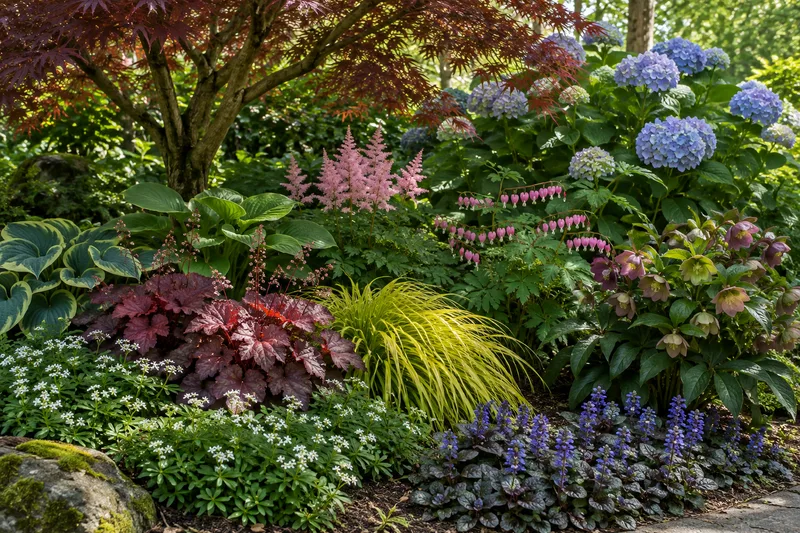
Plenty of flowering perennials for shade bloom well with only a few hours of sun. The most reliable include Lenten rose, bleeding heart, brunnera, foamflower, astilbe, coral bells, toad lily and Japanese anemone. Planted together, they can keep a shady bed in flower from late winter to fall.
This guide groups 19 shade perennials that bloom by season, with bloom time, height, light and USDA zones for each. It also covers which ones need part shade, which handle dry shade, and how to get more flowers from a shady spot.
What to expect from flowers in shade
Shade comes in degrees. The University of Minnesota Extension calls 3 to 6 hours of direct sun a day part shade, and less than 3 hours full shade. Deep shade, with almost no direct sun, is the hardest place to grow flowers.
- Part shade suits the widest range of shade perennials, including those rated "full sun to part shade".
- Full shade suits woodland plants such as Lenten rose, foamflower and lungwort. Expect fewer, smaller shows than in sun.
- Deep shade is best handled with foliage plants such as ferns and hostas, with a few early bloomers under deciduous trees.
Many shade perennials flower in spring for a simple reason. Under deciduous trees, the ground gets more light before the leaves open. Planning for summer and fall color takes a little more care, so the season tables below matter.
Flowering perennials for shade at a glance
Bloom months, heights, light and zones come from the Missouri Botanical Garden Plant Finder, which reports bloom times for St. Louis. Expect earlier flowers in warm regions and later ones in cold regions. Check your zone on the USDA Plant Hardiness Zone Map.
| Perennial | Bloom time | Flower color | Height | Light | USDA zones |
|---|---|---|---|---|---|
| Lenten rose (Helleborus orientalis) | Late winter into spring | White to rose-purple | 1 to 1.5 ft | Part to full shade | 4 to 9 |
| Virginia bluebells | March to April | Blue | 1.5 to 2 ft | Part to full shade | 3 to 8 |
| Barrenwort ('Sulphureum') | April | Yellow | 9 to 12 in | Part to full shade | 5 to 9 |
| Lungwort (Pulmonaria saccharata) | April to May | Blue | 1 to 1.5 ft | Part to full shade | 3 to 8 |
| Brunnera ('Jack Frost') | April to May | Blue | 1 to 1.5 ft | Part shade | 3 to 8 |
| Bleeding heart | April to May | Pink and white | 2 to 3 ft | Part to full shade | 3 to 9 |
| Bergenia (Bergenia cordifolia) | April to May | Pink | 1 to 1.5 ft | Part to full shade | 3 to 8 |
| Wild columbine | April to May | Red and yellow | 2 to 3 ft | Full sun to part shade | 3 to 8 |
| Variegated Solomon's seal | April to May | White | 2 to 3 ft | Part to full shade | 3 to 8 |
| Foamflower | May | White | 9 to 12 in | Part to full shade | 4 to 9 |
| Bigroot geranium | May to July | Purple-pink | 1 to 1.5 ft | Full sun to part shade | 4 to 8 |
| Spotted dead nettle ('White Nancy') | May to July | White | 6 to 9 in | Part to full shade | 3 to 8 |
| Yellow foxglove (Digitalis grandiflora) | May to June | Yellow | 2 to 3 ft | Part shade | 3 to 8 |
| Coral bells ('Palace Purple') | June to July | Blush-white | 1 to 2 ft | Full sun to part shade | 4 to 9 |
| Astilbe ('Visions') | July to August | Pink | 1 to 1.5 ft | Part to full shade | 4 to 8 |
| Black cohosh (Actaea racemosa) | Summer | White | 4 to 6 ft | Part to full shade | 3 to 8 |
| Toad lily (Tricyrtis hirta) | August to September | White to pale lilac, purple spots | 2 to 3 ft | Part to full shade | 4 to 8 |
| Japanese anemone ('Honorine Jobert') | August to September | White | 3 to 4 ft | Full sun to part shade | 4 to 8 |
| White wood aster | August to September | White | 1 to 2.5 ft | Part to full shade | 3 to 8 |
Shade perennials that bloom in late winter and spring
This is the easiest season for flowers in shade. Plant several of these, and the bed opens the year before the trees leaf out.
Lenten rose
Lenten rose is often the first perennial to flower, from late winter into spring. Flowers range from white through pink to rose-purple, often spotted inside. The Missouri Botanical Garden notes a long bloom of 8 to 10 weeks. It tolerates deer, heavy shade and dry soil, and its leaves stay green through winter.
Virginia bluebells
This native bears nodding clusters of blue flowers in March and April. It goes dormant by midsummer and leaves a gap, so plant it among ferns or hostas that fill in later. It also works under deciduous trees, where it flowers before the leaves close overhead.
Barrenwort
Barrenwort, also called epimedium, carries small yellow flowers above heart-shaped leaves in April. It is one of the few flowering perennials rated for drought, dry soil and heavy shade, which makes it a first choice under trees.
Lungwort
Lungwort brings blue spring flowers and spotted leaves that stay attractive after the blooms fade. The Missouri Botanical Garden rates it tolerant of deer, heavy shade and clay soil. It forms a low clump 1 to 1.5 feet tall.
Brunnera
'Jack Frost' brunnera bears sprays of tiny blue flowers in April and May over heart-shaped, silver leaves. Give it part shade and soil that does not dry out completely. Rabbits tend to leave it alone.
Bleeding heart
The arching stems of heart-shaped pink and white flowers are a spring classic. Bleeding heart reaches 2 to 3 feet. It dislikes dry summer soil, and its leaves may die back early if the soil dries, so pair it with hostas or ferns.
Bergenia
Bergenia has large, glossy leaves and pink flower clusters in April and May. Remove the spent flower stems promptly after bloom. It tolerates deer, rabbits and heavy shade.
Wild columbine
This native carries red and yellow nodding flowers in April and May. It suits the brighter edge of a shade bed, since it is rated for full sun to part shade. It tolerates drought and dry soil once established.
Variegated Solomon's seal
Arching stems with cream-edged leaves carry small, dangling white bells in spring. The leaves stay handsome all season. It is rated tolerant of drought, dry soil and heavy shade.
Foamflower
Foamflower is a low native ground cover with frothy white flower spikes in May. It needs soil that does not dry out, so save it for moist, shady beds. Deer and rabbits tend to pass it by.
Early summer bloomers for shade
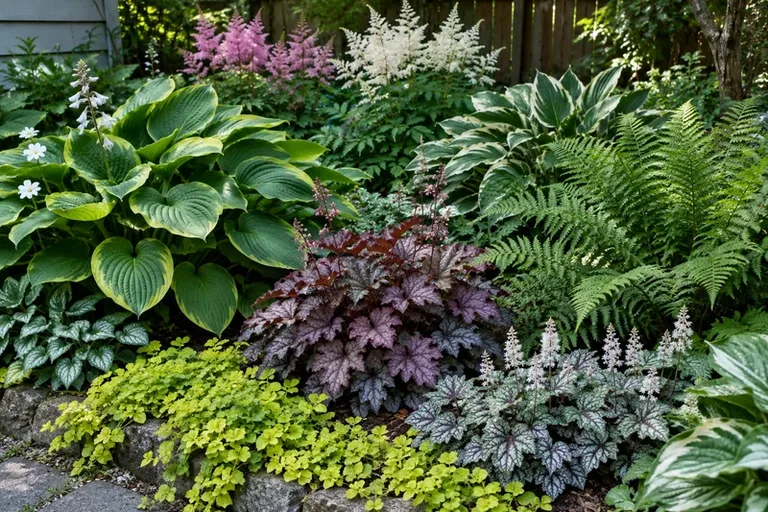
As the trees close overhead, these perennials keep the color going.
Bigroot geranium
Purple-pink flowers from May to July over a low, spreading mat of leaves. Its thick rhizomes help it handle dry spells, and it does not need cutting back after flowering. It suits part shade and the edges of trees.
Spotted dead nettle
'White Nancy' forms a low carpet of silver leaves with white flowers from May to July. The silver foliage brightens dark ground long after the flowers. It tolerates dry soil, though leaves may scorch if the soil stays dry for long.
Yellow foxglove
Yellow foxglove sends up soft yellow spikes in May and June and suits part shade. Deadheading after bloom can bring a second flush of flowers. It is rated tolerant of deer.
Coral bells
Coral bells are grown mainly for their leaves, but they also send up airy flower stems in June and July. The Missouri Botanical Garden advises removing faded flower stems to encourage continued bloom. 'Palace Purple' has deep purple leaves.
Late summer and fall bloomers for shade
These are the plants that most shade gardens lack. Add two or three, and the bed stays interesting until frost.
Astilbe
Astilbe carries feathery plumes above fern-like leaves. 'Visions', a Chinese astilbe, blooms pink in July and August. The Missouri Botanical Garden notes it has better sun and drought tolerance than most hybrid astilbes, though astilbe still prefers moist soil.
Black cohosh
Also called bugbane, this native sends up tall white flower spikes on a plant 4 to 6 feet tall. It brings height to the back of a shade bed. Keep the soil consistently moist, or the leaf edges may brown.
Toad lily
Toad lily opens unusual white to pale lilac flowers with heavy purple spotting in August and September. Plant it near a path where the small flowers can be seen up close. The soil must not dry out.
Japanese anemone
'Honorine Jobert' bears white flowers with yellow centers on 3 to 4 foot stems in late summer. It has a lengthy bloom period and takes full sun to part shade. Keep it in soil that does not dry out.
White wood aster
This native carries clouds of small white daisies in August and September. Unlike most late bloomers on this list, it tolerates drought and dry soil, so it works under trees.
Part shade perennials
Some shade perennials flower best with a few hours of sun. In part shade, with about 3 to 6 hours of direct sun, these give the most bloom:
- Wild columbine and bigroot geranium, both rated full sun to part shade.
- Coral bells, which handle more sun than most shade plants.
- Japanese anemone for late summer flowers.
- Brunnera and yellow foxglove, both rated for part shade.
If a bed gets less than 3 hours of sun, lean on the full shade plants in the table instead, such as Lenten rose, foamflower and lungwort.
Perennials for dry shade
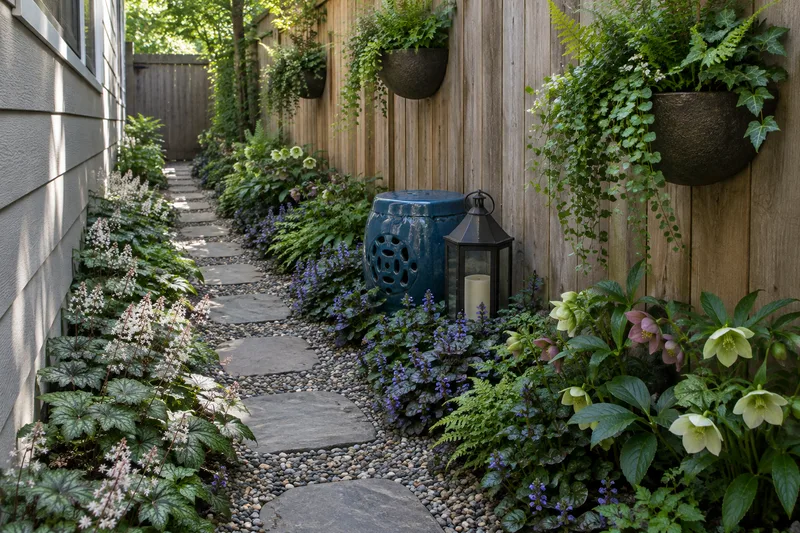
Dry shade, under trees or eaves, is the hardest spot for flowers. These perennials are rated by the Missouri Botanical Garden as tolerant of dry soil:
- Barrenwort
- Lenten rose
- Bigroot geranium
- Variegated Solomon's seal
- Wild columbine
- White wood aster
- Spotted dead nettle
Avoid foamflower, toad lily, bleeding heart, Japanese anemone and black cohosh in dry shade, since each needs soil that stays moist. Water any new planting through its first year. For more choices, including ground covers and ferns, see plants for dry shade under trees.
Native shade perennials that bloom
If you want plants native to North America, several on this list fit. The Old Farmer's Almanac lists these among native plants for shady gardens under trees:
- Virginia bluebells for early spring blue.
- Wild columbine for red and yellow spring flowers.
- Foamflower for a white spring ground cover.
- White wood aster for late summer white.
- Black cohosh for tall white spikes in summer.
Together they cover spring to late summer. Add Christmas fern and wild ginger for native foliage between them.
Shade perennials that deer and rabbits tend to avoid
No plant is fully deer proof, but the Missouri Botanical Garden lists these as tolerant of deer or rabbits. That means they are less likely to be eaten:
| Tolerates deer | Tolerates rabbits |
|---|---|
| Lenten rose, barrenwort, lungwort, bergenia, foamflower, wild columbine, bigroot geranium, spotted dead nettle, yellow foxglove, astilbe 'Visions', Japanese anemone | Barrenwort, bleeding heart, brunnera, bergenia, foamflower, wild columbine, bigroot geranium, Virginia bluebells, black cohosh, astilbe 'Visions' |
Hostas, by contrast, are listed with deer as a problem. Where deer visit often, lean on the plants in the first column.
Good partners in a shade bed
Flowers in shade look best set against good foliage. A few pairings that share light and water needs:
- Lenten rose with Christmas fern. Both stay green in winter, and the fern sets off the early flowers.
- Virginia bluebells with hostas. The hosta leaves fill out and cover the gap when the bluebells go dormant by midsummer.
- Astilbe with coral bells. Feathery pink plumes above dark purple leaves.
- Toad lily with Japanese painted fern. Both like moist soil, and the silvery fronds suit the spotted flowers.
How to get more flowers in shade
- Put flowers in the brightest spots. Save the edge of the shade, or a spot with morning sun, for the flowering plants. Use foliage plants in the darkest corners.
- Keep the soil moist. Many shade perennials, such as foamflower, toad lily and Japanese anemone, need soil that does not dry out. Water in dry spells, especially near trees.
- Deadhead the rebloomers. Remove faded stems of coral bells and yellow foxglove for more flowers, and cut bergenia stems after bloom.
- Thin low branches. Removing a few low tree limbs lets more light reach the bed. For large trees, hire a certified arborist.
- Divide crowded clumps. Smaller flowers and a hollow center are signs a clump needs dividing. See when and how to divide perennials.
A shade bed that flowers from late winter to fall
For part shade in zones 4 to 8, try this simple mix. Each season has at least two plants in flower.
- Late winter and spring: Lenten rose, brunnera and bleeding heart.
- Early summer: bigroot geranium and coral bells.
- Midsummer: astilbe.
- Late summer and fall: Japanese anemone and toad lily.
Add hostas and ferns between them for leaves that carry the bed between flowers. For more layouts and plants, see shade garden ideas.
Common questions
Which shade perennial blooms the longest?
Lenten rose has one of the longest shows, about 8 to 10 weeks from late winter into spring according to the Missouri Botanical Garden. Bigroot geranium and spotted dead nettle each flower for about three months, from May to July.
What flowers grow in full shade?
Lenten rose, foamflower, lungwort, bleeding heart, barrenwort and toad lily all flower in part to full shade. Blooms are fewer in full shade than in part shade.
Are there long-blooming perennials for sun too?
Yes. For a sunny bed, see our list of long-blooming perennials for sun, or browse all of our perennial guides.
Sources
- Missouri Botanical Garden, Plant Finder (bloom times, colors, heights, light, zones, tolerances and care notes).
- University of Minnesota Extension, Gardening in the shade.
- Clemson Cooperative Extension, Home and Garden Information Center, Dividing Perennials.
- USDA Agricultural Research Service, USDA Plant Hardiness Zone Map.