
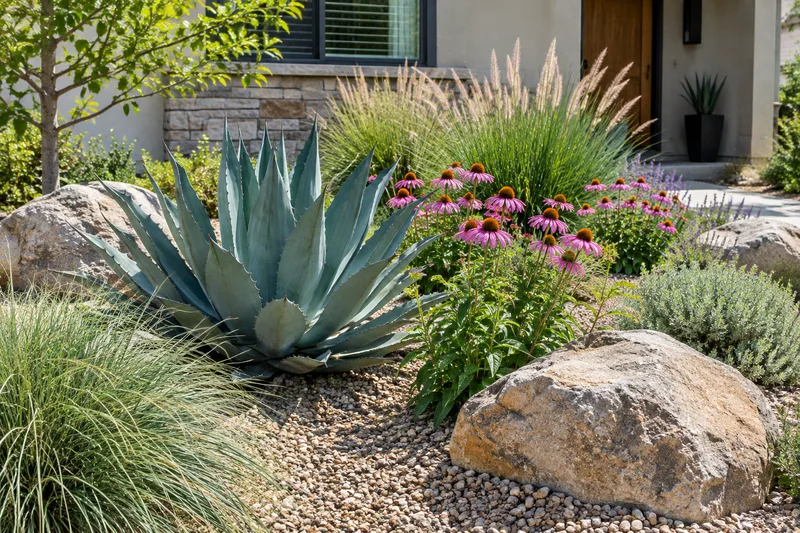
Front yard landscaping with rocks works best when rock and mulch each go where they suit. Use rock and gravel for paths, drainage channels, dry sunny beds and plants that like sharp drainage. Use organic mulch, such as shredded bark, in flower beds and around shrubs, where it feeds the soil as it breaks down. Both cover bare soil, slow weeds and cut down on watering, which is why they sit at the heart of most low-maintenance front yards.
Mulch vs rock in flower beds: which to use
Neither one is better everywhere. The right choice depends on the plants, the sun and how the bed is used. Denver Water, the water utility for Denver, Colorado, gives minimum depths for both.
| Question | Organic mulch (bark, wood chips) | Rock or gravel |
|---|---|---|
| Depth (Denver Water) | At least 4 inches | At least 2 inches |
| Effect on soil | Breaks down and adds organic matter | Does not break down or feed the soil |
| Heat | Keeps roots cool | Holds and gives off heat; Denver Water advises keeping it off the sunny sides of the house |
| Upkeep | Top up as it thins | Rake out leaves; refresh only where it scatters |
| Best for | Flower beds, shrubs, perennials, beds you replant often | Paths, dry beds, succulents, drainage channels, edges |
| Changing your mind later | Easy; it can be dug in or left to rot | Hard; rock must be shoveled out |
A common mix is mulch in the planting beds and rock along paths, under downspouts and in a strip at the bed's edge. Whichever you use, University of Massachusetts Extension advises spreading mulch over the root zone and never piling it against stems or trunks.
Types of rock for a front yard
- Pea gravel. Small, smooth stones. Good for paths and bed tops, but it rolls underfoot and needs a firm edge to stay put.
- Crushed gravel. Angular pieces that lock together. Firmer to walk on than pea gravel, so it suits paths.
- River rock. Rounded stones in larger sizes. Used for dry creek beds, borders and under downspouts.
- Lava rock. Light, porous and usually red or black. Gives a strong color contrast.
- Flagstone. Flat slabs for stepping stones and paths through gravel or ground cover.
- Boulders. Large single stones that add height and a focal point.
Choose one or two kinds in colors that suit the house and its stone or brick. Too many kinds of rock in one yard looks busy.
7 front yard landscaping ideas with rocks
1. Make a rock garden front yard bed
A rock garden bed pairs gravel with plants that like dry, well-drained ground, such as lavender, sedum and creeping thyme. It suits a sunny slope or a hot strip by the driveway. Set a few larger stones partly into the soil so they look settled, then plant in the gaps.
2. Lay a dry creek bed with river rock
River rock landscaping shines where water already runs after rain. A shallow channel lined with river rock carries water across the yard and looks like a dry stream between storms. Use larger stones along the edges and smaller ones in the bottom.
3. Edge beds with a strip of river rock
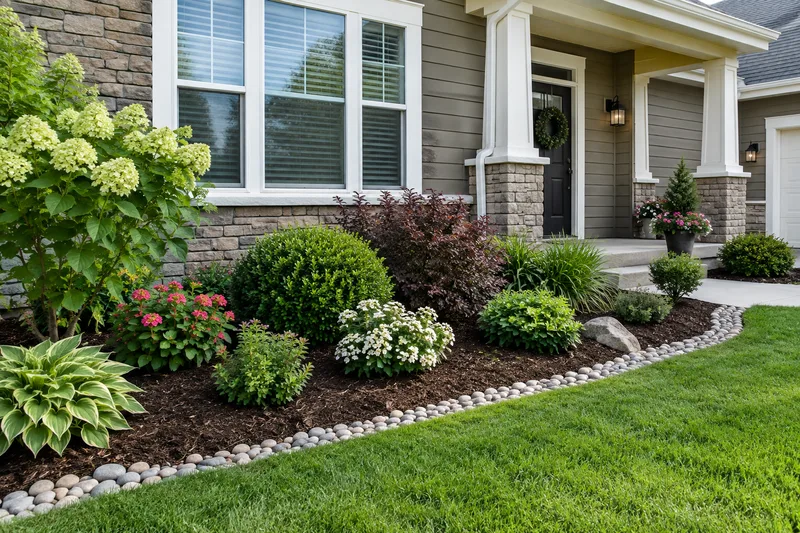
A line of rounded stones between lawn and bed frames the planting and keeps mulch from washing onto the grass. It is a simple way to combine rock and mulch in one bed, as in the photo above.
4. Build a gravel path
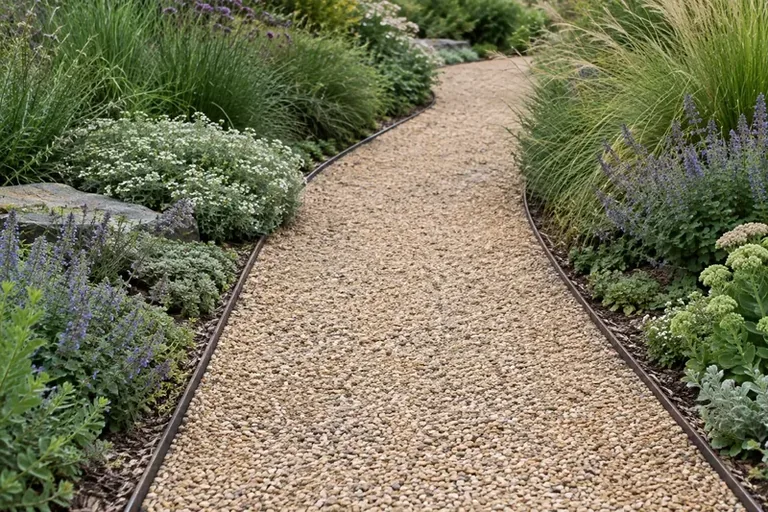
A gravel path needs no mowing and drains well. Hold it in with metal, stone or brick edging, so the gravel stays off the lawn. For a firmer surface, compare materials in Walkway Materials Compared.
5. Group boulders as a focal point
A few boulders of different sizes, set together rather than spread out, look more natural than single stones dotted around. Bury the base of each one a little, so it looks as if it has always been there.
6. Use gravel around succulents and dry-climate plants
Succulents and many Mediterranean plants dislike wet soil around their crowns. A gravel mulch drains fast and keeps the base of the plant dry. See Xeriscaping Basics for how to plan a whole dry bed.
7. Put rock where mulch washes away
Under downspouts, along steep edges and beside driveways, bark mulch tends to float off in heavy rain. Rock stays put. Use it in these spots and keep mulch in the calmer parts of the bed.
How to lay rock in a front yard bed
- Mark the area. Use a hose or rope to try out curves before you dig.
- Clear it. Remove turf and weeds, roots included, since rock makes later weeding harder.
- Shape the soil. Slope the ground so rainwater runs away from the house.
- Set the edging. Put in metal, stone or brick edging before the rock, following the edging maker's instructions.
- Decide on fabric. Some gardeners lay landscape fabric under rock to slow weeds from below. Skip it where you plan to add plants, and never use black plastic, which Denver Water advises against.
- Spread the rock. Spread it at least 2 inches deep, the minimum Denver Water gives for rock mulch.
- Plant through it. Pull the rock back, plant, water well, then pull the rock back around the plant without burying its crown.
Plants that suit rocks and gravel
These plants like sun and good drainage, so they look and grow well with rock. Sizes and zones come from the North Carolina State Extension Gardener Plant Toolbox.
| Plant | Height | USDA zones | Light | Note |
|---|---|---|---|---|
| English lavender | 1 to 2 ft | 5 to 9 | Full sun | Needs excellent drainage; fails in wet clay |
| Sedum (Hylotelephium telephium) | 2 to 2.5 ft | 3 to 9 | Full sun | Good drought tolerance |
| Creeping thyme (Thymus serpyllum) | 2 to 3 in | 4 to 9 | Full sun | Grows in sandy, gritty or rocky soil; rots if overwatered |
| Creeping stonecrop (Sedum spurium) | 2 to 6 in | 3 to 9 | Full sun to part shade | Mat-forming; prefers very dry soil |
| Little bluestem | 2 to 4 ft | 3 to 9 | Full sun | Native grass; copper fall color |
| Creeping juniper | 0.5 to 1.5 ft | 3 to 9 | Full sun | Evergreen mat for slopes and banks |
Common questions
Is rock or mulch cheaper over time?
Rock is usually laid once, while organic mulch is topped up as it breaks down. But rock costs more to buy and is hard to remove. Prices vary by region, so price both locally for your bed size.
Does rock make a front yard hotter?
It can. Denver Water notes that rock holds and gives off heat, and suggests keeping it off the sunny sides of the house. In a hot climate, use organic mulch around plants near south and west walls.
Can I put rock over existing mulch?
It is better to rake old mulch off first. As mulch rots under rock, it becomes soil where weed seeds can sprout.
Related guides
- Low-Maintenance Front Yard Landscaping Ideas: the full guide this post belongs to.
- Lawn Alternatives for a Low-Maintenance Front Yard: what to plant where the grass used to be.
- Drought-Tolerant Landscapes: how to plan a low-water yard.
Sources
- Denver Water, Xeriscape Principles.
- University of Massachusetts Amherst Extension, Landscaping to Conserve Water.
- North Carolina State Extension Gardener Plant Toolbox: English lavender, sedum, creeping thyme, creeping stonecrop, little bluestem and creeping juniper.