
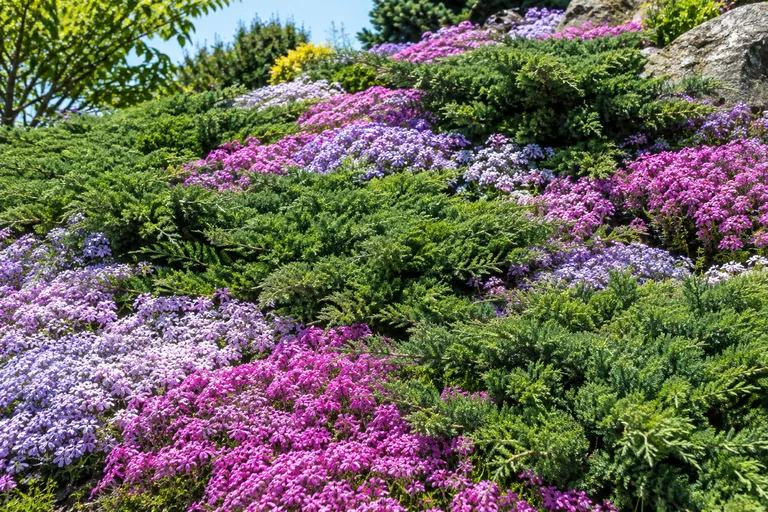
The best ground cover for slopes spreads into a dense mat, roots deeply and suits the slope's sun and soil. For sunny slopes, good choices include creeping juniper, creeping phlox, fragrant sumac 'Gro-Low' and, in dry sandy soil, bearberry. For shade, look at Allegheny spurge and native sedges. Skip plants your state lists as invasive, such as common periwinkle and English ivy in many areas. Both still appear on many slope plant lists.
The plant facts below (height, spread, USDA hardiness zones and light) come from the NC State Extension Gardener Plant Toolbox unless another source is named. This guide is part of our Hillside Landscaping guide.
What makes a good ground cover for a slope
A slope is a harder place to grow than flat ground. Water runs off before it soaks in, the soil on top is often thin, and mowing is awkward or unsafe. A good slope plant handles all of that.
- It spreads. Stems that root as they go, or a wide mat, cover the soil so rain cannot hit it directly.
- It has strong roots. Deep or matted roots bind the soil together.
- It fits the light. A sun lover will thin out in shade and leave bare patches.
- It needs no mowing. Most ground covers never need it, which is the main reason to swap grass for them on a hill.
- It stays where you put it. Fast spread is useful on a bank, but not when it escapes into lawns, beds or woods.
Plant more than one kind. Penn State Extension advises against planting one single species, and a mix of plants with different root depths covers the soil more fully.
Best ground cover plants for slopes at a glance
| Plant | Height | Spread | USDA zones | Light | Notes |
|---|---|---|---|---|---|
| Creeping juniper (Juniperus horizontalis) | 6 inches to 1.5 feet | 4 to 10 feet | 3 to 9 | Full sun | Evergreen; drought and deer tolerant; used on slopes to help control erosion |
| Bearberry (Arctostaphylos uva-ursi) | 6 inches to 1 foot | 3 to 6 feet | 3 to 7 | Sun to part shade | Evergreen; drought tolerant; needs light, well-drained soil; does not do well in the eastern US |
| Creeping phlox (Phlox subulata) | 4 to 6 inches | 2 to 3 feet | 3 to 9 | Full sun | Native; semi-evergreen; flowers in spring; tolerates erosion and drought |
| Fragrant sumac 'Gro-Low' (Rhus aromatica) | Under 3 feet | About 8 feet | 3 to 9 (species) | Sun to part shade | Native deciduous shrub; "great for slopes and erosion control" |
| Bearberry cotoneaster (Cotoneaster dammeri) | About 1 foot | 4 to 6 feet | 5 to 8 | Sun to part shade | Drought tolerant once established; used on low banks for erosion control |
| Creeping thyme (Thymus serpyllum) | 2 to 3 inches | 3 to 12 inches | 4 to 9 | Full sun | Drought tolerant; best for small, sunny spots and between stones |
| Little bluestem (Schizachyrium scoparium) | 2 to 4 feet | 1.5 to 3 feet | 3 to 9 | Full sun | Native grass; excellent drought resistance once established |
| Allegheny spurge (Pachysandra procumbens) | 6 inches to 1 foot | 1 to 2 feet | Not given by the source | Part to deep shade | Native to the Southeast; dense mat; listed as not invasive |
Ground cover for sunny slopes
Sunny slopes are often the driest part of a yard, so drought tolerance matters most.
- Creeping juniper is the classic choice for a large, hot bank. Its branches form a mat up to 10 feet wide, and it adapts to many soils as long as they drain well.
- Creeping phlox covers the ground in flowers in April and May. It is recommended for sunny slopes and handles hot, dry spells better than other phlox.
- Fragrant sumac 'Gro-Low' stays under 3 feet but spreads about 8 feet. In mass plantings the species is described as excellent for stabilizing banks and slopes.
- Little bluestem and other deep-rooted grasses suit a meadow-style slope. NC State Extension's New Hanover County office calls deep-rooted grasses and sedges ideal for a slope.
- Bearberry will even grow in pure sand, according to The Old Farmer's Almanac. NC State notes that moist soil can cause root disease. It also says bearberry does not do well in the wet, humid summers of the eastern US, so it suits dry, sandy sites best.
Ground cover for shady slopes
Shade under trees is a tough place for any plant, and slopes there often have dry, root-filled soil. Fewer plants cover fast in shade, so plan for slower fill-in.
- Allegheny spurge forms a dense mat under trees and shrubs. NC State lists it as native and states that it is not invasive.
- Pennsylvania sedge (Carex pensylvanica) is one of the native groundcovers Penn State Extension suggests. For the best look, it advises mowing it to about 3 inches tall in late winter.
- River oats (Chasmanthium latifolium) is called very good for slopes by Penn State Extension, because it develops a firm root mass.
- Ajuga grows in sun or shade and makes a dense mat. Use it with care: NC State notes it is listed as invasive in other parts of the country.
For more shade planting ideas, see Shade Garden Ideas.
Evergreen ground cover for hills
Evergreen ground covers keep the soil covered in winter, when rain and snowmelt can still wash a bare slope. From the table above:
- Creeping juniper: a needled evergreen shrub, zones 3 to 9.
- Bearberry: a low evergreen shrub, zones 3 to 7, for dry, sandy soil.
- Creeping phlox: semi-evergreen, so it holds some foliage through winter.
- Allegheny spurge: evergreen to semi-evergreen in zones 7 and 8, NC State notes.
Ground cover for erosion control
Ground cover slows erosion in two ways: leaves break the force of rain, and roots hold the soil. On a slope that is already washing out, plants alone may not be enough at first.
- Mix in shrubs. NC State Extension notes that woody shrubs have deep, branching roots that help prevent erosion.
- Cover the soil while plants grow. NC State Extension suggests natural jute or coconut coir fabric laid on the slope, with plants set through it.
- Mulch. Penn State Extension recommends at least two inches of mulch after planting, such as wood chips, undyed shredded bark, pine needles or composted leaves.
- Skip plastic. Penn State Extension warns that plastic or synthetic landscape cloth can increase erosion and runoff.
For a full plan for a slope that washes out, see How to Stop Erosion on a Sloped Yard.
Low maintenance slope plants: what to expect
Low maintenance is not no maintenance. The first year or two take the most work, while the plants fill in.
- Weeding until it fills in. Bare soil between new plants grows weeds. Mulch and close planting shorten this stage.
- Watering until established. Penn State Extension advises watering new plantings until established, then only during dry periods from late spring through fall.
- Some trimming at the edges. Spreading plants may need cutting back where they reach paths, lawns or other beds.
How to plant ground cover on a slope
- Plant in spring or fall. Penn State Extension recommends these seasons for most groundcovers.
- Clear weeds first. Penn State Extension suggests leaving prepared soil unplanted for about 2 to 3 weeks, so perennial weeds regrow and can be removed.
- Lay jute or coir fabric on steep or bare spots. NC State Extension advises doing any lime or fertilizing before laying fabric.
- Make a small flat spot for each plant. Hunker suggests a planting area at least two to three times the width of the root ball. Add a soil berm 3 to 6 inches high on the downhill side to catch water.
- Use plants, not seed, on steep ground. Hunker notes that seed can wash away on slopes, so set out established plants.
- Space by mature spread. Use the spread on the plant label or in the table above, so neighboring plants meet and cover the soil.
- Mulch and water slowly. Spread at least two inches of mulch, then water gently. iScape recommends drip irrigation at a very slow rate on a hillside, so water soaks in instead of running off.
Ground covers to avoid or use with care
Some ground covers sold for slopes spread far beyond the slope. Lowe's, for example, lists ivy and vinca among its slope plants. Extension services name these as invasive or aggressive in at least some states:
| Plant | What the source says |
|---|---|
| English ivy (Hedera helix) | NC State: an invasive species in North Carolina that climbs and can kill trees, and is nearly impossible to remove once established. |
| Common periwinkle (Vinca minor) | NC State: classified as invasive by the NC Invasive Plant Council and on many states' "most unwanted" lists. |
| Asiatic jasmine (Trachelospermum asiaticum) | NC State Extension, New Hanover County: one of the plants that grow unchecked and invade natural ecosystems. |
| Creeping liriope (Liriope spicata) | NC State: an invasive species in Tennessee and Georgia; spreads quickly by rhizomes into lawns and other beds. |
| Ajuga (Ajuga reptans) | NC State: listed as invasive in other parts of the country; a low threat in North Carolina. |
Invasive lists differ from state to state. Before you buy, check your state's invasive plant list or ask your county extension office.
More guides on Yard and Soil
- Hillside Landscaping: the full guide to planning a sloped yard.
- How to Stop Erosion on a Sloped Yard: fabric, mulch, rock and plants in the right order.
- Retaining Wall Ideas for Sloped Yards: walls for slopes too steep to plant.
- Best Drought-Tolerant Plants: more plants for dry, sunny ground.
Sources
- NC State Extension Gardener Plant Toolbox: Juniperus horizontalis, Arctostaphylos uva-ursi, Phlox subulata, Rhus aromatica, Cotoneaster dammeri, Thymus serpyllum, Schizachyrium scoparium, Pachysandra procumbens, Ajuga reptans, Hedera helix, Vinca minor and Liriope spicata.
- NC State Extension, New Hanover County Center, Erosion Control.
- Deb Christopher, Penn State Extension, Native Groundcovers Can Solve Tough Challenges in the Landscape.
- George and Becky Lohmiller, The Old Farmer's Almanac, 10 Low-Maintenance Groundcover Plants for Slopes, Shade, and Sun.
- Mark Johanson, Hunker, Hillside Landscaping: Slope Landscaping Ideas; iScape, Hillside Landscape Ideas and Solutions; Lowe's, slope ground cover suggestions (search results).