
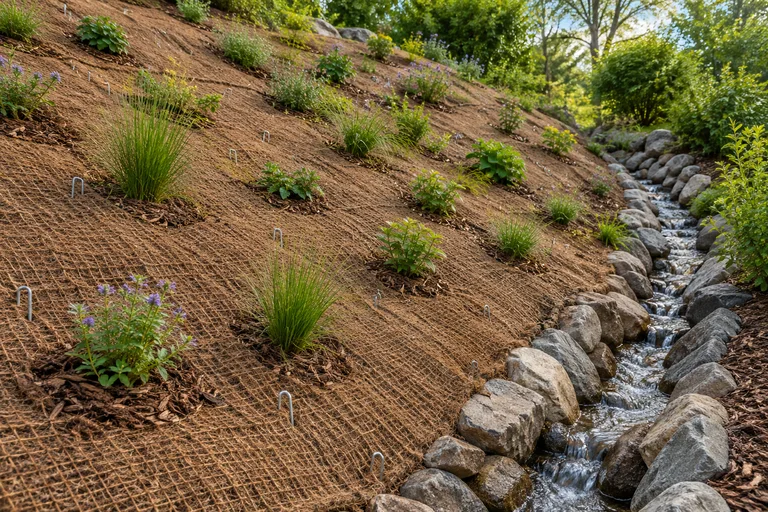
To stop erosion on a slope, work in this order: find where the water runs, slow it down, cover the bare soil, then plant deep-rooted plants. On gentle slopes, mulch, erosion control matting and dense planting are usually enough. On steep slopes, terraces or retaining walls take the pressure off. The goal is always the same: water should soak in slowly, not race downhill carrying soil with it.
The steps below follow that order. This guide is part of our Hillside Landscaping guide.
Why slopes erode
Rain that lands on a slope runs downhill instead of soaking in. The steeper the slope, the faster it runs, and fast water picks up soil. Bare soil washes away first, because there are no leaves to break the rain and no roots to hold the ground.
- Soil type matters. NativeSeed Group notes that sandy soils run off more readily than clay soils, because their particles are looser.
- Water from above matters. Runoff from a roof, a driveway or a neighbor's yard can do more damage than the rain that falls on the slope itself.
- Signs to look for: small gullies, exposed roots, soil piled at the bottom of the slope, and mulch that ends up on the path below.
Step 1: Read the slope
Before buying anything, find out how steep the slope is and where the water goes.
- Measure the grade. Divide the rise by the level distance and multiply by 100. A drop of 2 feet over 10 feet is a 20 percent slope.
- Watch a heavy rain. Note where water enters the slope and where it cuts channels.
- Test drainage. NativeSeed Group suggests digging a hole, filling it with water and checking after one to two hours. If water still stands after two or more days, rock likely lies under the soil, which raises the erosion risk.
Step 2: Slow and redirect the water
Fixing the water first keeps everything you do next from washing out.
- Place rock above the slope. NC State Extension suggests rock to slow and spread stormwater before it reaches the slope.
- Build a dry creek bed. A channel lined with river rock carries water down the slope along one path. Lawn Love notes that larger river rocks in a dry creek bed can redirect runoff and control erosion.
- Send roof water somewhere useful. The EPA describes a rain garden as a low area that collects rain water from a roof, driveway or street. The water then soaks into the ground.
- Regrade if needed. NC State Extension says that if an eroding slope is too steep, you may want to re-grade it to a gentler slope.
- Use sandbags only as a stopgap. NativeSeed Group describes stair-stepped sandbags as a temporary diversion, not a full fix.
Before you dig a creek bed, rain garden or trench, contact 811. The Common Ground Alliance's 811 service asks people to do this a few business days before digging so buried lines can be marked.
Step 3: Cover bare soil right away
Bare soil is where erosion starts, so cover it the same day you finish digging. Two covers do most of the work: erosion control matting and mulch.
Erosion control matting
Erosion control matting is a blanket of natural or synthetic fiber laid over the soil and pinned in place. NC State Extension suggests natural jute or coconut coir fabric, with plants set through it. The fabric breaks down over time as the plants take over.
- How long it lasts. Horticulture magazine says biodegradable mats of coconut, wood or straw fiber typically last around six months to a year.
- Plant before it breaks down. The same article advises getting seed or plants growing before the netting breaks down, so roots can take over.
- Prepare the soil first. NC State Extension advises doing any lime or fertilizing before laying fabric.
- Permanent mats. Non-degradable mats stay in place and have to be removed at some point, Horticulture magazine notes.
Mulch
- Penn State Extension recommends at least two inches of mulch after planting, such as wood chips, undyed shredded bark, pine needles or composted leaves.
- NativeSeed Group says slopes under 33 percent can be secured with mulch. Steeper slopes need matting or structure as well.
- Penn State Extension warns that plastic or synthetic landscape cloth can increase erosion and runoff.
| Cover | Best for | Keep in mind |
|---|---|---|
| Organic mulch | Gentle slopes and new beds | Can wash off steep ground in heavy rain |
| Jute or coir matting | Bare or steep slopes while plants grow | Breaks down in months; plant through it |
| Rock or boulders | Water paths and spaces between plants | Heavy to move; does not feed the soil |
| Plastic landscape cloth | Not recommended on slopes | Penn State: can increase erosion and runoff |
Step 4: Plant slope erosion plants with strong roots
Plants are the long-term fix. Leaves soften the rain, and roots bind the soil. NC State Extension names three groups that work well:
- Deep-rooted grasses and sedges. Ideal for a slope, and once established they need little or no mowing.
- Woody shrubs. Deep, branching roots help prevent erosion and keep foot traffic off weak spots.
- Trees. Their canopies block and slow rain before it hits the ground.
| Plant | Type | Height | Light | Source |
|---|---|---|---|---|
| Little bluestem | Native grass | 1 to 3 feet (New Hanover table); 2 to 4 feet (Plant Toolbox) | Full sun | NC State Extension |
| Switchgrass | Native grass | 2 to 5 feet | Full sun | NC State Extension, New Hanover |
| Creeping juniper | Evergreen shrub | 6 inches to 1.5 feet | Full sun | NC State Extension |
| Fragrant sumac 'Gro-Low' | Native shrub | Under 3 feet | Sun to part shade | NC State Extension |
| Inkberry holly | Evergreen shrub | 4 to 6 feet | Not given | NC State Extension, New Hanover |
Mix deep- and shallow-rooted plants, as Horticulture magazine suggests, and set out young plants rather than seed on steep ground. Avoid invasive covers: NC State Extension names English ivy, Asiatic jasmine and vinca as plants that grow unchecked and invade natural areas. For more choices, see Best Ground Cover Plants for Slopes.
Step 5: Add structure where plants are not enough
On steep slopes, plants and matting may not hold the soil on their own. Structure breaks the slope into shorter pieces.
- Terraces. NC State Extension explains that level steps let heavy rain soak into the soil instead of running off. Terraces can be as simple as a row of large rocks. See Terraced Garden Ideas for a Hillside.
- Retaining walls. A wall holds soil in place where the slope is too steep to plant. Horticulture magazine notes that a large wall may need a permit, and a series of smaller terrace walls can help avoid one. See Retaining Wall Ideas for Sloped Yards.
Step 6: Water gently and check after storms
- Water slowly. iScape recommends drip irrigation at a very slow rate on a hillside, so water soaks in instead of running off.
- Water new plants until established, then only in dry spells, as Penn State Extension advises.
- Walk the slope after heavy rain. Small gullies are easy to fill and replant. Large ones grow with every storm.
Erosion control for a hillside: which fix for which slope
| Slope | Usually enough | Add if it still washes out |
|---|---|---|
| Gentle, under about 20 percent | Mulch and dense ground cover | Rock along water paths |
| Moderate, up to about 33 percent | Matting, mulch, grasses and shrubs | Low terraces |
| Steep, over 33 percent | Terraces or retaining walls, plus matting and planting | Advice from a landscape contractor or engineer |
These lines are rough guides drawn from NativeSeed Group's 33 percent mulch limit and LawnStarter's slope notes, not fixed rules. Soil, rainfall and runoff from above change the answer.
Common erosion mistakes
- Planting before fixing the water. New plants wash out with the soil.
- Seeding a steep, bare slope with no cover. Seed can wash away before it roots.
- Laying plastic under mulch or rock. Penn State Extension warns it can increase erosion and runoff.
- Choosing invasive ground covers. They spread off the slope into lawns, beds and woods.
- Ignoring small gullies. Each storm makes them deeper.
More guides on Yard and Soil
- Hillside Landscaping: the full guide to planning a sloped yard.
- Best Ground Cover Plants for Slopes: plants for sun, shade and erosion control.
- Retaining Wall Ideas for Sloped Yards: materials, drainage and height limits.
- Terraced Garden Ideas for a Hillside: turn a slope into level beds.
Sources
- NC State Extension, New Hanover County Center, Erosion Control.
- NC State Extension Gardener Plant Toolbox: Schizachyrium scoparium, Juniperus horizontalis and Rhus aromatica.
- Deb Christopher, Penn State Extension, Native Groundcovers Can Solve Tough Challenges in the Landscape.
- US EPA, Soak Up the Rain: Rain Gardens.
- Common Ground Alliance, 811 Before You Dig.
- Julia Michaels, NativeSeed Group, How to Stop Erosion on a Slope or Hill.
- Maria Woodie, Horticulture magazine, 3 Ways to Control Erosion on a Slope.
- Sandy Choephel, Lawn Love, 10 Hardscaping Ideas for Extra Curb Appeal; iScape, Hillside Landscape Ideas and Solutions; Joyce Starr, LawnStarter, 6 Creative Ideas to Landscape a Slope.