
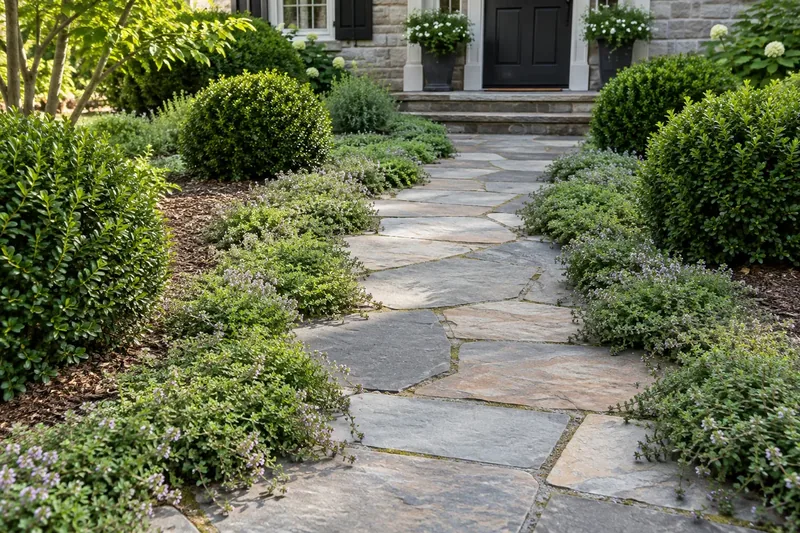
The best plants along a walkway are low and tidy at the edge, a little taller one step back, and fragrant near the front door. Creeping thyme, sweet alyssum, mondo grass and coral bells suit the edge. Catmint, lavender and dwarf boxwood fit the next row. Plant each one far enough back that, when fully grown, it stays off the path.
Below are the plants with their heights, USDA zones and light needs, how far back to set each one, and fragrant choices for sun and shade. Every plant fact comes from an extension service, listed at the end.
Best plants along a walkway at a glance
Use the table to shortlist plants for your zone and light. Heights are typical mature sizes from the North Carolina State Extension plant database.
| Plant | Height | USDA zones | Light | Why it suits a walkway |
|---|---|---|---|---|
| Creeping thyme (Thymus serpyllum) | 2 to 3 inches | 4 to 9 | Full sun | Fills gaps between stones; scented leaves; pink to purple summer flowers |
| Sweet alyssum (Lobularia maritima) | 3 to 10 inches | 5 to 9 (often grown as an annual) | Sun to part shade | Honey-scented flowers in spring and fall |
| Mondo grass (Ophiopogon japonicus) | 6 to 12 inches | 6 to 10 | Shade to sun | Evergreen; resists foot traffic |
| Coral bells (Heuchera) | 6 to 20 inches | 3 to 9 | Sun or part shade, by variety | Colorful leaves; evergreen to semi-evergreen |
| Lilyturf (Liriope muscari) | 1 to 1.5 feet | 5 to 10 | Sun to part shade | Evergreen clumps; purple spikes in late summer |
| Lady's mantle (Alchemilla mollis) | 1 to 1.5 feet | 3 to 8 | Sun to shade | Soft, rounded leaves; flowers around June |
| Catmint (Nepeta x faassenii) | 18 to 24 inches | 5 to 9 | Full sun to part shade | Long bloom; aromatic leaves; deer tend to avoid it |
| English lavender (Lavandula angustifolia) | 1 to 2 feet | 5 to 9 | Full sun | Fragrant summer flowers and leaves |
| Green Velvet boxwood (Buxus 'Green Velvet') | 2 to 3 feet | 5 to 8 | Sun to part shade | Evergreen; easy to clip into a low hedge |
Check your own USDA hardiness zone before you buy, and match each plant to the sun your walk really gets.
How to choose walkway border plants
A guide from the Washington State University Extension Master Gardeners in Skagit County sets out a few principles for entry gardens. They hold for any front walk:
- Tidier near the door. The closer plants are to the walk and the front door, the tidier and more refined they should be.
- No tunnel. Plant both sides if you like, but do not line the walk with shrubs that close it in.
- Repeat a few plants. Repetition and massing of the same plants keep the entry simple. Too many different plants look busy.
- Think about winter. A large share of perennials looks untidy out of season, and many deciduous shrubs look bare in winter. Mix in evergreens.
Two practical points finish the list. The soil along a sunny walk often dries out fast, and NC State lists thyme, lavender and catmint as drought tolerant. Lavender and thyme also need sharp drainage: NC State notes that lavender dies out in heavy clay and that thyme is prone to rot in wet soil.
Low plants for path edges
The front row should stay low enough that feet and the walk's edge are easy to see. These are the best low plants for path edges:
- Creeping thyme. At 2 to 3 inches tall, it can grow right up to the stones and into the gaps between them. It wants full sun and well-drained soil.
- Sweet alyssum. A quick filler from seed or small plants. NC State notes that white types are the most fragrant, and that flowering slows in hot summers. Cutting plants back can bring the flowers back.
- Mondo grass. A neat, grass-like evergreen that prefers shade but tolerates sun. NC State lists it among plants that handle foot traffic well.
- Coral bells. Grown mostly for their leaves, in shades from lime green to near black. Depending on the climate, they are evergreen or semi-evergreen.
- Lilyturf. Big blue lilyturf grows in clumps, which makes it better for edging than creeping lilyturf (Liriope spicata), a more aggressive spreader.
- Lady's mantle. A soft edge for part shade. In dry, sunny spots its leaves can scorch.
The second row: medium plants
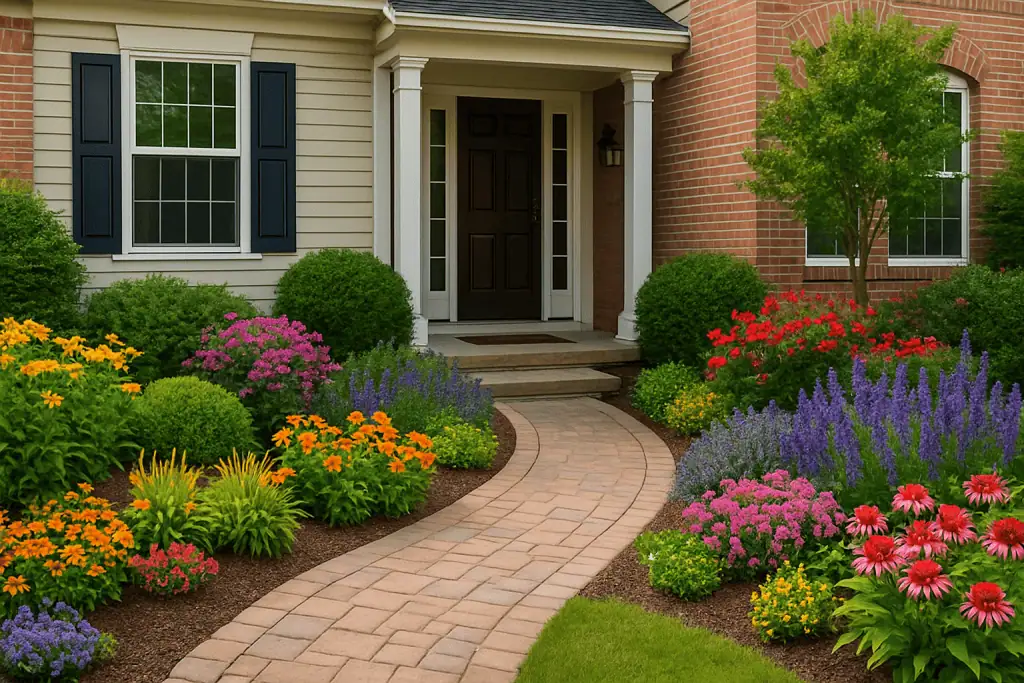
Behind the edge, a row of medium plants gives the walk its shape. Keep this row low enough that it does not block the view of the door.
- Catmint. Gray-green, aromatic leaves and a long bloom from spring into summer. NC State says shearing after the first flush of flowers brings more. It spreads up to 3 feet wide, so give it room.
- English lavender. Fragrant flowers in summer and leaves that release their scent when bruised. It needs full sun and perfectly drained soil.
- Green Velvet boxwood. An evergreen that can be clipped into a formal hedge. It gives the walk structure in winter, when the perennials are down.
For a formal entry, repeat one plant along both sides, such as boxwood behind a band of thyme. For a softer look, drift catmint and lavender along one side and let them lean a little toward the walk.
How far back to plant
Our walkway and entry guide gives the rule: plant at least half of a plant's mature width away from the path. The table applies that rule to the widths NC State lists.
| Plant | Mature width (NC State) | Plant at least this far from the walk edge |
|---|---|---|
| Creeping thyme | 3 to 12 inches | 1.5 to 6 inches, or in the gaps between stones |
| Sweet alyssum | 6 inches to 1 foot | 3 to 6 inches |
| Coral bells | 6 to 20 inches | 3 to 10 inches |
| Lilyturf | 1 to 1.5 feet | 6 to 9 inches |
| English lavender | 2 to 3 feet | 1 to 1.5 feet |
| Catmint | 2 to 3 feet | 1 to 1.5 feet |
| Green Velvet boxwood | 2 to 3 feet | 1 to 1.5 feet |
| Korean spice viburnum | 4 to 6 feet | 2 to 3 feet |
Use the larger number when the plant's label gives a range. A walk that looks a bit bare in the first year will look right once the plants fill in.
Fragrant plants by the front door
Scent works best where people pause: at the steps, the stoop and the door. Set fragrant shrubs a little back from the walk and within a few steps of the door. NC State describes all of these as fragrant:
| Plant | Size | USDA zones | Light | Fragrant season |
|---|---|---|---|---|
| Korean spice viburnum (Viburnum carlesii) | 4 to 6 feet tall and wide | 4 to 7 | Sun to part shade | Spring |
| Sweet box (Sarcococca ruscifolia) | 3 to 4 feet tall and wide | 7b to 9 | Part to deep shade | Late winter into early spring |
| Winter daphne (Daphne odora) | 3 to 6.5 feet tall, 2 to 4 feet wide | 7 to 9 | Sun to part shade | Mid to late winter |
| Gardenia (Gardenia jasminoides) | 4 to 8 feet tall and wide | 7b to 11 | Part shade or filtered sun | Spring and summer |
| English lavender | 1 to 2 feet tall | 5 to 9 | Full sun | Summer |
| Sweet alyssum | 3 to 10 inches tall | 5 to 9 | Sun to part shade | Spring and fall |
Two cautions. NC State rates winter daphne as highly poisonous, with every part of the plant toxic, so skip it where children or pets play. It also notes that daphne plants often live only three or four years. For a spot by the door that gets little or no sun, sweet box is the better fit in zones 7b to 9.
Planters at the door add scent and color too. See our front porch planter ideas for pots that suit sun and shade.
Plans for sun and shade
Two simple combinations, built from the plants above:
- Sunny walk: creeping thyme at the edge, a row of catmint or lavender behind it, and Green Velvet boxwood at the steps for winter shape. Add Korean spice viburnum near the door in zones 4 to 7.
- Shady walk: mondo grass or lilyturf at the edge, coral bells and lady's mantle behind, and sweet box by the door in zones 7b to 9.
The WSU Skagit County guide also lists tidy entry plants by light. For sun to part sun it includes dwarf English boxwood, a dwarf yellow daylily and a dwarf mugo pine. For part to full shade it includes tassel fern, a hellebore and sweet box.
Common walkway planting mistakes
- Planting for today's size. Plants set at the edge spill onto the walk within a season or two.
- A shrub tunnel. Tall shrubs on both sides make the walk feel narrow and hide the door.
- Too many kinds. One of everything looks busy. Pick a few plants and repeat them.
- Wet soil for dry-loving plants. Lavender and thyme fail in heavy, wet soil.
- Nothing for winter. Without evergreens, the walk looks bare for months.
- Tall plants at the steps. Keep plants low where the walk turns or changes level, so edges stay easy to see.
At night, low path lights tucked among the edge plants show the way and the plants at once. Our guide to path lighting ideas covers spacing and fixtures.
More guides on Yard and Soil
- Walkway and Entry Landscaping: how to plan the route, width and steps of a front walk.
- Front Porch Planter Ideas: planters for the door, the steps and the porch, in sun or shade.
- Walkway Materials Compared: pavers, poured concrete, natural stone and gravel side by side.
- Best Shrubs and Trees for Front Yards: larger plants to frame the house.
- Seasonal Flowers for Front Yards: color for each season near the walk.
Sources
- Everett Chu, WSU Skagit County Extension Master Gardeners, The Entryway Garden (tidier plants near the door, no shrub tunnel, repetition and massing, winter interest, sample plant lists).
- North Carolina State Extension Plant Toolbox: creeping thyme, sweet alyssum, mondo grass, coral bells, lilyturf, lady's mantle, catmint, English lavender, Green Velvet boxwood, Korean spice viburnum, sweet box, winter daphne, gardenia (heights, widths, zones, light, bloom, fragrance, cautions).