
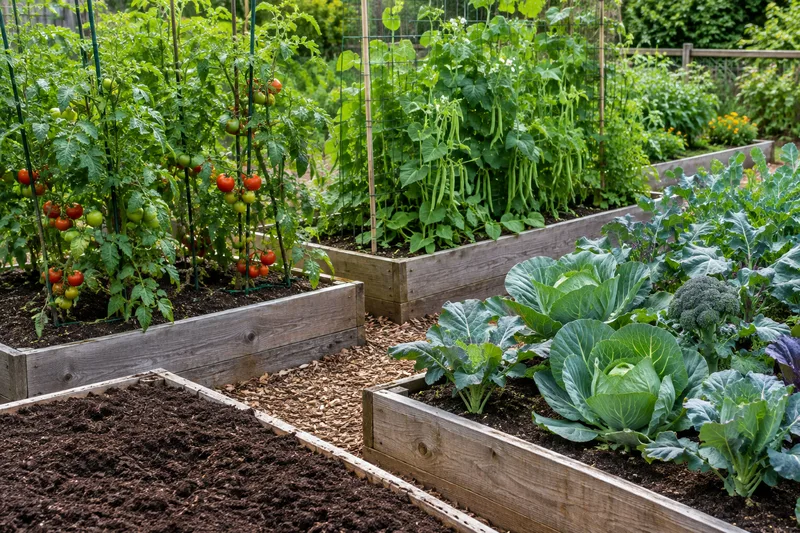
A good raised bed soil mix is a light, well-drained blend of three things. They are topsoil, compost and a coarse material such as coarse sand, pine bark fines or perlite. NC State Extension suggests 40% compost, 40% topsoil and 20% of that coarse material, by volume. Below are four tested recipes, the volume math for how much to buy, and how to fill a raised bed step by step.
What goes into a raised bed soil mix
Each part of the mix has a job. Iowa State University Extension sums up the goal: raised bed soil should be light and well drained. Too much of one part and the bed either dries out, packs down or runs short of nutrients.
| Ingredient | What it does | What to watch for |
|---|---|---|
| Topsoil | Gives the mix body and structure | Should be free of lead, pesticides and soil-borne disease (Iowa State) |
| Compost | Adds organic matter and nutrients | Should be fully mature and not too salty (Iowa State) |
| Coarse sand | Keeps the mix open so water drains | Use coarse builder's sand, not play sand. It is heavy (University of Maryland Extension) |
| Perlite or pine bark fines | Add air spaces for roots | Named by NC State as aeration materials |
| Peat or aged manure | Other sources of organic matter | Iowa State lists both as options alongside compost |
One thing does not work on its own: compost. Oregon State University Extension advises against filling a raised bed with compost alone. Blend it with topsoil and a coarse material instead.
Best soil for raised beds: four tested recipes
There is no single best soil for raised beds. Extension services publish several recipes that all aim for the same light, well-drained result.
| Recipe | Mix by volume | Note | Source |
|---|---|---|---|
| 40-40-20 mix | 40% compost, 40% topsoil, 20% coarse sand, pine bark fines or perlite | A balanced vegetable bed mix | NC State Extension |
| Equal thirds | One third topsoil, one third organic matter (aged manure, compost or peat), one third coarse sand | The most sand of the four, so the most drainage | Iowa State Extension |
| Topsoil and compost | About 70% topsoil and 30% compost | Only two parts to buy | Iowa State Extension |
| Amended native soil | Your own topsoil with 30 to 50% well-composted organic matter | Uses the soil you already have | Utah State University Extension |
Utah State also gives a 1:1:1 version: equal parts composted organic matter, a drainage material (coarse sand, vermiculite, pumice or perlite) and native topsoil. It notes that soilless mixes work too, but they are usually expensive and may run short of nutrients over time.
Bagged raised bed mix or bulk soil?
- Bagged mix is easy to carry and suits one small bed. Check the bag for its volume in cubic feet.
- Bulk soil is sold by the cubic yard and suits several beds or deep ones. Ask the supplier what is in the blend and where the topsoil came from.
- Mixing your own lets you follow a recipe above. Blend the parts on a tarp or in the bed before planting.
Raised bed soil calculator: how much soil do you need?
You do not need an online tool. The math is three steps:
- Measure the inside of the bed in feet: length and width.
- Turn the depth into feet. Divide the soil depth in inches by 12. Six inches is 0.5 feet.
- Multiply length x width x depth. The answer is in cubic feet. Divide by 27 to get cubic yards, because one cubic yard is 3 feet x 3 feet x 3 feet.
| Bed size (inside) | Soil depth | Cubic feet (L x W x D) | Cubic yards (cubic feet / 27) |
|---|---|---|---|
| 4 x 4 feet | 6 inches | 4 x 4 x 0.5 = 8 | 0.30 |
| 4 x 4 feet | 12 inches | 4 x 4 x 1 = 16 | 0.59 |
| 3 x 6 feet | 12 inches | 3 x 6 x 1 = 18 | 0.67 |
| 4 x 8 feet | 6 inches | 4 x 8 x 0.5 = 16 | 0.59 |
| 4 x 8 feet | 10 inches | 4 x 8 x 0.83 = 26.7 | 0.99 |
| 4 x 8 feet | 12 inches | 4 x 8 x 1 = 32 | 1.19 |
| 4 x 8 feet | 18 inches | 4 x 8 x 1.5 = 48 | 1.78 |
| 4 x 12 feet | 12 inches | 4 x 12 x 1 = 48 | 1.78 |
To split a recipe, multiply the total by each share. A 4 x 8 foot bed filled 12 inches deep holds 32 cubic feet. With the 40-40-20 mix, that is 12.8 cubic feet of compost, 12.8 of topsoil and 6.4 of coarse material.
To count bags, divide the cubic feet by the volume printed on the bag. For example, 32 cubic feet in bags of 1.5 cubic feet is 21.3, so buy 22 bags. Soil settles after filling, so plan to top the bed up later rather than overfilling it on day one.
How deep to fill for what you grow
Depth decides how much soil you buy, so match it to the crops. University of Delaware Extension suggests at least 1 foot of soil in a raised bed. The Old Farmer's Almanac also asks for at least 12 inches for root crops.
University of Maryland Extension gives minimum soil depths for vegetables in containers. They are a useful floor for a bed too:
| Crop size | Examples | Minimum depth (UMD, containers) |
|---|---|---|
| Small | Radish, scallions, spinach, salad greens, peas | 4 to 6 inches |
| Medium | Summer squash, cabbage family, beans, beets, carrots | 8 to 12 inches |
| Large | Tomatoes, peppers, eggplant, cucumbers | 12 to 16 inches |
If the bed sits on decent ground, it can be shallower. Utah State says a framed bed under 12 inches deep should have no bottom, so roots can reach the soil below.
How to fill a raised bed, step by step
- Level the site. NC State Extension advises leveling the ground first so the bed does not settle unevenly.
- Clear and loosen the ground. Iowa State suggests removing any grass sod and loosening the soil under the bed. For framed beds, Utah State suggests working the soil underneath 6 to 12 inches deep.
- Test or protect the ground if in doubt. University of Delaware Extension suggests sampling the soil before you build. Over contaminated ground, it advises geotextile barrier fabric between the bed and the soil below.
- Blend the first layer into the ground. Oregon State suggests adding 2 to 3 inches of compost or soil mix and mixing it into the original soil before filling.
- Add the mix in layers. Iowa State suggests blending each layer into the one below, so no sharp line forms that blocks water and roots.
- Water and let it settle. Fill to just below the rim, water well, then top up any low spots.
- Shape and mulch. Iowa State suggests sloping the surface slightly toward the edges, away from nearby buildings, and mulching around plants once they are in.
Filling a tall raised bed with wood and leaves
Deep beds take a lot of soil. Some gardeners fill the bottom with logs and branches, a method called hugelkultur. Clemson Cooperative Extension describes the layers:
- A 3 to 4 inch layer of corrugated cardboard on the ground.
- Wood from largest to smallest: logs, then branches, then twigs.
- Grass clippings, leaves or straw packed into the gaps.
- Topsoil and compost on top.
Clemson warns not to use diseased trees or leaves. As the wood breaks down, the bed sinks, so add compost to keep it full. Raw woody material can also tie up nitrogen. Utah State suggests about one quarter pound of actual nitrogen per 100 square feet for each inch of uncomposted woody material added.
Raised bed mix, potting mix or garden soil?
These three are easy to mix up at the store. They suit different jobs.
| Product | Best use | Why |
|---|---|---|
| Raised bed mix (topsoil, compost and coarse material) | Raised beds | The kind of blend the extension recipes above describe |
| Soilless potting mix | Pots and containers | Light and well drained (University of Maryland Extension). Utah State says it is costly to fill a bed with it, and it can run short of nutrients |
| Plain garden soil | Part of a bed mix, never alone in pots | University of Maryland Extension says it is too dense for containers and can drown roots |
What not to put in a raised bed
- Compost on its own. Oregon State advises against filling a bed with compost alone.
- Unripe or salty compost. Iowa State says compost should be fully mature and not too salty.
- Topsoil of unknown origin. Iowa State warns that brought-in topsoil may carry lead, pesticides or soil-borne disease.
- Play sand. University of Maryland Extension says to use coarse builder's sand instead.
- Diseased wood or leaves in a hugelkultur base, which Clemson rules out.
- Old tires or creosote-treated railroad ties as the frame, which University of Delaware Extension advises against.
Keeping raised bed soil healthy
A bed is not filled once and forgotten. The organic matter breaks down, the soil settles and plants use up nutrients.
- Top up each year. Oregon State suggests one quarter inch to 1 inch of compost a year on existing vegetable beds, and refilling raised beds as the mix settles.
- Test the soil. Utah State recommends a soil test to decide what fertilizer the bed needs.
- Keep feet off the bed. Walking on the soil packs it and undoes the loose structure you built.
Questions about raised bed soil
Can I fill a raised bed with only compost?
No. Oregon State University Extension advises against it. Blend compost with topsoil and a coarse material instead.
How deep should the soil be?
University of Delaware Extension suggests at least 1 foot. NC State says 10 to 18 inches is typical for raised beds.
Do I need to replace raised bed soil every year?
No. Top it up with compost each year instead, as Oregon State suggests.
Is bagged garden soil safe for vegetables?
Bagged and bulk products vary. Ask what is in them, and choose topsoil that the seller says is free of contaminants such as lead and pesticides, as Iowa State advises.
Once the bed is full, see What to Plant in a Raised Bed First for easy crops and a planting plan. The full beginner guide is on Raised Bed Gardening, and Companion Planting Improves Soil Health covers plants that help the soil.
Sources
- Tyler Osborn, NC State Extension, Getting Started With Raised Bed Gardening (April 30, 2025).
- Iowa State University Extension and Outreach, What would be a good soil mix for a raised bed?
- Rick Heflebower, Katie Wagner, JayDee Gunnell and JoDeane Condrat, Utah State University Extension, Raised Bed Gardening.
- Weston Miller and Jeremiah Mann, Oregon State University Extension, How to use compost in gardens and landscapes (EM 9308).
- Carrie Murphy, University of Delaware Cooperative Extension, Raised Bed Gardening (October 2024).
- Julia Nichols, Clemson Cooperative Extension, Hugelkultur Gardening (February 13, 2025).
- University of Maryland Extension, Growing Media (Potting Soil) for Containers and Types of Containers for Growing Vegetables.
- The Old Farmer's Almanac, What to Plant in a Raised Garden Bed.