
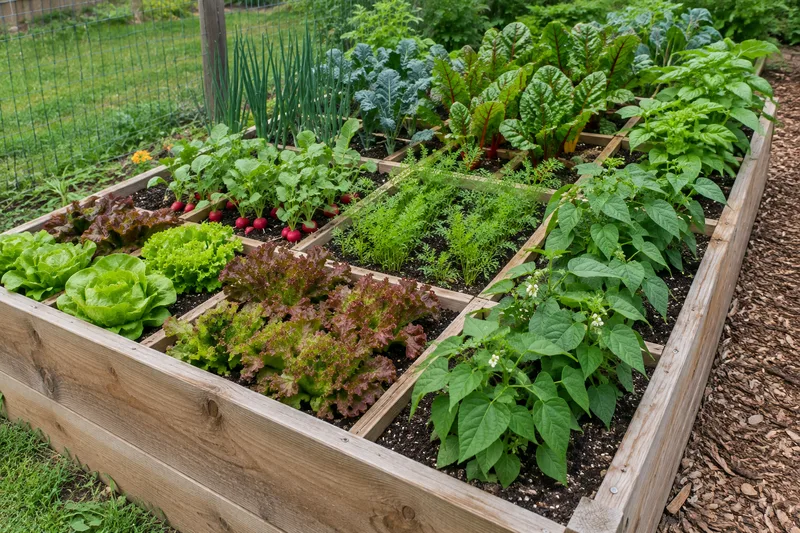
What to plant in raised beds first: fast, compact crops you like to eat. In cool spring weather that means lettuce, spinach, radishes, peas, beets and chard. After the last frost, add tomatoes, peppers, bush beans and herbs such as basil. Below are the easiest crops with spacing and days to harvest. You will also find when each one goes in, and a sample plan for a 4 by 8 foot bed.
Easy raised bed vegetables for beginners
A good first crop sprouts reliably, fits a small space and gives a harvest within a season. University of Missouri Extension publishes the spacing and days to harvest below. The in-row spacing is the distance between plants in a row.
| Crop | Season | Spacing in the row | Days to harvest |
|---|---|---|---|
| Radish | Cool | 1 inch | 25 to 35 |
| Leaf lettuce | Cool | 3 inches | 35 to 50 |
| Spinach | Cool | 3 inches | 40 to 50 |
| Kale | Cool | 8 inches | 50 to 65 |
| Beets | Cool | 3 inches | 55 to 65 |
| Swiss chard | Cool | 3 inches | 55 to 65 |
| Peas | Cool | 2 inches | 65 to 75 |
| Carrots | Cool | 3 inches | 70 to 85 |
| Bush snap beans | Warm | 3 inches | 50 to 60 |
| Tomatoes, staked | Warm | 18 inches | 65 to 75 |
| Peppers | Warm | 18 inches | 70 to 80 |
Days to harvest vary by variety, so check the seed packet or plant tag too. Root crops are a good match for a raised bed. Mississippi State Extension notes that carrots, onions and parsnips do well in the loose, amended soil of a raised bed.
In a raised bed you skip the wide paths between rows, so plants are set in a block. The Old Farmer's Almanac, for example, spaces tomatoes 18 inches apart in all directions. The sample plan below gives each plant its in-row spacing on every side.
Raised bed crops for beginners, by season
Vegetables fall into two groups, and the group decides when they go in. University of Minnesota Extension says soil temperature is the best guide to planting time.
Cool-season crops
- Lettuce, spinach, radishes, peas, kale, chard, beets, carrots and onions (University of Minnesota Extension).
- Peas, spinach, lettuce and radishes can be sown once the soil reaches 40 to 50°F.
- They must mature before hot weather, so they go in early. University of Maryland Extension plants them again in late summer for a fall harvest.
Warm-season crops
- Tomatoes, peppers, beans, summer squash and basil, plus tender crops such as cucumbers (University of Minnesota Extension).
- They need soil of 50 to 60°F and go in after the last frost.
- University of Maryland Extension notes that basil, tomatoes, cucumbers and peppers are damaged or killed by freezing temperatures.
University of Delaware Extension lists oregano with basil among warm-season herbs for raised beds. Its cool-season list for raised beds is peas, lettuce, Swiss chard, radishes and beets.
Herbs, flowers and fruit
A raised bed does not have to hold only vegetables. The Old Farmer's Almanac suggests these as good raised bed plants:
- Herbs: basil, thyme, rosemary, parsley, cilantro and dill. The Almanac pairs basil with tomatoes and peppers.
- Flowers: zinnias, marigolds, sunflowers and dahlias.
- Fruit: strawberries, blueberries, raspberries and blackberries.
NC State Extension lists strawberries, asparagus and herbs as perennial crops for raised beds. Perennials stay put for years, so give them their own bed or one end of a bed. That way they are not disturbed when you replant the annual crops.
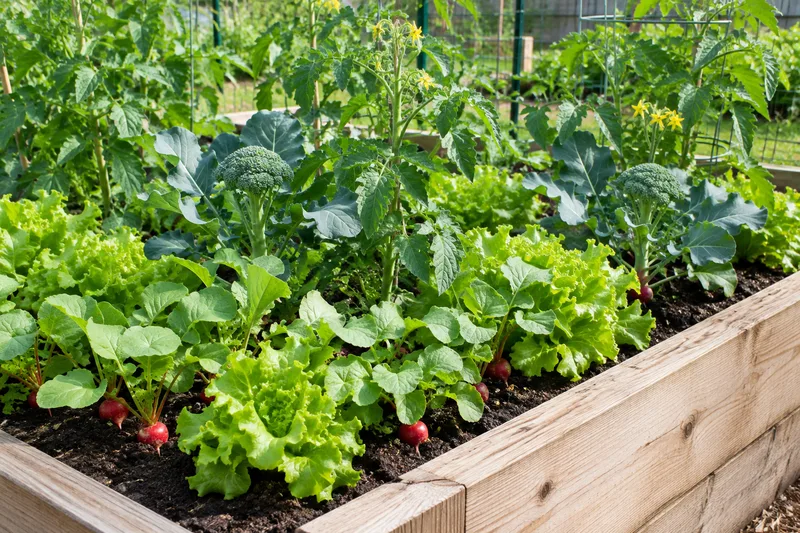
A raised bed planting plan for a 4 by 8 foot bed
This sample raised bed planting plan splits a 4 by 8 foot bed into four strips, each 2 feet deep and 4 feet across. It uses each strip twice: cool-season crops in spring, then warm-season crops after the last frost.
The tall crops sit on the north side so they do not shade the rest. The Old Farmer's Almanac gives the same advice: taller crops to the north, shorter ones to the south.
| Strip (north to south) | Spring (cool season) | Summer (warm season) |
|---|---|---|
| 1. North edge | Peas on a trellis along the north side, 2 inches apart | 2 staked tomatoes, 18 inches apart |
| 2. Second strip | Leaf lettuce and spinach, 3 inches apart | 2 peppers, 18 inches apart |
| 3. Third strip | Radishes at 1 inch and beets at 3 inches | Bush snap beans, 3 inches apart |
| 4. South edge | Carrots and Swiss chard, 3 inches apart | Basil and oregano, spaced as the plant tag says |
How to use the plan:
- Sow the spring strips as soon as the soil is warm enough for cool-season crops.
- Harvest radishes first. They are ready in about a month and free up space quickly.
- Pull spring crops as they finish, then set out the summer crops after the last frost.
- Put the tomato stakes and pea trellis on the north edge so their shade falls outside the bed.
- In late summer, sow lettuce, spinach and radishes again where beans have finished.
Want more pairings that share a bed well? See Companion Planting for Raised Bed Gardening.
When to plant each crop
Planting dates depend on your average last spring frost and first fall frost. University of Maryland Extension gives dates for central Maryland, with a last frost around April 15 and a first frost around October 25. It says to shift a week or two earlier or later for your own location.
The table turns the Maryland spring dates into weeks before or after that April 15 frost, so you can line them up with your own date.
| Crop | Spring window in central Maryland | Roughly, against the last frost |
|---|---|---|
| Spinach | 2nd week of March to 3rd week of April | About 5 weeks before to 1 week after |
| Peas | Mid-March through April | About 4 weeks before to 2 weeks after |
| Radish | Mid-March to early May | About 4 weeks before to 3 weeks after |
| Leaf lettuce | Mid-March through May | About 4 weeks before to 6 weeks after |
| Kale | 1st to 3rd week of April | About 2 weeks before to 1 week after |
| Carrots | Mid-April through May | Around the last frost to 6 weeks after |
| Snap beans | May to the 1st week of August | From about 2 weeks after |
| Tomatoes (young plants) | May to early July | From about 2 weeks after |
| Peppers (young plants) | Mid-May to mid-June | About 4 to 9 weeks after |
| Cucumbers | Mid-May to mid-July | From about 4 weeks after |
A second planting for fall
For fall, the same Maryland calendar sows leaf lettuce from mid-July through August, spinach from August to early September, and radishes from mid-July to mid-September.
To work out your own last sowing date, The Old Farmer's Almanac counts back from the first fall frost:
- Find your average first fall frost date.
- Subtract the crop's days to maturity from the seed packet.
- Subtract 10 to 14 more days for harvesting.
- Subtract 7 to 10 more days, because growth slows in the shorter, cooler days of fall.
The Almanac's example is a lettuce that matures in 45 days. Add 14 days for harvest and 7 for the fall slowdown, and the total is 66 days. With a first frost around November 1, the seed goes in by August 26.
To find your own frost dates and hardiness zone, see Seasonal Planting Guides.
What not to plant in a first raised bed
Almost anything grows in a raised bed, but some crops use too much space for a small first bed.
- Corn. It needs a large block of plants. The Old Farmer's Almanac lists it among crops to avoid.
- Winter squash and giant pumpkins. Their vines run far past a 4 by 8 bed (Old Farmer's Almanac).
- Trees and shrubs. The Almanac advises keeping them out of raised beds.
- Melons and potatoes. University of Maryland Extension calls these more challenging in containers. Leave them for a second year.
Tips for a good first harvest
- Fill the bed well first. A light, well-drained mix matters more than the crop list. See Raised Bed Soil Mix.
- Water about 1 inch a week, rain included, and water deeply (NC State Extension).
- Choose compact varieties. University of Maryland Extension suggests "bush" or "dwarf" types for small spaces.
- Trellis climbing crops. Utah State suggests vertical supports for pole beans and peas.
- Start small. Grow a few crops well rather than many crops badly.
Questions about planting a raised bed
What is the easiest vegetable to grow in a raised bed?
Radishes are hard to beat. University of Missouri Extension lists 25 to 35 days from seed to harvest. Leaf lettuce and bush beans are close behind.
How deep does a raised bed need to be for carrots?
The Old Farmer's Almanac asks for at least 12 inches of soil for root crops. University of Maryland Extension puts carrots in its 8 to 12 inch group for containers.
Should I start from seed or buy young plants?
Both, depending on the crop. University of Maryland Extension sows peas, leaf lettuce, carrots, beets and beans straight into the ground. Tomatoes and peppers are started indoors weeks ahead, so buying young plants is the simpler choice for a first bed. Sow seed a little thicker than the spacing in the table, then thin the seedlings to that spacing.
Can I build a bed in fall and plant it in spring?
Yes. University of Delaware Extension notes that soil in a new bed settles over the winter, so it is ready to plant by spring.
Can I grow flowers in a raised bed too?
Yes. The Old Farmer's Almanac includes zinnias, marigolds, sunflowers and dahlias in its raised bed list, and suggests flowers near squash.
For the full beginner guide, from choosing a spot to watering, see Raised Bed Gardening.
Sources
- David H. Trinklein, University of Missouri Extension, Vegetable Planting Calendar (G6201), Table 1.
- University of Minnesota Extension, Planting the vegetable garden.
- Mississippi State University Extension, Raised Beds.
- University of Maryland Extension, When to Plant Vegetables, Growing Vegetables in Containers and Types of Containers for Growing Vegetables.
- Carrie Murphy, University of Delaware Cooperative Extension, Raised Bed Gardening (October 2024).
- Tyler Osborn, NC State Extension, Getting Started With Raised Bed Gardening (April 30, 2025).
- Utah State University Extension, Raised Bed Gardening.
- The Old Farmer's Almanac, What to Plant in a Raised Garden Bed.
- Catherine Boeckmann, The Old Farmer's Almanac, Understanding When to Plant Vegetables (February 6, 2025).