
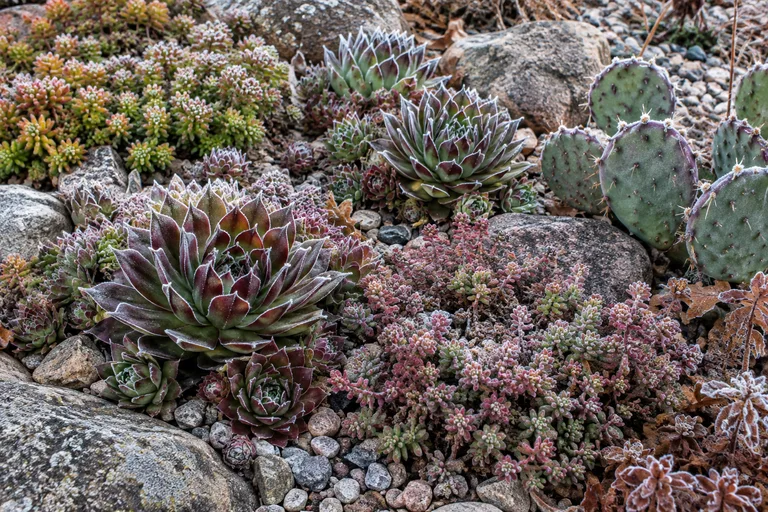
The cold hardy succulents that survive winters outdoors in most of the US are hens and chicks, the low stonecrops (sedums), upright stonecrop, eastern prickly pear and Adam's needle yucca. NC State Extension lists all of them for zone 4 or colder, and several for zone 3. Hardy ice plants and Parry's agave are hardy to zone 6. For all of them, wet soil in winter is as big a threat as cold.
This guide explains what cold hardy means on a plant tag, lists the toughest succulents with their zones and sizes, and shows how to plant them so they come through frost and freezing weather.
What "cold hardy" means for a succulent
Cold hardiness is measured with the USDA Plant Hardiness Zone Map. It is based on the average coldest winter temperature in each area, in bands of 10 degrees F, with half zones of 5 degrees. Lower numbers are colder. A plant listed for zones 4 to 9 should survive a typical winter in zone 4, the coldest end of its range.
Hardiness varies widely from one succulent to the next, even within one group of plants. Before planting any succulent outside, check its tag:
- If the range starts at zone 3, 4 or 5, it is a good candidate for a cold-winter garden.
- If the range starts at zone 9 or 10, it will not survive a cold winter in the ground.
- If no zone is listed at all, treat it as tender until you can confirm otherwise.
Look up your own zone on the USDA map before you shop.
Winter hardy succulents: the list
The zones, sizes and light below come from the NC State Extension Gardener Plant Toolbox. Sizes are for the plant, not the flower stalk, unless noted.
| Succulent | USDA zones | Height | Spread | Light | Good to know |
|---|---|---|---|---|---|
| Hens and chicks (Sempervivum tectorum) | 3 to 8 | Rosettes 3 to 4 inches across; flower stalks 8 to 12 inches | Forms colonies by offsets | Full sun to part shade | Each rosette dies after it flowers; its offsets carry on |
| Two-row stonecrop (Phedimus spurius) | 3 to 9 | 2 to 6 inches | 2 to 3 feet | Full sun | Semi-evergreen mat; prefers very dry soil |
| White stonecrop (Sedum album) | 3 to 9 | 3 to 6 inches | 1 to 1.5 feet | Full sun, tolerates light shade | Spreads fast and can overwhelm small plants |
| Orange stonecrop (Phedimus kamtschaticus) | 3 to 9 | 3 to 7 inches | About 1 foot | Full sun | Root rot in poorly drained soil |
| Upright stonecrop (Hylotelephium telephium) | 3 to 9 | 2 to 2.5 feet | 1.5 to 2 feet | Full sun | Flowers August to October |
| 'Angelina' stonecrop (Petrosedum rupestre) | 5 to 9 | 4 to 6 inches | 1 to 2 feet | Full sun, tolerates light shade | Mat-forming, spreads rapidly |
| Eastern prickly pear (Opuntia humifusa) | 4 to 9 | 6 to 12 inches | 1 to 1.5 feet | Full sun | Native to the eastern US; bristles irritate skin |
| Adam's needle yucca (Yucca filamentosa) | 4 to 10 | 3 to 8 feet | 3 to 5 feet | Full sun to part shade | Native to the Southeast; flowers April to June |
| Hardy ice plant (Delosperma cooperi) | 6 to 10 | 3 to 6 inches | 1 to 2 feet | Full sun | May not return in areas with wet winters |
| Yellow ice plant (Delosperma nubigenum) | 6 to 9 | 2 to 3 inches | 9 inches to 3 feet | Full sun to part shade | Leaves turn reddish in fall and winter |
| Parry's agave (Agave parryi) | 6 to 10 | 1 to 3 feet | 1 to 3 feet | Full sun | Cold tolerant to minus 5 degrees F if kept dry |
Hens and chicks
Hens and chicks are the classic cold hardy succulent. The large rosette is the hen; the small offsets around it are the chicks, and together they form a spreading colony. NC State says they thrive in sandy or gravelly soil and need sharp drainage. Overwatering can cause crown rot. When a rosette sends up a flower stalk in summer, that rosette dies afterward. Pull it out and the chicks fill the gap. In very hot, sunny spots, some afternoon shade helps.
Low stonecrops
Low stonecrops, the creeping sedums, are the easiest winter hardy succulents for a cold garden. Two-row stonecrop, white stonecrop and orange stonecrop are all listed for zones 3 to 9. They form mats a few inches tall and suit rock gardens, wall tops and gravel beds. All three want good drainage and do poorly in wet soil. White stonecrop spreads fast enough that NC State tags it as weedy, so keep it away from small, slow plants. For more on using them to cover ground, see Succulent Ground Covers for Dry Yards.
Upright stonecrop
Upright stonecrop grows into clumps 2 to 2.5 feet tall and flowers from August to October, when most of the garden is fading. It is hardy in zones 3 to 9 and likes medium to dry, sandy or rocky soil. It also mixes well with perennials in an ordinary flower bed, as long as the spot drains.
Eastern prickly pear
Eastern prickly pear is a cactus native to the eastern United States. It grows 6 to 12 inches tall, spreads 1 to 1.5 feet and is hardy in zones 4 to 9. Its yellow flowers, 2 to 3 inches across, appear from spring to early summer. NC State warns that it is intolerant of wet, poorly drained soil, where roots can rot. Wear thick gloves: the pads carry tiny barbed bristles that get into skin.
Adam's needle yucca
Adam's needle is a yucca native to the Southeast that is hardy to zone 4. It forms a clump of stiff leaves and sends up tall flower stalks from April to June. NC State lists it as tolerant of drought, heat, poor soil and salt spray, and as resistant to deer and rabbits. It needs good drainage; in wet spots its leaves can get leaf spots or blight.
Hardy ice plants
Hardy ice plants (Delosperma) make low mats covered in daisy-like flowers. Cooper's hardy ice plant flowers from summer until fall in neon pinkish purple. NC State lists it for zones 6 to 10 and notes it may have trouble returning in areas with wet winters. Yellow ice plant flowers in spring and is listed for zones 6 to 9, though NC State's own description says it grows well in zone 5. Plant both only in sandy or rocky soil that drains fast.
Parry's agave
Parry's agave is one of the hardiest agaves. NC State says it is cold tolerant to minus 5 degrees F as long as it is dry, and advises no watering in winter. It forms a rosette 1 to 3 feet across with a sharp spine at each leaf tip, so keep it away from paths. After 8 to 15 years, it sends up a flower stalk 10 to 20 feet tall, then that rosette dies. The offsets around it take its place.
Succulents for zone 5 and colder
Using the zones in the table, here is what to plant where:
- Zone 3: hens and chicks, two-row stonecrop, white stonecrop, orange stonecrop and upright stonecrop.
- Zone 4: all of the above, plus eastern prickly pear and Adam's needle yucca.
- Zone 5: all of the above, plus 'Angelina' stonecrop. Yellow ice plant is worth a try in a very well-drained spot.
- Zone 6: all of the above, plus Cooper's hardy ice plant and Parry's agave.
Cornell Cooperative Extension gives the same advice for cold areas: check plant information to make sure plants are hardy to at least zone 4 or 5.
Outdoor succulents that survive frost: why drainage matters most
Frost and freezing temperatures are only half the story. The plant pages above repeat one warning: wet soil kills hardy succulents. Parry's agave takes minus 5 degrees F only when dry. Cooper's ice plant may not come back where winters are wet. Hens and chicks, the stonecrops and prickly pear all rot in poorly drained soil.
Cold, wet soil is the combination to avoid. A plant that sits in soggy ground from fall to spring has little chance, even if it is listed for a colder zone than yours. Water drains slowly in heavy clay and where water collects at the bottom of a slope, so those are the riskiest spots.
How to plant cold hardy succulents
- Choose the driest, sunniest spot. A slope, the top of a wall or a raised bed drains faster than flat ground.
- Improve the soil. Cornell Cooperative Extension advises good drainage, with some gravel or sand added to the soil.
- Mulch with stone, not bark. Cornell suggests mulching around the plants with small stones or pebbles. Denver Water recommends rock or gravel mulch at least 2 inches deep, and no black plastic under it.
- Water new plants until they root in, then let the soil dry out between waterings.
- Feed lightly. Cornell suggests fertilizing only now and then during the growing season, with a slow-release fertilizer high in potassium, such as a cactus fertilizer.
For a full planting walkthrough, see How to Plant an Outdoor Succulent Bed.
Putting cold hardy succulents together
A cold-climate succulent bed works best when it mixes the three shapes these plants come in:
- Tall, spiky plants for height and a focal point: Adam's needle yucca, or Parry's agave in zone 6 and warmer.
- Rosettes and clumps for the middle: hens and chicks, upright stonecrop and eastern prickly pear.
- Low mats to fill the ground between them: two-row, orange, white and 'Angelina' stonecrops, or hardy ice plant where it is hardy.
Plant each kind in a group rather than one at a time, and repeat a few of them across the bed. Leave room for spreaders: a 2 to 3 foot mat of two-row stonecrop will soon cover a small rosette planted too close. Gravel between the plants ties the bed together, and it is the stone mulch Cornell suggests for hardy succulents. For more design ideas, see Succulents.
Winter care checklist
- No cover is needed. Cornell's Master Gardener writes that no winter covering is necessary for hardy succulents.
- Stop watering agaves for winter, as NC State advises.
- In spring, pull out any hens and chicks rosettes that flowered and died.
- Expect color changes. Yellow ice plant turns reddish in fall and winter; that is normal.
Common questions
Can succulents stay outside in winter?
Hardy ones can. Hens and chicks and the stonecrops in this guide are listed for zone 3, and prickly pear and Adam's needle for zone 4. A succulent that is not listed as hardy in your zone needs to come indoors for winter or be treated as an annual.
What is the most cold hardy succulent?
On NC State's lists, hens and chicks and the low stonecrops reach the coldest zone, zone 3.
Why do hardy succulents die over winter?
A likely cause is wet soil rather than cold, since every plant page above warns about poor drainage. Check whether water sits in that spot after rain. If it does, replant in a raised bed or on a mound with gritty soil and gravel mulch.
More guides on Yard and Soil
- Succulents: succulent landscaping ideas and care, with all of our succulent guides.
- Succulent Ground Covers for Dry Yards: low sedums and ice plants to cover bare ground.
- How to Plant an Outdoor Succulent Bed: soil, layout and planting, step by step.
- Succulents and Natives for Low-Water Landscapes: how to pair succulents with native plants.
Sources
- North Carolina State Extension, Extension Gardener Plant Toolbox: Sempervivum tectorum, Phedimus spurius, Sedum album, Phedimus kamtschaticus, Hylotelephium telephium, Petrosedum rupestre 'Angelina', Opuntia humifusa, Yucca filamentosa, Delosperma cooperi, Delosperma nubigenum and Agave parryi.
- Carol Sitarski, Cornell Cooperative Extension Allegany County, Growing Cold Hardy Succulents.
- USDA Agricultural Research Service, USDA Plant Hardiness Zone Map.
- Denver Water, Xeriscape Principles.