
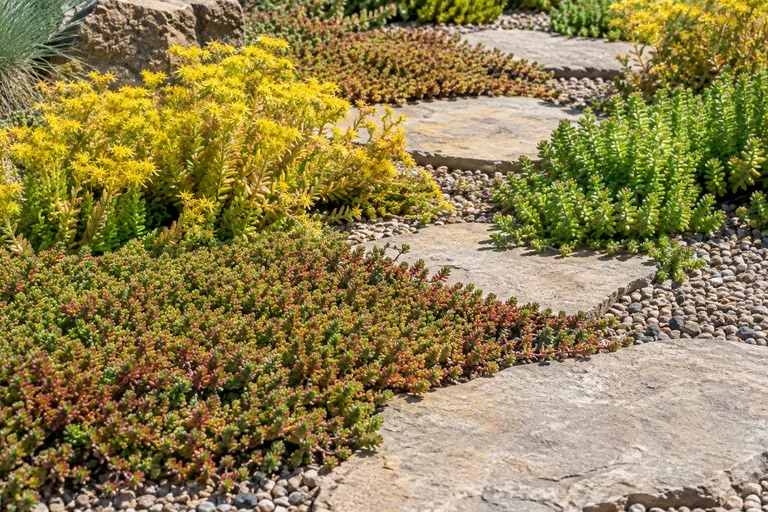
The best succulent ground cover for a dry, sunny yard is a low stonecrop (sedum), such as two-row stonecrop, white stonecrop or 'Angelina'. These form mats a few inches tall, spread 1 to 3 feet, and are hardy in zones 3 or 5 to 9. In zone 6 and warmer, hardy ice plants add bright flowers. Avoid highway iceplant (Carpobrotus edulis): the California Invasive Plant Council rates it a high-impact invasive plant in California.
This guide compares the main choices by zone, height and spread, explains the difference between the hardy ice plants and the invasive one, and shows how to plant a succulent ground cover so it fills in.
Best succulent ground covers at a glance
Zones, sizes, light and bloom times come from the NC State Extension Gardener Plant Toolbox.
| Ground cover | USDA zones | Height | Spread | Flowers | Light |
|---|---|---|---|---|---|
| Two-row stonecrop (Phedimus spurius) | 3 to 9 | 2 to 6 inches | 2 to 3 feet | Spring and summer | Full sun |
| White stonecrop (Sedum album) | 3 to 9 | 3 to 6 inches | 1 to 1.5 feet | White, June to August | Full sun, light shade |
| Orange stonecrop (Phedimus kamtschaticus) | 3 to 9 | 3 to 7 inches | About 1 foot | Golden yellow, summer | Full sun |
| 'Angelina' stonecrop (Petrosedum rupestre) | 5 to 9 | 4 to 6 inches | 1 to 2 feet | June to August | Full sun, light shade |
| Hens and chicks (Sempervivum tectorum) | 3 to 8 | Rosettes 3 to 4 inches across | Spreads by offsets | Summer, on 8 to 12 inch stalks | Full sun to part shade |
| Cooper's hardy ice plant (Delosperma cooperi) | 6 to 10 | 3 to 6 inches | 1 to 2 feet | Pinkish purple, summer to fall | Full sun |
| Yellow ice plant (Delosperma nubigenum) | 6 to 9 | 2 to 3 inches | 9 inches to 3 feet | Chartreuse yellow, spring | Full sun to part shade |
NC State lists orange stonecrop's bloom season inconsistently, as both spring and summer; its text puts the flowers in summer.
Sedum ground cover: the stonecrops
Sedum ground cover is the safe first choice for most of the country. The low stonecrops are hardy to zone 3 or 5, need little water once rooted, and stay only a few inches tall. Their one demand is drainage.
Two-row stonecrop
Two-row stonecrop is the widest spreader here, at 2 to 3 feet, and forms a dense, semi-evergreen mat 2 to 6 inches tall. NC State says it needs well-drained, sandy or shallow rocky soil and prefers very dry soil, so do not overwater it. It is easy to multiply by division or stem cuttings.
White stonecrop
White stonecrop grows 3 to 6 inches tall with small white star-shaped flowers from June to August. It spreads quickly along the ground on stems that root as they go. That makes it good at covering ground fast, but NC State tags it as aggressive and weedy, and says it can overwhelm other plants of similar height. Use it where it can spread freely, not in a bed of small, slow plants. It resists deer and rabbits.
Orange stonecrop
Orange stonecrop stays 3 to 7 inches tall and about a foot wide, with golden yellow flower clusters. It prefers dry to medium moisture and well-drained soil, and it can get root rot where soil drains poorly. NC State lists it as resistant to deer and rabbits and drought tolerant once established. It suits smaller spaces where a 2 to 3 foot spreader would be too much.
'Angelina' stonecrop
'Angelina' forms a mat 4 to 6 inches tall that spreads rapidly to 1 to 2 feet. It is hardy in zones 5 to 9. It takes full sun or light shade, and tolerates drought and dry, rocky soil. NC State notes that fallen leaves can root into new plants. The sap can irritate some people's skin, so wear gloves when dividing it.
Hens and chicks
Hens and chicks are rosettes rather than a mat, but they spread by offsets into colonies that cover ground slowly. They suit small spaces, the edge of a gravel path and the cracks of a dry wall. They are hardy in zones 3 to 8 and need sharp drainage. Each rosette dies after it flowers, and the offsets fill the space.
Ice plant ground cover: the hardy kinds and the invasive one
"Ice plant" is a common name for more than one group of plants, and the difference matters. The hardy ice plants (Delosperma) are garden plants for dry, sunny spots. Highway iceplant (Carpobrotus edulis) is a coastal plant with a serious invasive record in California.
Cooper's hardy ice plant
Cooper's hardy ice plant makes a mat 3 to 6 inches tall covered with 2 inch, neon pinkish purple daisy-like flowers from summer until fall. NC State lists it for zones 6 to 10 and calls it very drought tolerant and moderately salt tolerant. Space plants 16 to 24 inches apart. Avoid heavy or poorly drained soil, and note that it may have trouble returning in areas with wet winters. Deer occasionally damage it.
Yellow ice plant
Yellow ice plant is even lower, 2 to 3 inches, with chartreuse yellow flowers in spring. Its leaves take on a reddish tinge in fall and winter. NC State lists it for zones 6 to 9, though its description says it grows well in zone 5. Space plants 10 to 14 inches apart in sandy or rocky soil with good drainage.
NC State's pages for these two hardy ice plants give no invasive warning. Even so, any fast-spreading ground cover can escape into wild areas in the wrong place. Check your state's invasive plant list before planting one near natural land.
Highway iceplant: invasive in California
Highway iceplant, also called Hottentot fig, is the plant to avoid. The California Invasive Plant Council gives it a "High" rating, its category for species with severe ecological impacts. It says the plant has spread into coastal scrub, grasslands, chaparral, bluffs, dunes and beaches. Its dense mats change the soil over time and let other non-native plants move in.
It is also hard to get rid of. Cal-IPC notes that it spreads by seed and by pieces of stem, and that even small stem fragments can grow into a new plant. It was first brought in as an ornamental. Some ground cover lists still recommend it, so check the botanical name on any plant labeled "ice plant" before you buy.
Why succulents make a drought tolerant ground cover
Succulents store water in thick leaves and stems, which carries them through dry spells that would brown a lawn. NC State describes these ground covers in the same terms: two-row stonecrop is tolerant of drought, white stonecrop is drought and heat tolerant once established, and Cooper's ice plant is very drought tolerant.
Drought tolerant does not mean no water. New plants need regular watering until their roots grow out. After that, water only in long dry spells. Once established, the bigger risk is too much water, since every plant here dislikes wet soil.
For other plants that cope with dry ground, see Drought-Tolerant Landscapes.
Where a succulent ground cover works
- Hot, sunny, dry spots where grass struggles, such as a strip by a driveway or a south-facing bank.
- Rock gardens and the tops of low walls, where drainage is fast.
- Gravel beds and paths, as a living edge between stones.
- Around larger succulents, as a carpet that hides bare soil.
They are not a lawn replacement for play areas. NC State gives no foot traffic rating for these plants, so where people walk, set stepping stones and let the ground cover fill around them. They also do poorly in shade and in wet, heavy soil.
Mixing succulent ground covers
Two or three ground covers planted side by side make a patchwork that changes through the year. A few combinations built from the table above:
- Flowers from spring to fall in zone 6 and warmer: yellow ice plant flowers in spring, and Cooper's ice plant from summer to fall.
- A contrast of shapes: hens and chicks rosettes set into a low mat of two-row stonecrop.
- White and gold in summer: white stonecrop, which flowers from June to August, beside orange stonecrop's golden flowers.
Give each kind its own patch rather than mixing single plants. Fast spreaders such as white stonecrop can swamp slower neighbors, so pair it with plants that hold their own, or edge it with stone. Mind the heights too: at 2 to 3 inches, yellow ice plant sits below 'Angelina' and two-row stonecrop, so put it at the front.
How to plant a succulent ground cover
- Clear the area. Remove grass and weeds first. Weeding between young succulent mats is slow work, so start clean.
- Check drainage. Every plant in this guide needs well-drained soil. On heavy clay, Cornell Cooperative Extension advises adding some gravel or sand to the soil, and a raised or mounded bed helps.
- Space by spread. Use the spread in the table: Cooper's ice plant 16 to 24 inches apart and yellow ice plant 10 to 14 inches apart, per NC State. For stonecrops, NC State gives a spread but no spacing, so set them a little closer than their full spread if you want the mat to close sooner.
- Plant at the same depth the plants grew in their pots, and firm the soil around them.
- Mulch the gaps with gravel. Denver Water recommends rock or gravel mulch at least 2 inches deep, and no black plastic beneath it.
- Water new plants until they root in, then let the soil dry between waterings.
Stonecrops are easy to multiply, which saves money on a large area. Two-row stonecrop grows from division or stem cuttings, and 'Angelina' from fallen leaves.
Care through the year
- Spring: pull weeds while the mat is thin. Divide crowded clumps and replant the pieces in gaps.
- Summer: water only in long dry spells, and only once the soil has dried out.
- After flowering: remove hens and chicks rosettes that have flowered and died.
- Fall and winter: no cover needed for hardy kinds. Expect yellow ice plant to turn reddish.
- Any time: cut back white stonecrop where it creeps into other plants.
For more on which succulents survive cold winters, see Cold-Hardy Succulents for Outdoor Gardens.
Common questions
What is the fastest spreading succulent ground cover?
NC State lists white stonecrop and 'Angelina' with a rapid growth rate, and Cooper's ice plant as growing rapidly. White stonecrop spreads fast enough to be tagged weedy.
Can you walk on sedum ground cover?
NC State gives no foot traffic rating. Use stepping stones through a sedum ground cover rather than walking on the plants.
Is ice plant invasive?
Highway iceplant (Carpobrotus edulis) is rated a high-impact invasive plant in California by Cal-IPC. NC State's pages for the hardy ice plants, Delosperma cooperi and D. nubigenum, give no invasive warning. Check the botanical name and your state's list.
Do succulent ground covers grow in shade?
Most want full sun. White stonecrop and 'Angelina' tolerate light shade, and hens and chicks take part shade, but none of them suits deep shade.
More guides on Yard and Soil
- Succulents: succulent landscaping ideas and care, with all of our succulent guides.
- Cold-Hardy Succulents for Outdoor Gardens: succulents by USDA zone for cold winters.
- How to Plant an Outdoor Succulent Bed: soil, layout and planting, step by step.
- Drought-Tolerant Landscapes: how to plan a low-water yard.
Sources
- North Carolina State Extension, Extension Gardener Plant Toolbox: Phedimus spurius, Sedum album, Phedimus kamtschaticus, Petrosedum rupestre 'Angelina', Sempervivum tectorum, Delosperma cooperi and Delosperma nubigenum.
- California Invasive Plant Council, Carpobrotus edulis profile.
- Carol Sitarski, Cornell Cooperative Extension Allegany County, Growing Cold Hardy Succulents.
- Denver Water, Xeriscape Principles.