
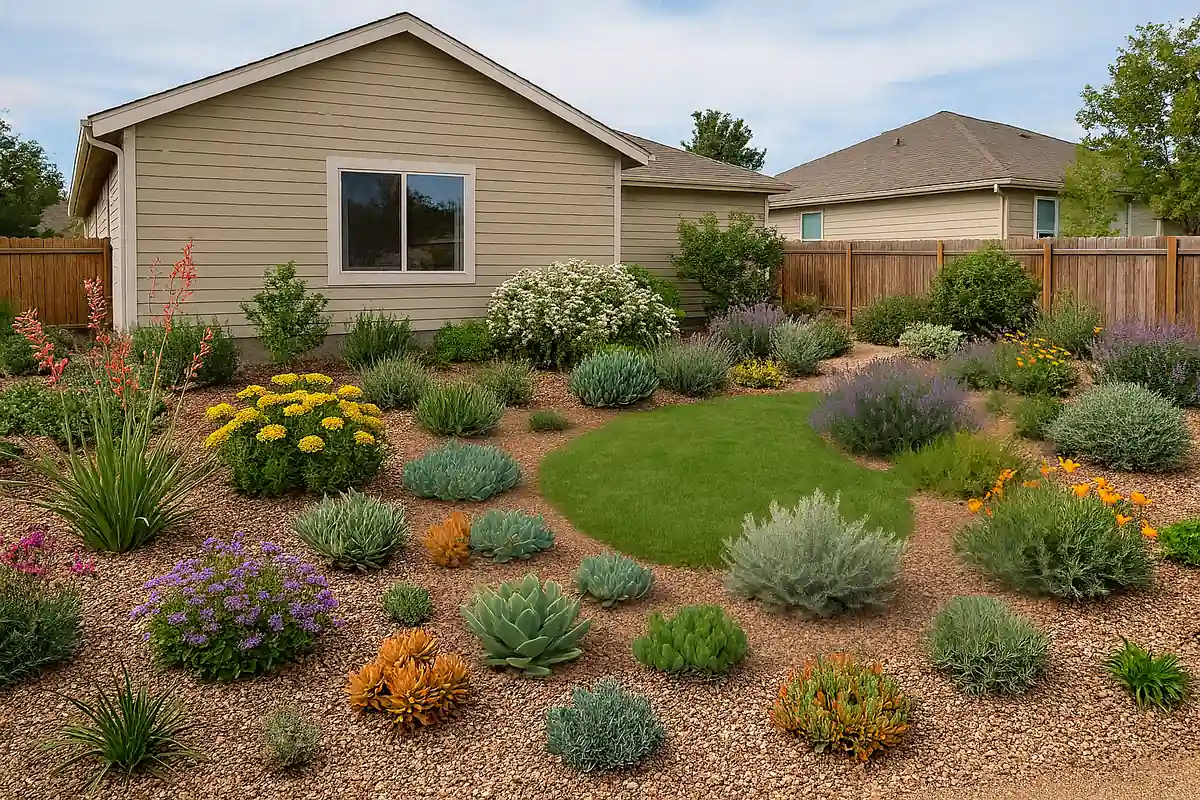
An outdoor succulent garden needs three things: full sun, soil that drains fast, and plants that are hardy in your USDA zone. Pick the sunniest, driest spot you have. Mix gravel or sand into the soil, or build the bed up above the ground around it. Plant in groups, spaced for each plant's full size. Finish with at least 2 inches of gravel mulch, then water only when the soil has dried out.
The steps below follow that order, from choosing the site to the first year of care, with plant picks that survive cold winters.
What you need
- Plants hardy in your zone, with a focal plant and enough of each smaller plant to group in 3s or 5s.
- Gravel or coarse sand to mix into the soil.
- Gravel mulch, enough to cover the bed at least 2 inches deep.
- A spade, a rake, a hand trowel and a hose.
- Thick gloves if you are planting prickly pear, agave or yucca.
- A few boulders, if the design calls for them.
Step 1: Pick a sunny, well-drained site
Most succulents for an outdoor bed want full sun, which NC State Extension defines as 6 or more hours of direct sun a day. Hens and chicks are the exception that likes a little help: NC State suggests some afternoon shade in extremely hot, sunny spots.
Drainage matters as much as sun. Almost every hardy succulent's NC State page carries the same warning about wet or poorly drained soil, from root rot in stonecrops and prickly pear to crown rot in hens and chicks. To test a spot, dig a hole about a shovel deep, fill it with water and watch it. If water is still standing long after the rest of the yard has dried, choose another spot or plan a raised bed.
Good sites include a south-facing slope, the strip along a sunny driveway, the top of a retaining wall, and any bed against a sunny wall where rain does not collect.
Step 2: Make the succulent bed soil
Succulent bed soil should drain quickly and stay lean. Cornell Cooperative Extension advises good drainage, with some gravel or sand added to the soil. NC State describes the same conditions for the plants themselves: hens and chicks thrive in sandy or gravelly soil, and Parry's agave needs well-drained sandy or rocky soil.
- Loosen the existing soil and work in gravel or coarse sand.
- On heavy clay, raise the bed. Clemson Cooperative Extension notes that raised beds help where drainage is poor.
- Shape low mounds for the plants that hate wet feet most, such as agave and prickly pear, so water runs off their crowns.
Step 3: Succulent garden design: lay it out before you plant
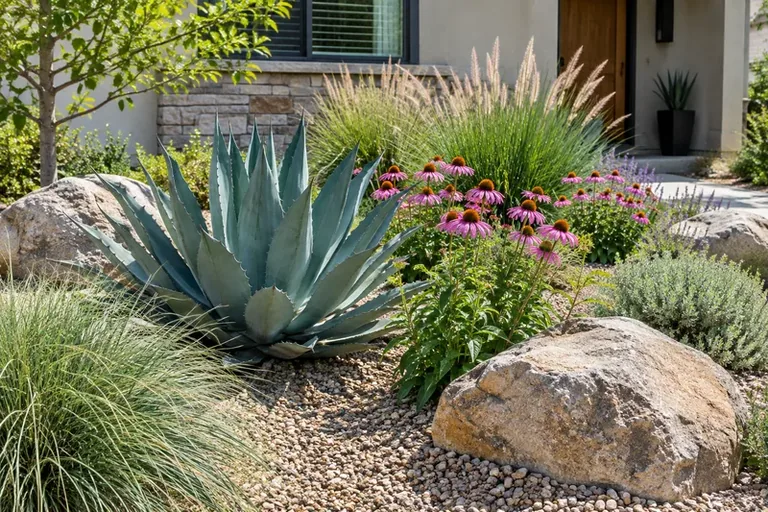
Set the plants out in their pots first and move them until the layout looks right. A few rules make a succulent garden design look planned:
- Start with a focal plant. One tall or bold plant, such as Adam's needle yucca or Parry's agave, gives the eye a place to land.
- Plant in groups of 3 or 5 of the same plant, not one of everything. Groups read as patches of color and texture.
- Mix shapes: spiky plants, rosettes, and low mats to fill between them.
- Add a few boulders. Rocks give the bed structure in winter and look natural with succulents.
- Leave room for the gravel to show between groups. Bare gravel is part of the look, not wasted space.
Succulents also mix well with other plants that like the same dry, sunny conditions, such as English lavender, which NC State says needs perfectly drained soil, and purple coneflower, which is drought tolerant once established. For more pairings, see Succulents and Natives for Low-Water Landscapes.
Step 4: Choose plants for your zone and space them
Choose plants by your USDA zone first, then space each one for its mature size. Sizes and zones below are from the NC State Extension Gardener Plant Toolbox.
| Plant | Role in the bed | USDA zones | Height | Spread |
|---|---|---|---|---|
| Adam's needle yucca | Focal plant | 4 to 10 | 3 to 8 feet | 3 to 5 feet |
| Parry's agave | Focal plant | 6 to 10 | 1 to 3 feet | 1 to 3 feet |
| Upright stonecrop | Middle clumps, fall flowers | 3 to 9 | 2 to 2.5 feet | 1.5 to 2 feet |
| Eastern prickly pear | Low clumps | 4 to 9 | 6 to 12 inches | 1 to 1.5 feet |
| Hens and chicks | Rosettes at the front | 3 to 8 | Rosettes 3 to 4 inches across | Spreads by offsets |
| Two-row stonecrop | Ground cover | 3 to 9 | 2 to 6 inches | 2 to 3 feet |
| 'Angelina' stonecrop | Ground cover | 5 to 9 | 4 to 6 inches | 1 to 2 feet |
| Cooper's hardy ice plant | Flowering ground cover | 6 to 10 | 3 to 6 inches | 1 to 2 feet |
Space plants about as far apart as their spread, so each one has room when grown. NC State gives exact spacing for hardy ice plant: 16 to 24 inches apart. For a cold-winter garden, see the full list in Cold-Hardy Succulents for Outdoor Gardens, and for low plants to fill the gaps, Succulent Ground Covers for Dry Yards.
Step 5: How to plant succulents outside
- Water the plants in their pots a day or so before planting, so the root ball holds together.
- Dig a hole as deep as the pot and a little wider.
- Set the plant at the same depth it grew in the pot. Keep the base of rosettes at or just above the soil surface.
- Fill around the roots with your gritty soil mix and firm it gently.
- Wear thick gloves for prickly pear and agave. NC State warns that prickly pear bristles get into skin, and Parry's agave has a sharp spine at each leaf tip.
- Water once to settle the soil.
Step 6: Mulch with gravel
A gravel mulch finishes the bed. Denver Water recommends rock or gravel mulch at least 2 inches deep, and says not to use black plastic, because it keeps air and water from reaching roots. Cornell also suggests mulching around succulents with small stones or pebbles.
Pull the gravel back slightly from the base of each plant so it does not pile against the stems. Choose a gravel color that suits the house or the hardscape nearby; the bed will show a lot of it.
Step 7: Water and care in the first year
- Let the soil dry between waterings. NC State gives this advice for hens and chicks and Parry's agave, and warns that overwatering causes rot.
- Water new plants regularly until they root in, then only in long dry spells.
- Do not water agaves in winter, as NC State advises.
- Feed lightly. Cornell suggests fertilizing only now and then during the growing season, with a slow-release fertilizer high in potassium.
- Pull weeds while they are small. Gravel makes this easier.
- Remove hens and chicks rosettes after they flower, since each one dies afterward.
- No winter covering is needed for hardy kinds, according to Cornell's Master Gardener.
Common mistakes to avoid
- Planting succulents that are not hardy in your zone. Check the zone on every tag before the plant goes in the ground.
- Skipping the drainage step. A bed on heavy clay without gravel, sand or a raised edge stays wet, and wet soil rots these plants.
- Laying black plastic under the gravel. Denver Water advises against it.
- Watering on a lawn schedule. Succulents need the soil to dry out between waterings.
- Crowding. A 2 to 3 foot mat of two-row stonecrop will cover a small rosette planted too close to it.
- Putting spiny plants by a path. Keep agave, yucca and prickly pear back from where people walk.
Common questions
Can you plant succulents directly in the ground?
Yes, if they are hardy in your zone and the soil drains fast. Tender succulents are better in pots that can come indoors for winter.
What goes under the gravel in a succulent bed?
Not black plastic, according to Denver Water. Put the gravel straight over the prepared soil, at least 2 inches deep.
How many plants do I need?
Divide the bed's length by each plant's spread to estimate how many fit in a row. Plants grouped in 3s and 5s, with gravel between groups, need fewer plants than a solid planting.
More guides on Yard and Soil
- Succulents: succulent landscaping ideas and care, with all of our succulent guides.
- Cold-Hardy Succulents for Outdoor Gardens: succulents by USDA zone for cold winters.
- Succulent Ground Covers for Dry Yards: low sedums and ice plants to cover bare ground.
- Succulents and Natives for Low-Water Landscapes: how to pair succulents with native plants.
Sources
- North Carolina State Extension, Extension Gardener Plant Toolbox: Sempervivum tectorum, Agave parryi, Yucca filamentosa, Opuntia humifusa, Hylotelephium telephium, Phedimus spurius, Phedimus kamtschaticus, Petrosedum rupestre 'Angelina', Delosperma cooperi, Lavandula angustifolia and Echinacea purpurea.
- Carol Sitarski, Cornell Cooperative Extension Allegany County, Growing Cold Hardy Succulents.
- Denver Water, Xeriscape Principles.
- Clemson Cooperative Extension Home and Garden Information Center, Spring-Flowering Bulbs (HGIC 1155), for the note on raised beds and poor drainage.