
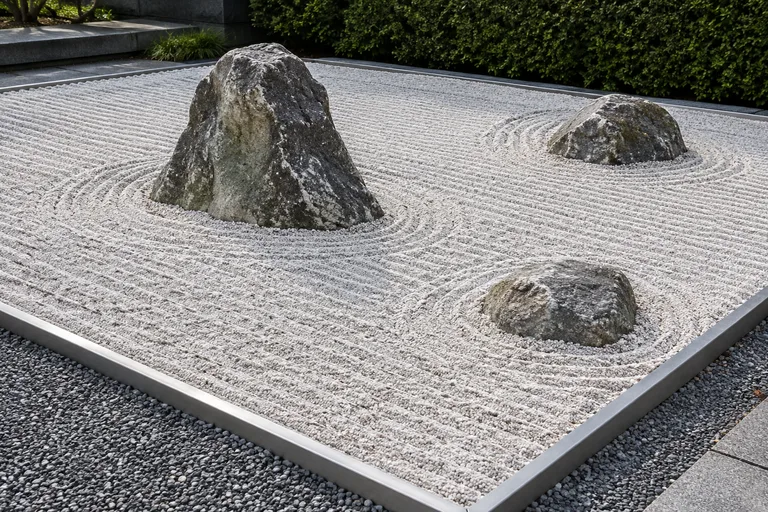
To make a dry rock garden, choose a level, well-drained spot, then clear and edge it. Set a few large rocks, each buried by at least a third. Spread gravel at least 2 inches deep and rake it into lines. The gravel stands in for water, and the rocks for islands or mountains. Plants are few or none. This step-by-step guide covers the Japanese raked gravel garden, how it differs from a planted rock garden, and how to keep it looking crisp.
What is a dry rock garden?
In Japan, a garden of raked sand or gravel and stone is called karesansui. Portland Japanese Garden explains that the word literally translates to "dry landscape." According to the same source:
- The style developed in Japan in the late Kamakura period (1185 to 1333).
- It is often part of a Zen monastery, such as the famous Ryoan-ji in Kyoto, and often attached to the abbot's quarters.
- It was made for contemplation, not for seated meditation, and caring for the garden was part of the monks' practice.
- It is often called a zen garden, but karesansui is the more accurate name.
Portland Japanese Garden also names a principle behind these gardens: yohaku-no-bi, "the beauty of blank space." The open gravel is as important as the stones.
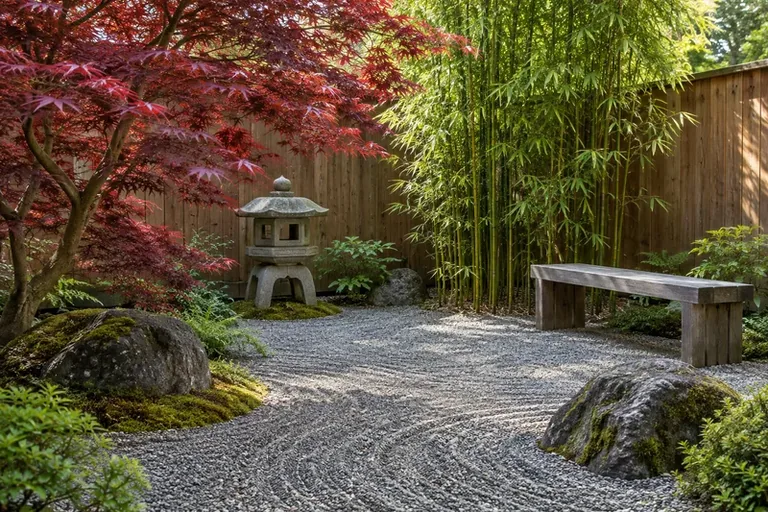
Dry rock garden or planted rock garden?
"Rock garden" also means something else in the US: a planted garden of small alpine or drought-tolerant plants among rocks. Both are dry, but they are built for different reasons.
| Japanese dry rock garden (karesansui) | Planted rock garden | |
|---|---|---|
| Main idea | Rocks and raked gravel suggest a landscape of islands and water | Rocks give small plants the dry, rocky home they like |
| Best site | Level ground, seen from one spot | A slope or raised area with good drainage |
| Plants | Few or none; moss or a clipped shrub | Many low, clumping plants |
| Ground | Raked gravel or sand | A mix of soil, sand and small rocks |
| Main upkeep | Raking, clearing leaves, weeding | Weeding, watering while plants establish |
Virginia Cooperative Extension describes the planted kind as a way to turn a small, hot, dry patch into a focal point. This guide focuses on the Japanese kind and notes where the two overlap.
What you need
- Rocks. Three to five larger stones of one type. Colorado State University Extension advises using rocks of one geological type and including some large ones; it notes some weigh 200 pounds or more.
- Gravel. Small, even-sized, pale gravel shows rake lines best.
- Edging. Stone, steel or timber, to hold the gravel in.
- Landscape fabric (optional). Denver Water says mulch can go straight on the soil or over landscape fabric. It advises against black plastic, because it stops air and water reaching roots.
- A rake. A wide-toothed wooden rake makes clean lines. A flat board or the back of a rake smooths the gravel first.
- Tools: a spade, a tamper or plate compactor, string or a hose for marking.
Rock garden design: placing the stones
Rock garden design comes down to a few stones, set well. Colorado State University Extension gives these rules for setting rocks:
- Bury at least one-third of each rock, so it looks rooted, not dropped.
- Follow the natural grain of the stone.
- Show off any lichen by turning that face outward.
Some simple design habits help too:
- Set the largest stone first, a little off-center, then place the others in relation to it.
- Group stones in twos and threes rather than spreading them evenly.
- Leave more open gravel than you think you need.
- Design from the main viewing spot. Portland Japanese Garden's Flat Garden is meant to be seen from one place, like a painting.
How to make a dry rock garden, step by step
- Pick the spot. Choose level ground you can see from a window, deck or bench. Good drainage matters: a Virginia Cooperative Extension article on rock gardens stresses avoiding standing water.
- Mark the shape with string or a hose. Simple shapes, such as a rectangle against a fence or a soft curve, work best.
- Clear the ground. Remove grass, weeds and roots, then level and firm the soil.
- Install the edging so its top sits at the finished gravel height.
- Set the rocks. Dig a hole for each, set it so at least one-third is buried, and pack soil around it.
- Lay landscape fabric if you want it, cutting it to fit around the rocks. Never use black plastic.
- Spread the gravel at least 2 inches deep, the minimum Denver Water gives for rock or gravel mulch. Smooth it flat.
- Rake the pattern (below).
Raking patterns for a raked gravel garden
In a dry garden, the gravel plays the part of water. Portland Japanese Garden describes its Flat Garden as having islands in a "sea of white gravel," where the raked gravel stands for the cool water of summer. Simple patterns work best:
- Straight lines across the whole area suggest calm water.
- Rings around each rock suggest ripples around an island.
- Long, gentle waves suggest moving water.
Smooth the gravel flat before each new pattern. Rake in one steady pass, walking backward so you do not step on finished lines. Re-rake after heavy rain, wind or leaf fall.
Adding plants
A Japanese dry garden needs few plants. Moss at the base of a rock in a shady spot, or one clipped evergreen shrub at the edge, is usually enough. Clemson Cooperative Extension notes that moss prefers shade, acidic soil and moisture, so it will not take in a sunny gravel garden.
A planted rock garden is the opposite. Virginia Cooperative Extension suggests starter plants such as phlox, bellflowers, columbine, dwarf geraniums, pasque flower (pulsatilla), creeping thyme, agaves, yuccas and hens and chicks. Colorado State University Extension prefers low, clumping, slow-spreading plants, with some repeated, and warns against overplanting.
For plants that suit a Japanese-style garden, see Plants for a Japanese Garden. For dry-climate choices, see Xeriscaping Basics.
A dry stream bed variation
A dry stream is a winding band of rounded stones that looks like a streambed in the dry season. It can also do real work. NC State Extension shows a home garden on a steep lot where rainwater had cut a ditch toward the house. The owners lined the ditch with several tons of rock and planted along it, which solved the erosion problem.
Care and upkeep
A dry rock garden needs no mowing and little water, but it is not care-free. Colorado State University Extension says rock gardens need a lot of care, and that weed control is the biggest challenge.
- Pull weeds while they are small, before roots spread under the gravel.
- Blow or rake out leaves often; they break down and feed weeds.
- Top up thin spots of gravel.
- Re-rake after storms.
- Keep the garden no bigger than you can easily look after, as Colorado State advises.
Questions about dry rock gardens
How deep should the gravel be?
At least 2 inches, the minimum Denver Water gives for rock or gravel mulch. Rake lines need enough depth to hold their shape.
Is landscape fabric needed?
It is optional. Denver Water says gravel can go straight on the soil or over landscape fabric, but never over black plastic.
Sand or gravel?
Karesansui gardens use raked sand or gravel. Outdoors at home, gravel is easier, because it stays in place better in wind and rain.
Is a dry rock garden low maintenance?
Lower than a lawn, but weeds, leaves and raking need regular attention.
More guides on Yard and Soil
- Japanese Zen Gardens: every element of the style explained.
- Small Zen Garden Ideas for a Backyard: ideas for corners and side yards.
- Plants for a Japanese Garden: sizes and zones for each plant.
- Xeriscaping Basics: low-water gardening principles.
Sources
- Portland Japanese Garden, Sand and Stone Garden and Flat Garden.
- Colorado State University Extension, Rock Garden Plants.
- Virginia Tech News, Rock gardens offer landscaping that can withstand drought and poor soil, Virginia Cooperative Extension expert says.
- Denver Water, Xeriscape Principles.
- Clemson Cooperative Extension, Home and Garden Information Center, Moss.
- NC State Extension Gardener Plant Toolbox, Dry Rock Stream Garden.