
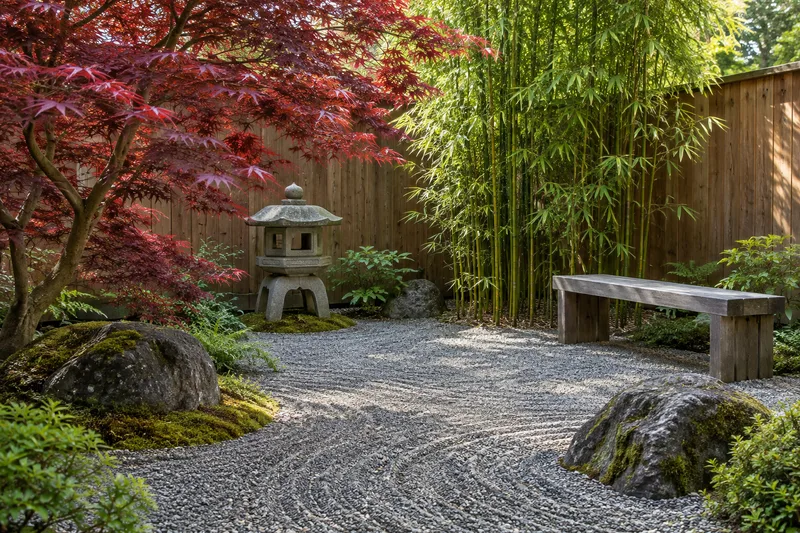
Small zen garden ideas work because a zen garden needs very little: a patch of raked gravel, two or three rocks, one plant and a place to sit. A fenced corner, a side yard or a small courtyard is enough. The 15 ideas below are sized for a small backyard, and each one can stand alone or join the others.
The photo above shows the idea at small scale: one corner of a fenced yard, with gravel, two mossy boulders, a lantern, a maple, bamboo and a bench.
Before you start: pick the spot and the view
- Where will you see it from? A small garden is often viewed more than walked. Plan it around a window, a back step or a bench.
- How much sun does it get? Moss and Japanese forest grass want shade. Gravel, rocks and pines suit sun.
- What is behind it? A plain fence or wall makes a calm backdrop. A busy view needs a screen.
15 small zen garden ideas
1. Turn one corner into a zen corner
The easiest backyard zen garden uses a corner where two fences meet. The fences frame the space, so you only need to finish the front edge. Zen corner ideas work especially well in the dead corner behind a garage or at the end of a narrow yard.
2. Rake a small gravel "sea"
Even a few square feet of raked gravel reads as a zen garden. Edge it firmly and spread it deep enough to rake: Denver Water advises rock or gravel mulch at least 2 inches deep. Rake straight lines, or rings around each rock.
3. Use three stones, not thirty
In a small space, a few larger rocks look calmer than many small ones. Colorado State University Extension advises using one type of rock and burying at least one-third of each, so it looks rooted.
4. Let moss replace a shady patch of lawn
If a shady corner grows moss better than grass, let it. Clemson Cooperative Extension notes that mosses tolerate more shade than grasses and prefer acidic, wet soil. It calls moss a low-maintenance ground cover that needs no mowing, as long as it gets little foot traffic.
5. Add a stone water basin
A low stone basin brings the sound of water without a pond. Portland Japanese Garden explains that tea gardens use a basin called a tsukubai, where guests rinse their hands and mouth. A small basin with a bamboo spout and a hidden pump fits in a corner.
6. Lay a short stepping stone path
Three to five flat stones are enough to lead the eye and the feet into a small garden. Portland Japanese Garden notes that tea gardens were the first kind of garden to use stepping stones, and favored naturally shaped ones.
7. Run a dry stream bed down the side yard
Narrow side yards suit a dry stream: a winding band of rounded stones with grasses along its edges. It can also handle runoff. NC State Extension shows a dry rock stream that solved an erosion problem on a steep lot. For the build, see How to Make a Dry Rock Garden.
8. Plant one focal tree
One small tree is enough. A Japanese maple is the classic choice. NC State Extension lists Japanese maple for zones 5 to 8, at 15 to 25 feet for the species, and 'Bloodgood' at 15 to 20 feet. In a tight corner, choose a dwarf or laceleaf type, or keep the tree in a large pot. Sizes for more trees are in Plants for a Japanese Garden.
9. Screen the view with bamboo fencing
A panel of bamboo or reed fencing hides a neighbor's window or a plain fence. It gives the bamboo look without the risk of live running bamboo spreading across a small yard.
10. Keep the plant list short
Small spaces need small plants, and few kinds of them. Two good fillers:
- Mondo grass: 6 to 12 inches tall, zones 6 to 10, prefers shade but tolerates sun (NC State Extension).
- Japanese forest grass: 1 to 1.5 feet tall, zones 5 to 9, for part to full shade (NC State Extension).
11. Add a single lantern
One stone lantern near the path or basin gives the garden a focal point. In a small space, two or more compete with each other.
12. Build in a bench or a small deck
A plain wooden bench or a low deck gives the garden its viewing spot. Portland Japanese Garden's Flat Garden is designed to be seen from one place, like a painting. A small backyard zen garden works the same way.
13. Make a courtyard garden
Japan has a long tradition of tiny gardens. Portland Japanese Garden says the tsubo-niwa, a courtyard garden, began in small spaces between temple and aristocratic buildings in the Heian period (794 to 1185). It describes its own as holding stone, water and plants in very little space. An enclosed patio can do the same.
14. Build a mini zen garden outdoors in a trough
For a balcony, patio or doorstep, a mini zen garden outdoor version fits in a wide, shallow trough. Fill it with gravel, set one stone and one small plant, and rake a pattern. Choose a trough with drainage holes, so rain does not pool.
15. Light it softly at night
A low light on the lantern, the tree or one rock makes the garden part of the evening view from the house. Keep it soft and aimed. See Landscape Lighting Design for planning.
How to put a small zen garden together
- Measure the space and mark the gravel area with string or a hose.
- Clear it of grass and weeds and level the ground.
- Set the rocks and stepping stones first.
- Install the edging, then any screen or bench.
- Plant the tree, then the low plants.
- Spread the gravel and rake the first pattern.
Keeping a small zen garden tidy
- Clear leaves from gravel often. In a small space, a few leaves show.
- Pull weeds while they are small.
- Re-rake after heavy rain.
- Trim plants lightly to keep their size and shape.
Questions about small zen gardens
How small can a zen garden be?
Very small. A tabletop tray is a zen garden. Outdoors, a single corner with gravel, a stone and a plant is enough.
Is a small zen garden low maintenance?
Mostly. There is no lawn to mow, but leaves, weeds and rain-flattened gravel need regular attention.
Can a small zen garden be in the shade?
Yes. Shade suits moss, ferns and Japanese forest grass. For more shade planting, see Shade Garden Ideas for Small Yards.
More guides on Yard and Soil
- Japanese Zen Gardens: every element of the style explained.
- How to Make a Dry Rock Garden: gravel, rocks and raking, step by step.
- Plants for a Japanese Garden: sizes and zones for trees, shrubs and ground covers.
- Shade Garden Ideas for Small Yards: planting ideas for shady corners.
- Low-Maintenance Backyard Garden Layouts: layouts that need little care.
Sources
- Portland Japanese Garden, Tea Garden, Flat Garden and Tsubo-Niwa.
- Denver Water, Xeriscape Principles.
- Colorado State University Extension, Rock Garden Plants.
- Clemson Cooperative Extension, Home and Garden Information Center, Moss.
- NC State Extension Gardener Plant Toolbox: Acer palmatum, Acer palmatum 'Bloodgood', Ophiopogon japonicus, Hakonechloa macra and Dry Rock Stream Garden.