
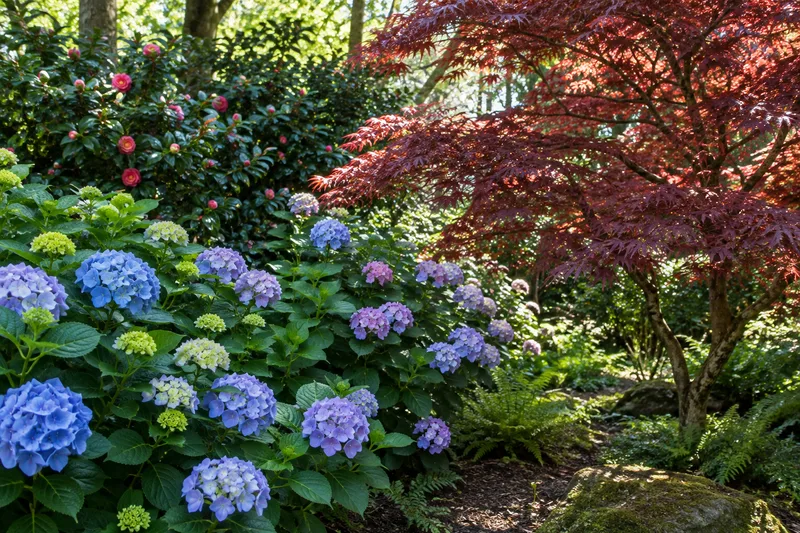
The core Japanese garden plants fall into three groups. A Japanese maple or flowering cherry gives seasonal color. Evergreens such as pine, hinoki cypress and Japanese holly give structure. A soft ground layer of moss, Japanese forest grass or mondo grass covers the soil. Most need well-drained soil, and many prefer part shade. The table below gives the size, USDA hardiness zones and light for each, so you can check what will grow in your yard.
How Japanese gardens use plants
Japanese gardens use fewer kinds of plants than most Western borders, and they rely on green more than flowers. Portland Japanese Garden's Flat Garden shows the approach. A laceleaf Japanese maple stands for autumn, a weeping cherry for spring and black pines for winter. Rounded azaleas suggest hills.
- Evergreens hold the shape of the garden all year.
- One or two deciduous trees mark the seasons with blossom or leaf color.
- Low plants and moss cover the ground and soften stone.
Not every plant grown in Japan suits the traditional style. A Japanese gardens site, Real Japanese Gardens, notes that lavender, rosemary and heuchera are popular in Japan but are not part of traditional Japanese gardens.
Japanese garden plants at a glance
Sizes and zones are from NC State Extension's Gardener Plant Toolbox. Moss is from Clemson Cooperative Extension. Sizes are typical mature sizes for the species; cultivars can be much smaller.
| Plant | Type | Height and width | USDA zones | Light |
|---|---|---|---|---|
| Japanese maple (Acer palmatum) | Deciduous small tree | 15 to 25 ft tall, 10 to 25 ft wide | 5 to 8 | Dappled sun or light shade |
| Japanese maple 'Bloodgood' | Deciduous small tree | 15 to 20 ft tall, 12 to 20 ft wide | 5 to 8 | Full sun in the North, part shade in the South |
| Japanese maple 'Germain's Gyration' | Deciduous, spreading mound | 6 to 8 ft tall, 8 to 12 ft wide | 5 to 8 (species) | As for the species |
| Japanese flowering cherry (Prunus serrulata) | Deciduous flowering tree | 15 to 25 ft tall and wide | 5 to 8 | Full sun to part shade; flowers best in sun |
| Japanese black pine (Pinus thunbergii) | Evergreen conifer | 20 to 60 ft tall, 12 to 20 ft wide | 5 to 8 | Full sun |
| Hinoki cypress (Chamaecyparis obtusa) | Evergreen conifer | 50 to 75 ft tall, 10 to 25 ft wide (species) | 4 to 8 | Full sun to part shade |
| Japanese holly (Ilex crenata) | Evergreen shrub | 5 to 10 ft tall, 5 to 8 ft wide; many cultivars 3 to 4 ft | 5 to 8 | Full sun to part shade |
| Japanese pieris (Pieris japonica) | Evergreen shrub | 8 to 10 ft tall, 6 to 8 ft wide | 4 to 8 | Full sun to part shade |
| Camellia (Camellia japonica) | Evergreen shrub | 10 to 13 ft tall, 5 to 10 ft wide | 7 to 9 | Part shade |
| Japanese forest grass (Hakonechloa macra) | Deciduous grass | 1 to 1.5 ft tall, 1 to 2 ft wide | 5 to 9 | Part to full shade |
| Mondo grass (Ophiopogon japonicus) | Evergreen ground cover | 6 to 12 in tall and wide | 6 to 10 | Prefers shade, tolerates sun |
| Moss | Ground cover | A low mat | Not given | Shade |
Japanese maple varieties
A Japanese maple is the plant most people picture in a Japanese garden. NC State Extension describes the species as a small tree, often multi-stemmed, for zones 5 to 8. It does best in dappled sunlight in soil high in organic matter, evenly moist and well drained. Its leaves can scorch with too much sun, wind or drought, so shelter it from drying winds.
Japanese maple varieties differ in size, leaf shape and color. A few named on NC State's page:
- 'Bloodgood': upright and rounded, with deep burgundy leaves in spring and summer that turn bright crimson in fall. 15 to 20 feet tall.
- 'Crimson Queen': a dwarf with lacy, finely cut purple leaves that turn bright scarlet in fall. A laceleaf type for small spaces.
- 'Sango-kaku': grown for its coral-colored twigs, which stand out in winter.
- 'Germain's Gyration': a spreading mound of twisting branches, 6 to 8 feet tall and 8 to 12 feet wide.
In a small garden, choose a dwarf or laceleaf type, and always check the mature size on the tag.
Evergreens for a Japanese garden
Evergreens for a Japanese garden give it a shape that holds through winter. Many are pruned into soft, rounded forms.
Japanese black pine
The classic pine of Japanese gardens. NC State Extension lists it for full sun and notes it tolerates salt, drought and heat. The species is large, so look for compact cultivars or plan to prune. NC State also notes pests such as pinewood nematodes and fungal problems such as Diplodia tip blight.
Hinoki cypress
The species grows 50 to 75 feet tall, but dwarf cultivars suit home gardens. NC State lists 'Chirimen' at 4 to 6 feet tall and 'Pygmaea Aurescens' at 3 to 5 feet. It needs good drainage and some protection from wind.
Japanese holly
A small-leaved evergreen shrub that takes hard pruning, so it suits clipped mounds, hedges and topiary. NC State lists 'Helleri' at 4 feet tall and 5 feet wide. It prefers acidic soil; in alkaline soil the leaves turn yellow.
Japanese pieris and camellia
Both are flowering evergreens for part shade and acidic, well-drained soil. Pieris carries fragrant white flowers in drooping clusters in spring. Camellia typically blooms from February through April, according to NC State, but it is only listed for zones 7 to 9.
Flowering trees and shrubs
Flowers in a Japanese garden come mostly from trees and shrubs, used one or two at a time:
- Japanese flowering cherry. Blooms typically late March to April. NC State names 'Kwanzan' (pink double flowers, upright and vase-shaped) and 'Mt Fuji' (white, semi-double).
- Azaleas. Often clipped into rounded mounds, as in Portland Japanese Garden's Flat Garden.
- Camellia. Late winter to early spring flowers on an evergreen shrub.
- Hydrangea. Real Japanese Gardens describes it as a popular ornamental in Japan, grown for its large flower heads.
Moss for gardens
Moss gives a Japanese garden its soft, settled look, but it grows only where it is happy. Clemson Cooperative Extension notes that mosses:
- tolerate more shade than grasses,
- prefer acidic soil,
- grow better than grass in wet soil, and
- spread by wind-blown spores, forming a mat on the soil surface.
Clemson also calls moss a low-maintenance ground cover that needs little watering, no fertilizer and no mowing, as long as it gets little foot traffic. The easiest way to get moss for gardens is to give it those conditions and let it come in. Where the ground is sunny or dry, use mondo grass or another low plant instead.
Grasses and ground covers
- Japanese forest grass: soft, arching clumps for shade in rich, moist, well-drained soil. NC State notes it grows best in cool-summer climates and may not tolerate hot summers in zones 8 to 9 in the South.
- Mondo grass: low, evergreen and grass-like. NC State lists it as a lawn substitute in shady areas and for walkways and borders. 'Nana' is a very short form.
- Sedum: Real Japanese Gardens lists it as a drought-tolerant evergreen ground cover for rock gardens, walls and hillsides.
- Japanese sweet flag (Acorus gramineus): the same site notes it prefers moist soil and suits pond edges.
Japanese garden plants for sun and for shade
| Sunny garden | Shady garden |
|---|---|
| Japanese black pine | Japanese maple (most types) |
| Japanese flowering cherry | Camellia |
| Hinoki cypress | Japanese forest grass |
| Japanese holly | Moss |
| Mondo grass (tolerates sun) | Mondo grass |
How to choose Japanese garden plants for your yard
- Find your zone. Look up your area on the USDA Plant Hardiness Zone Map, then check it against the zones in the table.
- Count the hours of sun. Maples, camellias, forest grass and moss want shade for part of the day. Pines and cherries want sun.
- Check the soil. Several of these plants need acidic soil. NC State gives a pH below 6.0 for pieris and about 5.5 to 6.5 for camellia, and notes that Japanese holly yellows in alkaline soil. A soil test through your county extension office tells you where you stand.
- Check drainage. Most of these plants need soil that drains well. Moss is the exception, since it does well in wet soil.
- Check the mature size of the exact cultivar, not just the species.
Plants to use with care
- Japanese pieris near children and pets. NC State Extension rates it as highly poisonous to people, cats, dogs and horses.
- Running bamboo in an open bed. It can spread well beyond where it was planted. Use a clumping type or a container.
- Camellia north of zone 7.
- Japanese forest grass in hot southern summers.
- Japanese holly in alkaline soil.
Questions about Japanese garden plants
What is the most important plant in a Japanese garden?
There is no single one, but evergreens do the most work, because they hold the garden's shape all year. A Japanese maple is the most common focal tree.
Can a Japanese garden grow in a cold climate?
Yes. Japanese maple, Japanese black pine, Japanese holly and Japanese forest grass are all listed for zone 5, and hinoki cypress and Japanese pieris for zone 4. Camellias are the main plant to skip.
Which Japanese garden plants stay small?
Dwarf and laceleaf Japanese maples, dwarf hinoki cypress cultivars, compact Japanese holly, Japanese forest grass and mondo grass.
More guides on Yard and Soil
- Japanese Zen Gardens: every element of the style explained.
- Japanese Garden Bed Ideas: how to put these plants together in a bed.
- Small Zen Garden Ideas for a Backyard: ideas for small spaces.
- Best Plants for Shade Gardens: more plants for shady spots.
- Trees for Landscaping: choosing trees for the yard.
Sources
- NC State Extension Gardener Plant Toolbox: Acer palmatum, Acer palmatum 'Bloodgood', Prunus serrulata, Pinus thunbergii, Chamaecyparis obtusa, Ilex crenata, Pieris japonica, Camellia japonica, Hakonechloa macra and Ophiopogon japonicus.
- Clemson Cooperative Extension, Home and Garden Information Center, Moss.
- Portland Japanese Garden, Flat Garden.
- Real Japanese Gardens, The most popular plants in Japanese private gardens.