
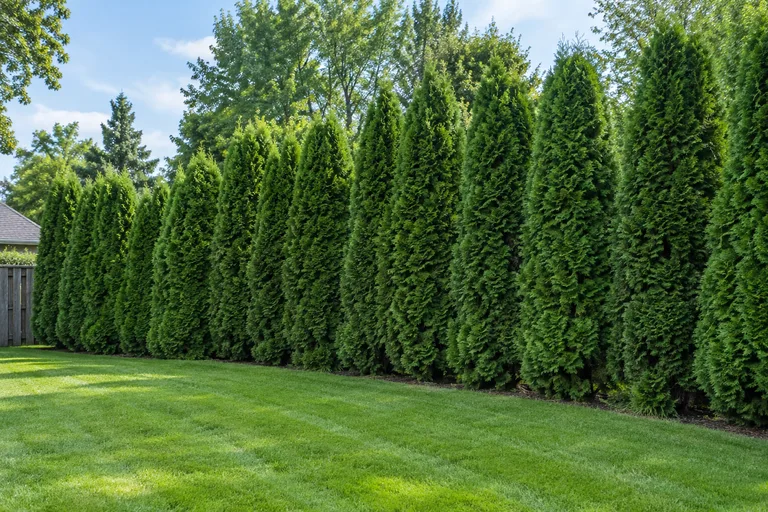
The best fast growing privacy trees are evergreens that keep their screen all year: Thuja 'Green Giant', Leyland cypress, Norway spruce, eastern white pine, Nellie R. Stevens holly and wax myrtle. NC State Extension rates all six as rapid growers. Choose the one that suits your zone and fits the width you have, because a fast tree can also outgrow a small yard.
This guide compares mature height, width, zones and growth rate for each tree. It then covers how to plan a screen, privacy trees for small yards, and the trade-offs that come with fast growth. For trees of every kind, see our Trees for Landscaping guide.
Fast growing privacy trees: size, zones and speed
All figures come from the NC State Extension Gardener Plant Toolbox. Growth rate is NC State's rating for the species.
| Tree | Height (feet) | Width (feet) | USDA zones | Growth rate | Good to know |
|---|---|---|---|---|---|
| Thuja 'Green Giant' | 40 to 60 | 12 to 18 | 5 to 8 | Rapid | Resists deer |
| Leyland cypress | 60 to 70 | 10 to 15 | 6 to 10 | Rapid | Shallow roots; poorly adapted to hot summers |
| Norway spruce (Picea abies) | 40 to 60 | 25 to 30 | 2 to 7 | Rapid | Prefers cool summers |
| Eastern white pine (Pinus strobus) | 50 to 80 | 20 to 40 | 3 to 8 | Rapid | Does not tolerate salt; can suffer wind damage |
| Nellie R. Stevens holly | 15 to 30 | 8 to 25 | 6 to 9 | Rapid | Dense, prickly leaves; red winter berries |
| Wax myrtle (Morella cerifera) | 20 to 25 | 8 to 10 | 7 to 11 | Rapid | Highly salt tolerant |
| Eastern red cedar (Juniperus virginiana) | 30 to 40 | 10 to 20 | 2 to 9 | Medium | Tough screen or windbreak |
| Japanese cedar (Cryptomeria japonica) | 50 to 70 | 20 to 30 | 5 to 9 | Medium | Suggested as a Leyland cypress alternative |
| Southern magnolia (Magnolia grandiflora) | 60 to 80 | 30 to 50 | 6 to 10 | Medium | Nothing grows beneath it; 'Little Gem' is smaller |
| American arborvitae (Thuja occidentalis) | 40 to 60 | 10 to 15 | 3 to 7 | Slow | Deer browsing can be serious |
The first six are the fastest. The last four grow more slowly but bring other strengths, such as cold hardiness, salt tolerance or a wider zone range.
Evergreen privacy trees or deciduous trees?
For a year-round screen, choose evergreens. Deciduous trees drop their leaves in fall, so the view opens up for several months each year.
Some fast deciduous trees also carry a risk near a house or fence. NC State says silver maple wood "is weak and breaks easily in storms and with snow loads." A deciduous tree still makes sense where summer screening is enough, such as around a pool or patio used only in warm months.
Trees for a privacy screen: how to plan one
A good screen starts with a tape measure. Check the height you need to block, the width of the planting strip and the distance to the house.
- Set the height. Decide what you need to hide: a neighbor's window, a second story or a road. A 60-foot tree is more than most fences need.
- Measure the width. Compare the width column above with the strip you have. Norway spruce spreads 25 to 30 feet; wax myrtle stays 8 to 10 feet wide.
- Space by mature width. University of Wisconsin Extension advises spacing shrubs by their mature spread so they "just barely touch" when grown. Use the same idea for a screen of trees. NC State says Thuja 'Green Giant' needs 12 to 24 feet of space.
- Keep trees off the house. The same Wisconsin guide advises planting trees 15 to 25 feet from the house.
- Look up and down. The Arbor Day Foundation advises placing trees to avoid power lines and buildings. Have buried utility lines marked before digging.
- Mix kinds if the screen is long. A row of one kind can be lost to a single pest or disease. Two or three kinds in a staggered row spread that risk.
Match the tree to the site
Zone is only the start. The conditions along a fence line or road narrow the choice further.
- Deer: NC State says Thuja 'Green Giant' resists deer, while deer browsing on American arborvitae can be a serious problem.
- Road salt and coast: wax myrtle is highly salt tolerant. Eastern white pine does not tolerate salt.
- Hot summers: Norway spruce performs poorly in southern zone 7, and Leyland cypress is poorly adapted to areas with hot summers.
- Winter wind: University of Wisconsin Extension notes that some evergreens will not tolerate the drying effect of winter winds. Check the tag for exposed sites.
- Shade beneath: NC State says nothing grows beneath a southern magnolia, so plan the bed under it as mulch or leaf litter.
Privacy trees for small yards
In a small yard, width matters more than speed. A tree that spreads 30 feet can swallow the whole space. These narrower choices fit tighter strips:
| Tree | Height (feet) | Width (feet) | USDA zones | Notes |
|---|---|---|---|---|
| 'Sky Pencil' holly (Ilex crenata) | 4 to 10 | 1 to 3 | 5 to 8 | Slow; columnar form for narrow spaces or containers |
| Wax myrtle | 20 to 25 | 8 to 10 | 7 to 11 | Rapid; salt tolerant |
| Eastern red cedar | 30 to 40 | 10 to 20 | 2 to 9 | Medium; tough |
| Leyland cypress | 60 to 70 | 10 to 15 | 6 to 10 | Narrow but very tall |
Arborvitae also comes in narrow forms. NC State describes the cultivar 'Emerald Green' as narrow and columnar, but it lists no exact size, so check the tag before you buy.
Where even a narrow tree is too big, a trellis, a screen panel or tall planters can do the job. See Small Garden Privacy Ideas for options that take up less ground.
Best privacy trees by zone
This table groups the trees above by the USDA zones their ranges cover. Zones are based on the lowest winter temperatures.
| Your zone | Privacy trees that fit |
|---|---|
| Zones 2 to 4 | Norway spruce, eastern red cedar; American arborvitae and eastern white pine from zone 3 |
| Zones 5 to 6 | All of the above, plus Thuja 'Green Giant', Japanese cedar and 'Sky Pencil' holly; Leyland cypress, Nellie R. Stevens holly and southern magnolia from zone 6 |
| Zone 7 | Every tree on this page |
| Zone 8 | Every tree except Norway spruce and American arborvitae (to zone 7) |
| Zones 9 to 10 | Leyland cypress, wax myrtle and southern magnolia; Nellie R. Stevens holly, Japanese cedar and eastern red cedar to zone 9 |
Your county extension office can say which of these do best locally. It can also tell you which plants are invasive in your state, so check before you buy.
Common questions
What is the fastest growing privacy tree?
NC State rates Thuja 'Green Giant', Leyland cypress, Norway spruce, eastern white pine, Nellie R. Stevens holly and wax myrtle as rapid growers. It does not rank one as the single fastest. Pick from these by zone and width.
How far apart should privacy trees be planted?
Space them by mature width, so the trees just touch when fully grown. That is the University of Wisconsin Extension rule for shrubs, and it works for trees in a row too.
Which privacy trees resist deer?
NC State says Thuja 'Green Giant' resists deer. American arborvitae is the opposite: deer browsing can be a serious problem.
Can I plant a privacy screen near the road?
Wax myrtle is highly salt tolerant, so it suits sites near roads that are salted in winter. Avoid eastern white pine there, as it does not tolerate salt.
More guides on Yard and Soil
- Trees for Landscaping: shade, privacy and ornamental trees with sizes and zones.
- Small Garden Privacy Ideas: screens and plants for tight spaces.
- Best Shade Trees for Yards: large and small shade trees by zone.
- Small Ornamental Trees for Front Yards: small flowering trees for beds near the house.
- Best Shrubs and Trees for Front Yards: evergreen shrubs and trees for year-round structure.
Sources
- NC State Extension, Extension Gardener Plant Toolbox: Thuja 'Green Giant', Leyland cypress, Norway spruce, eastern white pine, Nellie R. Stevens holly, wax myrtle, eastern red cedar, Japanese cedar, southern magnolia, American arborvitae, 'Sky Pencil' holly and silver maple.
- Dan Wilson, Thomas Wilson and Wayne Tlusty, University of Wisconsin Madison Division of Extension, Selecting Landscape Plants.
- Arbor Day Foundation, Planning, Selection, and Location.