
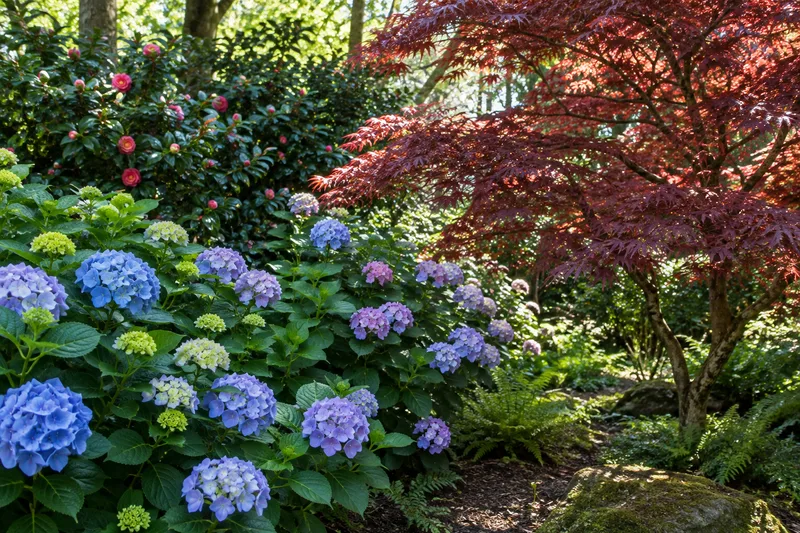
Small ornamental trees are trees grown mainly for their flowers, leaves, bark or fruit that stay about 30 feet tall or less. For a front yard, the classic choices are flowering dogwood, eastern redbud and serviceberry. Japanese maple, kousa dogwood, star magnolia, fringe tree and crape myrtle are close behind. Each fits a bed near the house and gives at least one season of show.
The right one depends on your zone, the space between the house and the walk, and when you want color. This guide gives the height, spread, zones and bloom time of 14 small trees, then covers placement near the house and the few to avoid. For larger trees, see our Trees for Landscaping guide.
Small ornamental trees: size, zones and season
All sizes, zones and bloom months come from the NC State Extension Gardener Plant Toolbox. Sizes are mature ranges; named varieties may be smaller.
| Tree | Height (feet) | Spread (feet) | USDA zones | Main show |
|---|---|---|---|---|
| Flowering dogwood (Cornus florida) | 15 to 25 | 15 to 30 | 5 to 9 | Flowers March to May; red fall color; red berries |
| Kousa dogwood (Cornus kousa) | 20 to 30 | 15 to 30 | 5 to 8 | Flowers about a month after flowering dogwood; red to pink fruit |
| Eastern redbud (Cercis canadensis) | 20 to 30 | 25 to 35 | 4 to 9 | Pink to purple flowers March to May, before the leaves |
| Serviceberry (Amelanchier arborea) | 15 to 25 | 10 to 15 | 4 to 9 | Flowers March to May; edible berries; fall color |
| Japanese maple (Acer palmatum) | 15 to 25 | 10 to 25 | 5 to 8 | Leaves; yellow to deep red in fall |
| Star magnolia (Magnolia stellata) | 15 to 20 | 10 to 15 | 4 to 8 | Fragrant flowers in late winter to early spring |
| Saucer magnolia (Magnolia x soulangeana) | 15 to 33 | 15 to 25 | 4 to 9 | Spring flowers before the leaves |
| Sweetbay magnolia (Magnolia virginiana) | 10 to 35 | 10 to 35 | 5 to 10 | Fragrant creamy-white flowers, spring into summer |
| Fringe tree (Chionanthus virginicus) | 12 to 30 | 12 to 20 | 3 to 9 | Fragrant flowers April to May |
| Japanese tree lilac (Syringa reticulata) | 25 to 30 | 15 to 20 | 3 to 7 | Flowers in June; peeling bark |
| Crape myrtle (Lagerstroemia indica) | 6 to 30 | 6 to 30 | 6 to 9 | Flowers July to September; peeling bark |
| Paperbark maple (Acer griseum) | 20 to 30 | 15 to 25 | 4 to 8 | Bark that peels in papery curls; orange and red fall color |
| American witch hazel (Hamamelis virginiana) | 15 to 30 | 15 to 20 | 3 to 9 | Fragrant flowers October to December |
| Green hawthorn 'Winter King' (Crataegus viridis) | 20 to 35 | 20 to 35 | 4 to 7 | Red fruit that lasts into winter |
Check spread as closely as height. Redbud, for example, often grows wider than it is tall, at 25 to 35 feet across.
Dogwood, redbud and serviceberry
Dogwood, redbud and serviceberry suit beds near a house. Each flowers in spring, stays modest in size and adds a second season of interest. Kousa dogwood is included here as a later-blooming dogwood.
Flowering dogwood
Flowering dogwood blooms from March to May, before the leaves open. In fall it turns red to reddish purple and carries red berries from August to October. It grows in full sun to partial shade, in zones 5 to 9. NC State lists spot anthracnose and powdery mildew as its more common diseases.
Kousa dogwood
Kousa dogwood is the later-blooming cousin. Its white to pink flowers open among the new leaves, about a month after flowering dogwood. NC State says it is more resistant to anthracnose and blight than native dogwoods. Its red to pink fruit ripens from late summer into fall.
Eastern redbud
Redbud covers its bare branches in pink to purple flowers from March to May. Flat brown seed pods follow and hang on into winter. It grows in full sun or partial shade, in zones 4 to 9. NC State notes its lifespan is typically under 75 years, so it is not a tree for the very long term.
Serviceberry
Serviceberry flowers from March to May. Its edible berries are eaten by songbirds, and fall color ranges from gold to orange or red. It is the narrowest of the three, at 10 to 15 feet wide, so it fits tight corners and side yards. Iowa State University Extension gives a height of 10 to 25 feet.
More small flowering trees and what each does best
Beyond the classic three, these small trees each answer a different need: shade tolerance, wet soil, cold winters or color outside spring.
Japanese maple
Japanese maple is grown for its leaves, which turn yellow to deep red in fall. It grows 15 to 25 feet tall in zones 5 to 8. NC State says afternoon shade helps prevent leaf scorch from sun, wind or drought. That makes it a good choice for an east-facing bed or under taller trees.
Star magnolia and saucer magnolia
Star magnolia opens fragrant flowers in late winter to early spring, before its leaves. It flowers best in full sun, grows 15 to 20 feet tall, and suits zones 4 to 8. Saucer magnolia is larger, at 15 to 33 feet, and blooms in spring before the leaves. Both risk frost damage to their early flowers.
Sweetbay magnolia
Sweetbay magnolia grows in moist to occasionally wet soil, so it can fill a damp low spot. Its fragrant, creamy-white flowers open from spring into summer. NC State says it is semi-evergreen to evergreen in the South and deciduous in colder climates. It grows in zones 5 to 10.
Fringe tree
Fringe tree flowers in April and May, with a delicate fragrance. It grows in zones 3 to 9, so it suits colder yards than dogwood. Female plants bear olive-like fruit from July to September, which is worth knowing for beds beside a walk.
Crape myrtle
Crape myrtle brings flowers in the heat of summer, from July to September, and its bark peels to show brown and gray. It needs full sun and grows in zones 6 to 9. Sizes run from dwarf shrubs to 30-foot trees, so read the tag for the mature height of each variety. NC State lists powdery mildew as a possible disease.
American witch hazel
Witch hazel flowers late in the year, from October to December. The flowers are fragrant and the leaves turn gold to yellow in fall. It grows in zones 3 to 9, in full sun or partial shade. Iowa State University Extension gives a height of 15 to 18 feet for common witch hazel.
Japanese tree lilac
Japanese tree lilac flowers in June, for about two weeks, after most spring trees are done. Its reddish brown bark peels and turns gray and scaly with age. It suits cold climates, zones 3 to 7, and wants full sun.
Paperbark maple and 'Winter King' hawthorn
These two are for winter interest. Paperbark maple's bark peels in papery curls that stay on the tree, and its leaves turn orange and red in fall. 'Winter King' green hawthorn holds red fruit into winter and is largely free of the thorns found on the species. NC State notes the hawthorn is susceptible to cedar hawthorn rust.
How to choose a small ornamental tree
Run through these points before you buy. They rule out most poor fits in a few minutes.
- Zone first. Fringe tree, witch hazel and Japanese tree lilac go down to zone 3; crape myrtle starts at zone 6.
- Spread second. Measure the bed. Serviceberry stays 10 to 15 feet wide; redbud reaches 25 to 35 feet.
- Light. Crape myrtle and Japanese tree lilac want full sun. Japanese maple prefers some afternoon shade.
- Soil. Sweetbay magnolia takes moist to occasionally wet soil. For the others, check the soil needs on the tag.
- Season. Choose the tree that flowers or colors when the rest of the yard is quiet.
- Litter and disease. Note fruit on female fringe trees, redbud pods, mildew on crape myrtle and rust on hawthorn.
Small flowering trees by season
With careful choices, a front yard can have a small tree in flower for much of the year. Bloom months below are from NC State.
- Late winter to early spring: star magnolia, then saucer magnolia.
- Spring: eastern redbud, flowering dogwood and serviceberry (March to May), then fringe tree (April to May).
- Early summer: kousa dogwood, Japanese tree lilac (June) and sweetbay magnolia.
- Summer: crape myrtle, from July to September.
- Fall: American witch hazel, from October to December.
- Winter: peeling bark on paperbark maple, Japanese tree lilac and crape myrtle; red fruit on 'Winter King' hawthorn.
Pair a spring bloomer with a summer or fall tree in the same yard. That spreads the color across the seasons.
Ornamental trees near the house
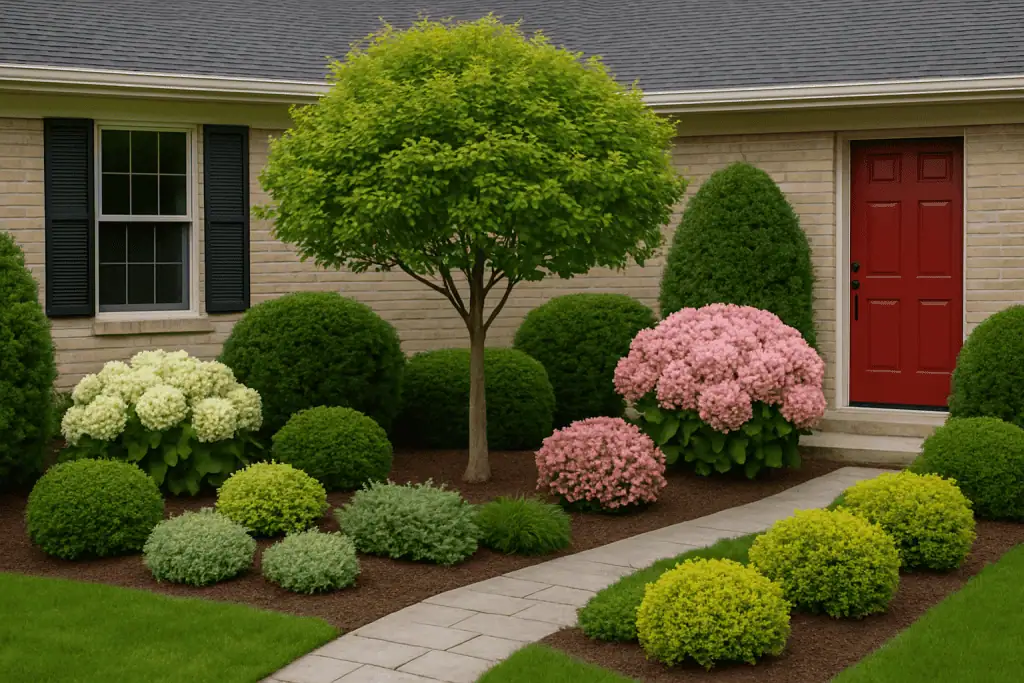
A small tree in a bed by the front door frames the entry and softens the walls. It still needs room, so plan for its full size.
- Mind the spread. Half the mature spread is roughly how far branches reach from the trunk. Plant at least that far from the wall. University of Wisconsin Extension uses the same idea for shrubs, placing them slightly more than half their spread from the foundation.
- Know the rule for larger trees. The same Wisconsin guide advises planting trees 15 to 25 feet from the house. Keep anything that reaches 30 feet or more toward the far end of the yard.
- Match the light. Japanese maple does better with afternoon shade, which helps prevent leaf scorch. Crape myrtle wants full sun.
- Watch the exposure. Iowa State University Extension says star magnolia flowers are often damaged by late frost. It advises avoiding southern exposures, which push early bloom, and suggests an eastern exposure instead.
- Think about paths. Green hawthorn has thorns up to 1.5 inches long, but 'Winter King' is largely spineless, so it is the better hawthorn near a walk.
- Look up. The Arbor Day Foundation advises placing trees to avoid power lines and buildings. Under wires, choose a tree whose full height stays well below them.
For shrubs to plant around a small tree, see Best Shrubs and Trees for Front Yards.
Small trees for very tight spaces
Some front beds have room for only a few feet of spread. Dwarf and narrow forms help:
- Dwarf Japanese maples. NC State names 'Crimson Queen' as a dwarf that suits small spaces.
- Dwarf crape myrtles. 'Pocomoke' grows about 1.6 feet tall and 'Baton Rouge' 2 to 3 feet, according to NC State. These act more like shrubs.
- Narrow evergreens. 'Sky Pencil' holly grows 4 to 10 feet tall and only 1 to 3 feet wide.
- Semi-dwarf southern magnolia. NC State calls 'Little Gem' semi-dwarf, but notes it can still reach 30 feet.
Small ornamental trees to think twice about
A few popular small trees come with problems worth knowing before you buy.
- Callery or Bradford pear. NC State says its weak branch crotches break with age, wind and ice, and its flowers smell foul. It is an invasive species in North Carolina, and NC State advises considering alternatives. Redbud and serviceberry give spring flowers without those problems.
- Crape myrtle cut back hard. NC State advises against severe pruning or topping. Choose a variety sized for the spot instead.
- Magnolias in frost pockets. NC State notes that star magnolia's early flowers are prone to frost damage, and late frosts can kill saucer magnolia flowers. NC State suggests late-flowering varieties to avoid frost damage.
Invasive status varies by state. Your local extension office can tell you which trees to avoid where you live.
Common questions
What is the smallest ornamental tree for a front yard?
Of the trees in the table, star magnolia is among the smallest. NC State gives 15 to 20 feet, while Iowa State gives 10 to 12 feet. Dwarf Japanese maples can be smaller still.
Which small tree flowers the longest?
Crape myrtle, which NC State lists as flowering from July to September. For a long show from a spring bloomer, pair it with a summer or fall tree.
Which small trees have the best fall color?
Flowering dogwood turns red to reddish purple, kousa dogwood reddish purple to scarlet, and paperbark maple orange and red. Serviceberry and Japanese maple also color well.
Are any of these trees native?
Iowa State University Extension lists serviceberry, redbud, fringetree, hawthorn and sweetbay magnolia among native small ornamental trees under 30 feet tall.
More guides on Yard and Soil
- Trees for Landscaping: shade, privacy and ornamental trees with sizes and zones.
- Best Shrubs and Trees for Front Yards: shrubs and trees together for front yard beds.
- Best Shade Trees for Yards: larger trees for shade, with a zone guide.
- Fast-Growing Privacy Trees: evergreen screens for year-round privacy.
- Front Yard Flower Beds: flowers to plant beneath and around a small tree.
Sources
- NC State Extension, Extension Gardener Plant Toolbox: flowering dogwood, kousa dogwood, eastern redbud, serviceberry, Japanese maple, star magnolia, saucer magnolia, sweetbay magnolia, fringe tree, Japanese tree lilac, crape myrtle, paperbark maple, American witch hazel, green hawthorn, 'Sky Pencil' holly, southern magnolia and Callery pear.
- Iowa State University Extension and Outreach, Yard and Garden: What are some good native small ornamental trees for my landscape? and Richard Jauron, Large Shrubs or Small Trees for the Home Landscape.
- Dan Wilson, Thomas Wilson and Wayne Tlusty, University of Wisconsin Madison Division of Extension, Selecting Landscape Plants.
- Arbor Day Foundation, Planning, Selection, and Location.