
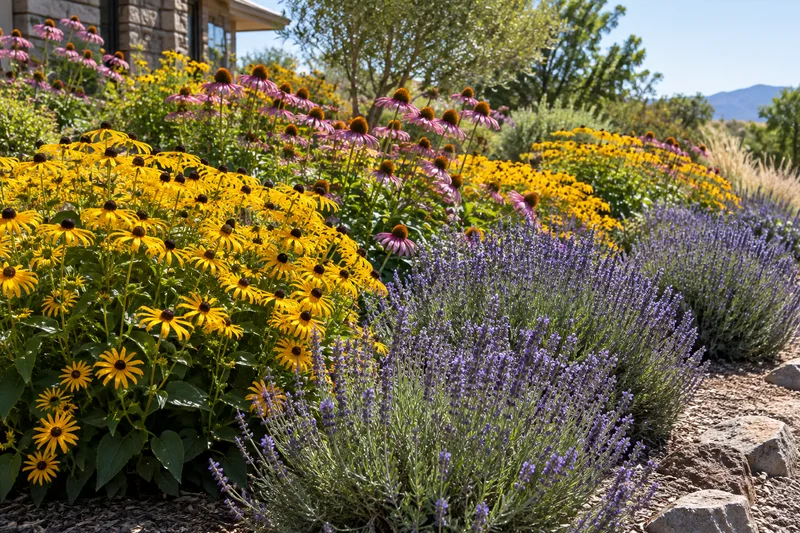
The flowers that bloom all summer with the least fuss are mostly annuals. In sun, the best are zinnia, annual vinca, angelonia, petunia, African marigold, cosmos and lantana. In shade, impatiens fill the gap. Annuals grow, flower and set seed in one season, so many keep blooming until frost. A few perennials, such as catmint and salvia, can also flower for months if you trim them at the right time.
This guide lists each plant with its light, height and bloom period, then shows how to plan a bed that has color from spring to fall. Light matters most. NC State Extension defines full sun as 6 or more hours of direct sun a day, and partial shade as 2 to 6 hours.
Flowers that bloom all summer at a glance
The heights and bloom periods below come from the North Carolina State Extension Gardener Plant Toolbox. Bloom times shift with climate and weather, so treat the months as a guide rather than a promise.
| Flower | Type | Light | Height | Bloom period |
|---|---|---|---|---|
| Zinnia | Annual | Full sun | 6 inches to 3 feet | Summer into fall |
| Annual vinca | Annual (perennial in zones 10 and 11) | Full sun to part shade | 6 inches to 1.5 feet | July to September, stopping at frost |
| Angelonia | Annual (perennial in zones 9 to 11) | Full sun | 1 to 1.5 feet | June into September |
| Petunia | Tender perennial grown as an annual | Full sun to part shade | 6 inches to 1.5 feet | Summer |
| African marigold | Annual | Full sun | 1 to 4 feet | Early summer to early fall |
| Cosmos | Annual | Full sun to part shade | 2 to 4 feet | All season |
| Lantana | Annual, or a shrub in zones 7 to 11 | Full sun | 1 to 6 feet | Midsummer until frost |
| Sunflower | Annual | Full sun | 1.5 to 10 feet | July to October |
| Impatiens | Annual (a perennial in the tropics) | Part shade to full shade | 6 inches to 2 feet | Late spring to early fall |
Annuals or perennials: which bloom longer?
Annuals usually win on bloom length. An annual has one season to flower and make seed, so it keeps producing flowers for as long as the weather allows. Removing faded flowers stops seed from forming, and many annuals answer with more buds. NC State Extension notes this for petunias: deadheading gives more flower buds.
Perennials come back every year, which saves replanting. The trade is that most perennials flower for a few weeks, not the whole summer. The best plan for most yards is a mix:
- Annuals for nonstop color along edges, in pots and in gaps.
- Perennials for structure and for color that returns each year.
- Spring bulbs underneath, for color before the annuals go in.
Long blooming annuals: summer flowers for sun
These are the workhorses of a summer bed. Give them sun and soil that drains, plant them once frost is past, and most will flower until cold weather stops them.
Zinnia
Zinnias come in heights from 6 inches to 3 feet, so there is one for the edge of a bed and one for the back. NC State Extension says they bloom continuously from summer to fall in cool-summer climates, but may slow down at the peak of summer. The Profusion series needs no deadheading, because new flowers grow above the old ones. Zinnias are prone to powdery mildew and leaf spots. Full sun, good drainage and room for air to move between plants help prevent both.
Annual vinca
Annual vinca, also called Madagascar periwinkle, is one of the best choices for hot, dry spots. NC State Extension says it blooms all summer from July through September, only stopping at frost. It keeps flowering even under heat stress and has moderate to high drought tolerance. Modern hybrids need no pinching or deadheading. The one thing it will not forgive is wet ground, so plant it in moist soil that drains well.
Angelonia
Angelonia is sometimes called summer snapdragon. Its upright spikes reach 1 to 1.5 feet and flower from June into September. NC State Extension lists it as heat and drought tolerant, with good tolerance for summer heat and humidity. Space plants 9 to 12 inches apart in the ground. In zones 9 to 11 it can live through winter.
Petunia
Petunias are tender perennials grown as annuals in most of the country. They grow 6 inches to 1.5 feet tall and spread 1 to 3 feet, which suits edging, pots and hanging baskets. They flower best with regular deadheading. When stems get long and bare, pinch them back to bring on new growth. Petunias take full sun or part shade.
African marigold
African marigolds are the tall marigolds, 1 to 4 feet, with big rounded flower heads from early summer to early fall. They like full sun and accept light afternoon shade, but they dislike full shade. Deadhead them promptly, because heavy spent heads can snap the stems. Tall types may need stakes or a spot out of the wind. Seed can be started indoors 6 to 8 weeks before the last frost date.
Cosmos
Cosmos is an easy, airy annual, 2 to 4 feet tall, that NC State Extension describes as blooming all season. It copes with poor soil, so it does not need a rich bed. Rake the seed lightly into loose soil, because seed planted too deep comes up poorly. Deadheading promotes more blooms. Cosmos also takes part shade.
Lantana
Lantana loves heat and flowers from midsummer until the first frost. In zones 7 to 11 it can live as a small shrub; farther north it is grown as an annual. NC State Extension notes that it grows quickly and aggressively, so give it room. It also calls lantana a weedy pest in some tropical regions, and it is toxic to livestock such as cattle, sheep, horses and goats. In a frost-free area, ask your state extension office before planting it.
Sunflower
Annual sunflowers range from 1.5 feet to 10 feet tall and bloom from July to October. Stems branch on their upper half, with a flower head at the end of each branch. Taller types may need a sheltered site and stakes. Put the tall ones at the back of the bed or along a fence, where they will not shade shorter flowers.
Summer flowers for shade
Most long-blooming flowers want sun, but a shady bed does not have to go without color. Impatiens perform best in part shade to full shade and bloom from late spring to early fall, according to NC State Extension. When plants look tired in midsummer, trim off the top third of each plant to bring on new flowers.
Common impatiens are susceptible to downy mildew. New Guinea impatiens (Impatiens hawkeri) are listed as resistant to it, so they are a safer choice where the disease has been a problem.
For spots that get 2 to 6 hours of sun, three plants from the sun list also cope:
- Petunia
- Annual vinca
- Cosmos
Expect fewer flowers than in full sun.
Perennials that flower for most of the summer
No perennial flowers as long as annual vinca or cosmos, but a handful come close, especially with a trim after the first flush. This is a short list. For a full guide with more plants, see Long-Blooming Perennials for Sun.
| Perennial | USDA zones | Light | Height | Bloom period | For more flowers |
|---|---|---|---|---|---|
| Catmint (Nepeta x faassenii) | 5 to 9 | Full sun to part shade | 1.5 to 2 feet | Spring into summer | Shear after flowering for repeat bloom |
| Salvia (Salvia nemorosa) | 4 to 8 | Full sun | 1.5 to 3 feet | June to September | Cut browned stems to the base leaves |
| Threadleaf coreopsis | 3 to 9 | Full sun to part shade | 2.5 to 3 feet | May to July | Avoid rich, wet soil, or stems flop |
| Purple coneflower | 3 to 8 | Full sun to part shade | 3 to 4 feet | June to August | Leave some seed heads for birds |
| Black-eyed Susan (Rudbeckia fulgida) | 3 to 9 | Full sun | 2 to 3 feet | August to October | Drought tolerant once established |
| Daylily | 3 to 9 | Full sun to part shade | 1 to 3 feet | Spring to frost, by cultivar | Choose a reblooming type |
Daylily bloom time depends on the cultivar. NC State Extension describes the group as flowering from spring through summer to frost, so one plant will not cover all of that. Check the tag. Deer often damage daylilies, so plan for that if deer visit your yard.
Purple coneflower's main bloom runs from June to August, though NC State also describes flowering from early summer through mid-fall. Native bees nest in its hollow stems, so cut dead stems back to 12 to 24 inches and leave them standing.
Flowers that bloom from spring to fall: plan a relay
No single plant flowers from the last frost of spring to the first frost of fall. The way to get flowers that bloom from spring to fall is a relay: plants that hand off to each other, with a few long-season annuals running through the whole bed.
| When | What can be in flower (from the lists above) |
|---|---|
| Late spring | Catmint, threadleaf coreopsis (from May), impatiens in shade |
| June | Salvia, purple coneflower, angelonia, African marigold, zinnia |
| July | Annual vinca, lantana, sunflowers, plus the June plants |
| August | Black-eyed Susan, cosmos, zinnia, vinca, angelonia |
| September to frost | Black-eyed Susan into October, lantana and vinca until frost, sunflowers into October |
To build the relay in a real bed:
- Pick one or two long-season annuals, such as vinca or zinnia, and repeat them along the whole bed. They carry the color while the perennials take turns.
- Add perennials in groups, so each month has at least one in flower.
- Plant spring bulbs under and between them in fall, for color in spring before the annuals go in. See Spring Bulbs to Plant in Fall.
- Walk the bed once a month next summer and note any gap. Fill it with annuals the following year.
Putting a summer bed together
Height decides where each plant goes. Use the heights in the tables above, and set each plant where it will not hide its neighbors:
- Back of the bed or along a fence: sunflowers, tall African marigolds and cosmos.
- Middle: taller zinnias, angelonia, salvia, purple coneflower and black-eyed Susan.
- Front edge: short zinnias, petunias, annual vinca and catmint.
Plant in groups rather than one of each. A group of five or seven of one plant reads as a single patch of color from a distance, while single plants dotted around look busy. Repeat the same plant at intervals along a long bed, so the eye follows it from one end to the other.
Keep the colors simple at first. Two or three colors that work together look calmer than one of everything. For ideas on pairing colors, see Color Schemes for Cottage Gardens.
Pots extend the show to a patio or a front step. Petunias, vinca and angelonia stay compact enough for containers, and a pot can be moved into sun as the light changes through the season.
How to keep summer flowers blooming
Plants that bloom all summer still need a little help in August. These habits make the biggest difference:
- Deadhead. Pinch or cut off faded flowers on petunias, cosmos and marigolds. It stops seed forming and brings on new buds.
- Choose self-cleaning types. Profusion zinnias and modern vinca hybrids need no deadheading at all.
- Cut back tired plants. Shear catmint after its first flush, cut spent salvia stems to the base leaves, and trim leggy impatiens by a third.
- Water deeply and less often. Denver Water advises deep, infrequent watering to grow deep roots, which carry plants through hot spells.
- Keep the drainage good. Vinca, angelonia and lantana all want soil that dries between waterings.
- Give plants air. Spacing and sun help zinnias avoid powdery mildew.
- Stake the tall ones. Tall marigolds and sunflowers can snap in wind or under heavy flower heads.
When to plant summer flowers
Most summer annuals are tender, which means frost kills them. Set plants out after your area's last spring frost date; your county extension office can tell you the usual date. Some, like marigolds, can be started indoors from seed 6 to 8 weeks before that date. Cosmos is easy to sow straight into the bed once the soil is workable and frost is past.
Container plants bought in bloom can go in as soon as frost danger is over. Water them in well and keep the soil evenly moist while their roots grow out into the bed.
Common questions
Which flower blooms the longest in summer?
Of the plants in this guide, cosmos is described as blooming all season, and annual vinca and lantana keep flowering until frost. Among perennials, salvia's listed bloom runs from June to September.
Do petunias bloom all summer?
They can. Deadhead them and pinch back long, bare stems, and they keep making new buds through the summer.
What can I plant for summer color in shade?
Impatiens are the main choice for part to full shade. New Guinea impatiens resist downy mildew. In part shade, petunias, vinca and cosmos also flower.
Which summer flowers handle heat and dry spells?
Annual vinca, angelonia and lantana are all listed as heat tolerant, and vinca and angelonia as drought tolerant. New plants still need regular water until their roots settle in.
More guides on Yard and Soil
- Flowering Plants: a plant list by bloom season, with light and care for each.
- Long-Blooming Perennials for Sun: perennials that flower for the longest stretch.
- Spring Bulbs to Plant in Fall: tulips, daffodils and smaller bulbs for spring color.
- Seasonal Flowers for Front Yards: flower ideas for each season by the front door.
Sources
- North Carolina State Extension, Extension Gardener Plant Toolbox: Zinnia elegans, Catharanthus roseus, Angelonia angustifolia, Petunia x hybrida, Tagetes erecta, Cosmos bipinnatus, Lantana camara, Helianthus annuus and Impatiens walleriana.
- North Carolina State Extension, Extension Gardener Plant Toolbox: Nepeta x faassenii, Salvia nemorosa, Coreopsis verticillata, Echinacea purpurea, Rudbeckia fulgida and Hemerocallis.
- Denver Water, Xeriscape Principles.