
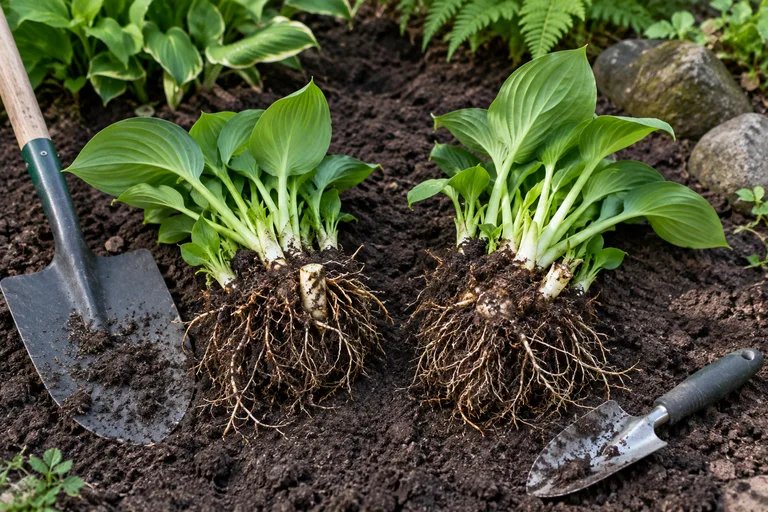
To divide perennials, dig up the clump, split it into pieces that each have healthy roots and several shoots, and replant the pieces at the same depth right away. Most perennials need dividing every three to five years. As a rule, divide spring and summer bloomers in fall, and fall bloomers in spring.
Below you will find the signs that a plant is ready, the best timing and a step-by-step method. Then come notes for dividing hostas, daylilies, iris and peonies, and the perennials you should leave alone.
Why divide perennials?
Many perennials spread outward each year. After a few seasons the clump gets crowded, and the plants compete for water and nutrients. Dividing restarts the plant and gives you extra plants for free.
Clemson Cooperative Extension and the University of Minnesota Extension list these signs that a clump needs dividing:
- Flowers smaller than normal, or fewer of them.
- A hollow or dead center, with growth only around the edge.
- Smaller leaves and a weaker plant overall.
- Stems that flop and now need staking.
When to divide perennials
Divide spring and summer bloomers in fall, and fall bloomers in spring. That way the plant is not flowering when you divide it, and it can put its energy into new roots and leaves.
- Spring: Clemson suggests dividing in early spring, as soon as the growing tips have come up. Spring divisions have the whole season to recover before winter.
- Fall: the University of Minnesota Extension says to divide four to six weeks before the ground freezes, so the roots can settle in. This matters most in cold, northern climates.
- The day itself: choose a cool, cloudy day, ideally with light rain in the forecast. Clemson advises never dividing on hot, sunny days.
Some plants follow their own schedule. The table shows timing for common perennials.
| Perennial | Best time to divide | How often | Source |
|---|---|---|---|
| Hosta | Spring, before the leaves get large | When crowded | UMN |
| Daylily ('Stella de Oro') | Spring is best in St. Louis | Every 3 to 4 years | MBG |
| Bearded iris | About a month after flowering, until early fall | Every 3 to 4 years when crowded | Clemson, MBG |
| Siberian iris | Fall | When crowded | UMN |
| Garden peony | Fall | Rarely; can stay in place for years | UMN, MBG |
| Asters and chrysanthemums | Spring (fall bloomers) | Every 1 to 2 years | Clemson |
| Shasta daisy | Spring or fall, not in flower | Every 2 to 3 years | MBG |
| Purple coneflower | Spring or fall, not in flower | About every 4 years, when crowded | MBG |
| Bee balm | Spring or fall, not in flower | Every 3 to 4 years, to control spread | MBG |
| Catmint, Japanese painted fern | Spring or fall | Every year if needed | UMN |
How to divide perennials, step by step
This method follows Clemson Cooperative Extension and the University of Minnesota Extension.
- Water first. Water the plant well a day or two before you dig, and prepare the new planting holes.
- Cut back the top. Trim stems and leaves to about 6 inches above the ground. This makes the clump easier to handle.
- Dig around the clump. Push a spade in on all four sides, about 4 to 6 inches out from the plant, then pry the clump up.
- Clear the roots. Shake or hose off loose soil so you can see the crowns and roots. Remove dead leaves and stems.
- Split the clump. Pull, cut or pry it apart, depending on the root type (see below). Each division should have three to five strong shoots and a good supply of roots. Throw away the weak, woody center.
- Trim and replant. Cut off broken roots with clean pruners. Replant at the same depth the plant grew before, and firm the soil to remove air pockets.
- Water well. Soak each division after planting. Keep divisions shaded and moist if you cannot replant them right away.
Spreading, clumping and tough roots
Clemson sorts perennials by how their roots grow, and each type splits a different way:
- Spreading roots: pull the clump apart by hand, or cut it with shears or a knife, into pieces of three to five shoots.
- Clumping roots: cut through the crown with a heavy, sharp knife, or push two garden forks into the center back to back and pry them apart. Keep at least one growing bud, or eye, on each piece.
- Large, tough roots: use a sharp spade or saw. Clemson notes that dropping a clump to break it suits some plants, but not brittle roots such as peonies.
Dividing hostas
Hostas are among the easiest perennials to divide. The University of Minnesota Extension suggests dividing them in spring, before the leaves get too large. Their roots are dense, so you may need a sharp knife, a garden fork or even an axe. Clemson recommends dividing hostas into clumps with one to three eyes each. An eye is a growing bud at the crown, where next year's leaves come from.
Dividing daylilies
Daylilies have fleshy roots, and the University of Minnesota Extension recommends cutting them apart with a sharp knife. Clemson notes that divisions with three or more shoots bloom sooner. The Missouri Botanical Garden suggests dividing 'Stella de Oro' clumps every 3 to 4 years, with spring best in St. Louis. Replant each piece at the same depth it grew before.
Dividing iris and peonies
Bearded iris: divide from about a month after flowering until early fall. Clemson advises cutting away and discarding rhizome sections that are a year old or older, and replanting so the top of the rhizome just shows.
Peonies: peonies rarely need dividing, and the Missouri Botanical Garden notes they can be left undisturbed for years. If you do divide them, do it in fall. Give each piece three to five eyes. Plant the eyes shallow: Clemson says no deeper than 1 inch, and the University of Minnesota Extension gives 1 1/2 inches. Divisions may take a few years to bloom.
Perennials you should not divide
Some perennials dislike being disturbed or have a single woody base or deep taproot. Clemson Cooperative Extension lists these as plants that resent division:
- Butterfly weed
- Euphorbias
- Oriental poppies (if needed, the University of Minnesota Extension advises fall)
- Baby's breath
- Gas plant
- Japanese anemones
- False indigo (Baptisia)
- Columbines
Lenten roses are hard to move once they are more than a few years old, though seedlings around the base move easily. Lavender, rosemary and similar plants are small woody shrubs and should not be divided at all. Clemson suggests cutting off rooted side branches and replanting those instead.
Aftercare for new divisions
- Keep new divisions from drying out while new roots grow. Water whenever the soil is dry.
- Shade small divisions from hot afternoon sun if a heat wave arrives.
- In colder areas, give fall divisions a loose winter mulch such as pine straw or leaves for their first winter, as Clemson advises.
- Be patient with peonies. The University of Minnesota Extension notes divisions can take a few years to bloom.
Common questions
Can you divide perennials in summer?
It is best avoided. Heat and sun dry out new divisions fast. Bearded iris is the main exception, since it is divided after it flowers.
How often should perennials be divided?
Most every three to five years, according to Clemson. Fast growers such as asters and chrysanthemums may need it every one or two years.
Which perennials are easiest to divide?
Hostas, daylilies and coral bells are among the easiest. The University of Minnesota Extension notes that coral bells form offsets at the soil surface that come apart easily.
Use your new divisions to fill gaps with long-blooming perennials for sun or flowering perennials for shade. For more planning help, see our perennial garden ideas.
Sources
- Clemson Cooperative Extension, Home and Garden Information Center, Dividing Perennials.
- University of Minnesota Extension, Dividing perennials.
- Missouri Botanical Garden, Plant Finder (division intervals for daylily, bearded iris, Shasta daisy, coneflower and bee balm; peony care).