
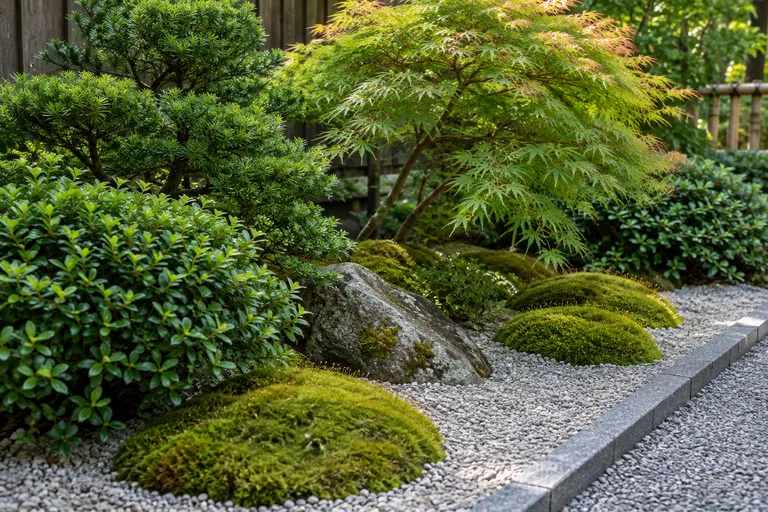
The best Japanese garden bed ideas use few plants, mostly evergreen, set in three layers. Gravel or fine mulch covers the ground, with one or two partly buried rocks and a clean edge. Leaf shape and texture do more work than flower color. This guide shows how to lay out a Japanese garden bed, which plants suit sun and shade, how to mulch and edge it, and how to adapt the idea to a flower bed or a raised bed.
For the wider style, from raked gravel to water and stepping stones, see the Japanese Zen Gardens guide.
What makes a garden bed look Japanese?
A bed reads as Japanese because of how it is planted more than what is in it. A few habits make the difference:
- Restraint. Three to five kinds of plants, repeated, instead of a dozen single plants.
- Green first. Evergreens and foliage carry the bed all year. Flowers are brief seasonal accents.
- Texture contrast. Fine needles next to broad leaves, soft grass next to clipped mounds, moss next to stone.
- Visible ground. Gravel or moss shows between plants. Portland Japanese Garden calls this idea yohaku-no-bi, "the beauty of blank space."
- Stone. One or two rocks, partly buried, give the bed a fixed point.
Lay out a Japanese garden bed in three layers
Most Japanese garden beds can be built from three layers. The table gives each layer a role and a few plant choices, with hardiness zones from NC State Extension. Check your own zone before buying.
| Layer | Role in the bed | Plant ideas (USDA zones) |
|---|---|---|
| Back: one focal plant | Height, seasonal color, the eye's first stop | Japanese maple (5 to 8), Japanese flowering cherry (5 to 8) for a larger bed, a dwarf hinoki cypress (species 4 to 8) |
| Middle: evergreen structure | Year-round shape, often clipped into soft mounds | Japanese holly (5 to 8), Japanese pieris (4 to 8), camellia (7 to 9) |
| Front: soft cover | Fills the ground, softens rock and edge | Japanese forest grass (5 to 9), mondo grass (6 to 10), moss in damp shade |
Sizes vary a great deal. NC State Extension lists the species hinoki cypress at 50 to 75 feet tall, while a cultivar such as 'Chirimen' reaches 4 to 6 feet. Always check the plant tag for the cultivar's mature size. Full sizes for each plant are in Plants for a Japanese Garden.
Japanese garden bed ideas for sun and shade
Pick the idea that matches the light your bed gets. Each one uses the three layers above.
1. A shade bed under a Japanese maple
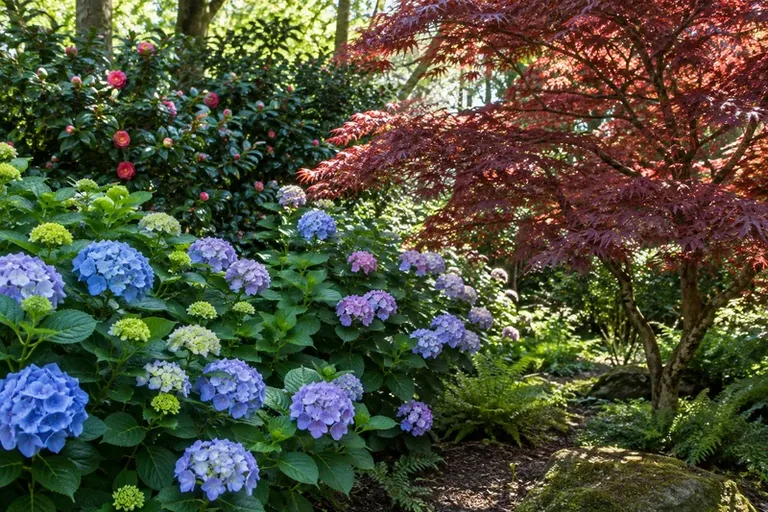
A Japanese maple suits dappled light. NC State Extension says its leaves can scorch with too much sun, wind or drought, and it likes evenly moist soil high in organic matter. Under it, plant Japanese forest grass, ferns and moss. NC State Extension lists Japanese forest grass for part to full shade and rich, moist, well-drained soil.
Hydrangeas and camellias add flowers to a shady bed. A Japanese gardens site notes that hydrangeas are a popular ornamental in Japan.
2. A sunny gravel bed with pine and stone
For full sun, build the bed around a pine. NC State Extension lists Japanese black pine for full sun and notes it tolerates salt, drought and heat. The species grows 20 to 60 feet tall, so a small bed needs a dwarf cultivar or regular pruning. Add two rocks, a mounded Japanese holly and a gravel mulch. Mondo grass, which NC State lists as sun tolerant, can edge the front.
3. A Japanese flower bed with seasonal accents
A Japanese flower bed is still mostly green. Let one or two flowering shrubs mark the season:
- Late winter to spring: camellia, which NC State lists as blooming typically February through April.
- Spring: Japanese pieris, with fragrant white flowers in drooping clusters. Note that NC State rates it as highly poisonous to people and pets.
- Spring, in a larger bed: a Japanese flowering cherry, which typically blooms late March to April.
- Autumn: the fall leaf color of a Japanese maple.
Plant the flowering shrub off-center, and keep the rest of the bed calm green around it.
4. A foundation bed in front of the house
A Japanese look suits a front foundation bed. Use clipped Japanese holly as the middle layer. NC State Extension notes it can be pruned hard to control size and suits hedges and topiary. It also says alkaline soil turns the leaves yellow. Add one small maple at a corner of the house, a gravel mulch and a stone edge. For more front bed layouts, see Front Yard Flower Beds.
5. A Japanese raised garden bed
A Japanese raised garden bed works well where the ground is heavy clay or wet. Japanese maple, camellia and pieris all need well-drained soil, according to NC State Extension, and a raised bed lets you fill it with a better mix. Keep the walls simple: dark-stained timber, natural stone or a low stone wall. Plant one small tree or dwarf conifer, a mound of evergreen and a skirt of forest grass. For building and filling raised beds, see Raised Bed Gardening.
6. A bed with a dry stream running through it
Run a winding band of rounded stones through the bed, as if a stream had dried up. Plant grasses and ferns along its banks. A dry stream can also carry runoff. NC State Extension shows a garden where a dry rock stream solved an erosion problem on a steep lot. For how to set stones and gravel, see How to Make a Dry Rock Garden.
7. A bed along a stepping stone path
Line a path of flat stepping stones with low plants on both sides. Mondo grass and moss can fill the gaps between stones. Taller plants go further back, so the path stays open.
A sample plan for a small part-shade bed
Here is one way to put the layers together in a bed about the size of a small border, in part shade, in zones 5 to 8. Adjust the numbers to your space, and space each plant for its mature width on the tag.
- Back corner: one Japanese maple, set off-center rather than in the middle.
- Beside it: one large rock, buried by a third, with a second smaller rock nearby.
- Middle: three dwarf Japanese holly, clipped into low mounds, in a loose triangle.
- Front: a drift of Japanese forest grass, all one kind, curving along the edge.
- Ground: fine bark mulch, with moss left to grow wherever it appears.
The odd groups, the off-center tree and the single kind of grass keep the bed calm. In a sunny bed, swap the maple for a dwarf pine and the forest grass for mondo grass.
Japanese garden beds through the year
A well-planned bed changes with the seasons without looking empty:
- Winter: evergreen mounds, rocks and gravel hold the shape. Camellias may flower in late winter.
- Spring: cherry or pieris flowers and the fresh leaves of the maple.
- Summer: calm green, with the soft movement of grasses.
- Autumn: maple color. NC State Extension notes that 'Bloodgood' turns crimson to reddish-orange in fall.
Mulch: gravel or fine bark
Bare soil looks unfinished in a Japanese garden bed. Cover it with one of these:
| Mulch | Depth (Denver Water) | Best for |
|---|---|---|
| Gravel or small stone | At least 2 inches | Sunny beds, beds around rocks, a clean dry-garden look |
| Fine bark or wood chips | At least 4 inches | Shade beds, maples and acid-loving shrubs |
| Moss | Not a mulch; grows on its own | Damp, shady beds with little foot traffic |
Denver Water advises against black plastic under mulch, because it stops air and water reaching roots. It says mulch can go straight on the soil or over landscape fabric. Clemson Cooperative Extension notes that moss prefers shade, acidic soil and wet ground, which is why it rarely takes in a sunny bed.
Edging ideas for Japanese garden beds
A clean edge turns the bed into a deliberate shape. Good choices:
- A row of natural stones, partly buried, for a rustic look.
- Steel or aluminum edging, nearly invisible, for gravel beds.
- A gravel strip between the bed and the lawn, which also makes mowing easier.
- Bamboo edging, low and simple, for a traditional touch. It weathers, so expect to replace it.
How to plant a Japanese garden bed, step by step
- Watch the light. Note how many hours of direct sun the bed gets before choosing plants.
- Mark the shape with a hose. Gentle curves look more natural than straight lines.
- Clear and improve the soil. Remove grass and weeds. Add compost where the plants need rich, moist soil.
- Set the rocks first. Colorado State University Extension advises burying at least one-third of each rock.
- Plant from back to front: focal plant, then evergreens, then the ground layer.
- Edge the bed.
- Mulch and water in. Keep mulch away from trunks and stems.
Plants to use with care
- Running bamboo. It can spread far beyond a bed. Choose a clumping type or plant it in a container.
- Japanese pieris where children or pets play, because NC State Extension rates it as highly poisonous.
- Camellias in cold areas: NC State lists Camellia japonica for zones 7 to 9 only.
- Japanese forest grass in hot-summer areas: NC State notes it may not tolerate the hot summers of zones 8 to 9 in the South.
- Japanese holly in alkaline soil, where its leaves yellow.
Questions about Japanese garden beds
How many plants does a Japanese garden bed need?
Fewer than most people expect. A small bed can look complete with one focal plant, two or three evergreen mounds and a ground layer of one kind.
Can a Japanese garden bed have flowers?
Yes. Choose one or two flowering shrubs and let them stand out against green. Avoid mixing many bright colors.
Do Japanese garden beds need a lot of care?
Less than a mixed flower border. Expect weeding, topping up mulch, clearing leaves from gravel and a light trim to keep evergreen shapes.
More guides on Yard and Soil
- Japanese Zen Gardens: all the elements of the style in one guide.
- Plants for a Japanese Garden: sizes, zones and light for each plant.
- How to Make a Dry Rock Garden: gravel, rocks and raking.
- Front Yard Flower Beds: more bed layouts for the front of the house.
- Raised Bed Gardening: building and filling raised beds.
Sources
- NC State Extension Gardener Plant Toolbox: Acer palmatum, Acer palmatum 'Bloodgood', Prunus serrulata, Chamaecyparis obtusa, Ilex crenata, Pieris japonica, Camellia japonica, Hakonechloa macra, Ophiopogon japonicus, Pinus thunbergii and Dry Rock Stream Garden.
- Denver Water, Xeriscape Principles.
- Clemson Cooperative Extension, Home and Garden Information Center, Moss.
- Colorado State University Extension, Rock Garden Plants.
- Portland Japanese Garden, Sand and Stone Garden.
- Real Japanese Gardens, The most popular plants in Japanese private gardens.