
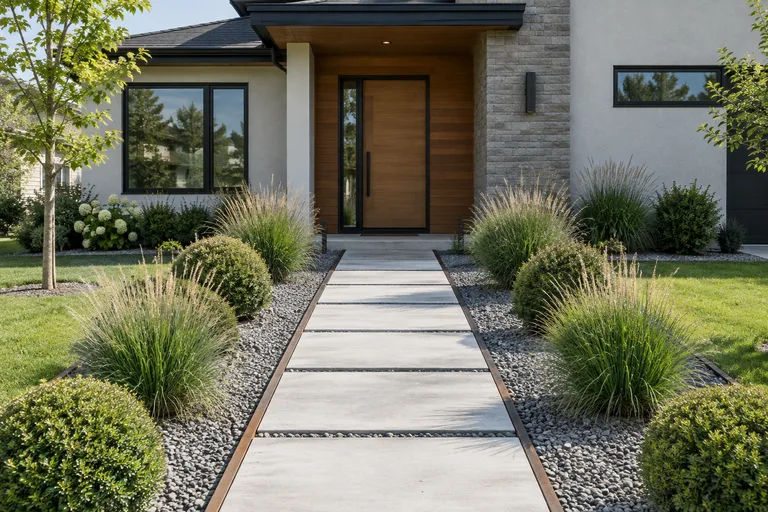
Modern front yard landscaping uses clean lines, a direct path to the front door and a few repeated materials, such as concrete, gravel and steel. Plants are chosen for their shape. It suits a contemporary house, but the same ideas can freshen a traditional one. The goal is a front yard that looks tidy in every season and takes little work to keep that way.
Below are the basics of modern front yard design, 12 ideas to borrow, a table of plants with sizes and zones, and the mistakes worth avoiding. For the wider style, see our modern garden design guide.
What makes a front yard modern?
A modern front yard is defined by structure, not decoration. Most share these traits:
- Clean lines. Straight or long, gently curved edges on the path, beds and lawn.
- Simple shapes. Rectangles and squares that line up with the house, its door and its windows.
- A short material list. One main paving, one loose material and one accent, used again and again.
- Repeated plants. A few kinds of plant in blocks or rows, not one of everything.
- Foliage first. Greens, grays and blue-grays carry the color, with one or two flower colors as accents.
- Little or no lawn. Lawn, if there is any, is a neat panel with a crisp edge.
Start with the path to the front door
The path is the backbone of a modern front yard, so plan it before anything else. It should lead clearly from the street or driveway to the door.
- Width. Gardenista recommends a front path no less than 4 feet wide at its narrowest and no wider than 6 feet.
- Line. A straight path, or one with a single right-angle turn, fits the style. An offset line of large pavers adds interest without curves.
- Surface. Poured concrete gives one smooth surface. Large concrete pavers give a crisp grid.
- Stepping stones. Gardenista advises setting stepping stones no more than 6 inches apart to avoid a tripping hazard.
- Light. Low, simple fixtures along the path and at the steps keep it safe at night. See Landscape Lighting Design.
Gardenista's first rule is to design the path to complement the home's architecture. On a modern house, that often means repeating the color of the walls or the line of the roof in the paving. For more on entries, see Walkway and Entry Landscaping.
12 modern front yard landscaping ideas
Pick a few of these and repeat them, rather than using all twelve at once.
1. Large pavers with gravel joints
Big square or rectangular concrete pavers turn a plain walk into a pattern. Set them in a grid and fill the gaps with gravel or a low ground cover. Houzz notes that pavers are less prone to cracking than poured concrete, and a damaged one is easy to replace.
2. Gravel in place of lawn
A gravel yard with planted islands needs no mowing. Edge the gravel with steel or concrete, because Houzz notes that gravel scatters unless it is held in by edging. Denver Water recommends rock and gravel mulch at least 2 inches deep, with no black plastic underneath. For more ideas, see Low-Maintenance Front Yards.
3. A smaller, rectangular lawn
If you want some grass, shrink it to a clean rectangle with a hard edge. Denver Water notes that reducing the amount of lawn is one way to use less water. The neat shape reads as modern on its own.
4. Corten steel or concrete planters by the door
A pair of tall, square planters on each side of the door frames the entry. Weathering steel, often sold as corten, gives a warm rust color. Set it where its runoff falls on gravel or soil. The Federal Highway Administration notes that drainage from uncoated weathering steel leaves dark stains on concrete. More in Modern Garden Materials.
5. A block of one grass
A row or block of one upright grass is one of the simplest modern looks. Feather reed grass 'Karl Foerster' grows 3 to 5 feet tall but only 1 to 1.5 feet wide. NC State Extension notes that its flower stalks stand through winter.
6. Clipped evergreen spheres
Rounded boxwood or Japanese holly, repeated in a line along the path, gives green structure all year. NC State Extension lists boxwood 'Green Velvet' at 2 to 3 feet tall and wide, with a rounded habit.
7. One sculptural tree
A single tree with a strong outline or striking bark works as a focal point. Paperbark maple has peeling, cinnamon to red-brown bark and grows slowly to 20 to 30 feet, according to NC State Extension, so give it room. For other choices, see Trees for Landscaping.
8. Low walls with clean faces
On a sloping lot, low retaining walls in smooth concrete or square-cut stone create level terraces. They can double as seating or raised beds. See Hillside Landscaping for slope basics.
9. A horizontal slat screen
Horizontal wood or composite slats hide trash bins, utility boxes or a neighbor's driveway. Their long lines echo the lines of a modern house.
10. A dry garden for hot, sunny yards
In sunny, dry spots, gravel planted with Parry's agave, red yucca and blue fescue makes a bold, low-water front yard. Check each plant's zones in the table below. For more, see Drought-Tolerant Landscapes.
11. Clear house numbers and a simple mailbox
Large, plain house numbers and a mailbox in a matching finish are small details. They make the whole entry look planned.
12. A small seating spot
A concrete or wood bench on a paved pad near the entry turns part of the front yard into a place to sit. Build it from the same materials as the path.
Minimalist front yard: keep it simple
A minimalist front yard takes the modern rules one step further. It uses fewer plants and fewer materials, so each one counts.
- Choose one main paving, one loose material and one accent material.
- Limit the plant list to a few kinds and repeat them.
- Keep a clear view from the street to the front door.
- Line up beds, paths and lawn with the house's walls and windows.
- Leave some open space. Plain gravel or lawn is part of the design.
The RHS advice for modern gardens fits here too: less really is more, and the hard landscaping comes first.
Modern front yard plants
The best modern front yard plants have a strong shape and stay neat for most of the year. The figures below come from NC State Extension's Gardener Plant Toolbox. Zones are USDA plant hardiness zones.
| Plant | Shape | Height | Width | USDA zones | Light |
|---|---|---|---|---|---|
| Feather reed grass 'Karl Foerster' | Upright grass | 3 to 5 ft | 1 to 1.5 ft | 5 to 9 | Full sun to part sun |
| Prairie dropseed | Fine, arching mound | 2 to 3 ft | 2 to 3 ft | 3 to 9 | Full sun, some part shade |
| Blue fescue | Blue-gray dome | 9 to 12 in | 12 to 18 in | 4 to 8 | Full sun, some part shade |
| Boxwood 'Green Velvet' | Rounded evergreen shrub | 2 to 3 ft | 2 to 3 ft | 5 to 8 | Sun or part shade, morning sun best |
| Japanese holly | Dense, rounded evergreen shrub | 5 to 10 ft (many cultivars 3 to 4 ft) | 5 to 8 ft | 5 to 8 | Full sun to part shade |
| Adam's needle yucca | Spiky evergreen rosette | 3 to 8 ft | 3 to 5 ft | 4 to 10 | Full sun or part shade |
| Red yucca (Hesperaloe parviflora) | Arching clump | 3 to 5 ft | 4 to 6 ft | 6 to 10 | Full sun |
| Parry's agave | Gray-green rosette | 1 to 3 ft | 1 to 3 ft | 6 to 10 | Full sun |
| Japanese forest grass | Cascading mound | 1 to 1.5 ft | 1 to 2 ft | 5 to 9 | Part shade to deep shade |
A few notes from the same source. Blue fescue is short-lived, so clumps may need dividing or replacing every two to three years. Japanese forest grass grows best in cool summers and may not handle the heat of zones 8 to 9. Boxwood can get root rot in wet spots. For more choices and planting tips, see Plants for a Modern Garden.
How to keep a modern front yard low maintenance
- Edge everything. Steel, concrete or paver edges keep gravel and mulch in place.
- Cover bare soil. Denver Water recommends organic mulch at least 4 inches deep and rock mulch at least 2 inches deep.
- Group plants by need. Denver Water advises grouping plants with similar light and water needs.
- Cut grasses once a year. NC State Extension advises cutting feather reed grass back in early spring, leaving about a third of the plant.
- Sweep and rinse. Houzz advises cleaning spills on concrete quickly to prevent stains.
For more ways to make the front of a house look cared for, see Curb Appeal Landscaping.
Mistakes to avoid
- Agave beside the path. NC State Extension says its leaf spines are a hazard and advises planting it away from walkways.
- Gravel next to lawn with no edge. LawnStarter notes that gravel which migrates onto grass can be a safety hazard when mowing.
- Steel draining onto pale concrete. Rusty runoff stains concrete, so plan where water from steel planters and edging will go.
- Ignoring drainage. Houzz notes that poured concrete is impermeable, so it needs proper drainage to keep water from pooling.
- Too many ideas at once. A few ideas, repeated, look calmer than many ideas used once.
Questions about modern front yards
Is gravel a good choice for a modern front yard?
Yes, with edging. It fills space evenly and needs no mowing. Expect to weed it and, as Gardenista notes, to top it up every 8 to 10 years.
Can a traditional house have a modern front yard?
Yes. Keep the clean lines and the short plant list, but choose materials and colors that match the house, such as pavers in a brick tone or stone that echoes the walls.
Do I have to remove the whole lawn?
No. A smaller lawn with a crisp edge looks modern and still gives a soft green space. Replace only the parts nobody uses.
For the full style, from materials to layout, see the Modern Garden Design guide.
Sources
- Gardenista, Hardscaping 101: Front Paths.
- Marianne Lipanovich, Houzz, Popular Materials for Garden Paths and Walkways.
- LawnStarter, 12 Materials to Consider for Your Garden Path.
- Denver Water, Xeriscape Principles.
- US Federal Highway Administration, Technical Advisory T 5140.22 on uncoated weathering steel.
- Royal Horticultural Society, Modern and minimal garden design.
- NC State Extension, Gardener Plant Toolbox: feather reed grass 'Karl Foerster', prairie dropseed, blue fescue, boxwood 'Green Velvet', Japanese holly, Adam's needle yucca, red yucca, Parry's agave, Japanese forest grass and paperbark maple.