
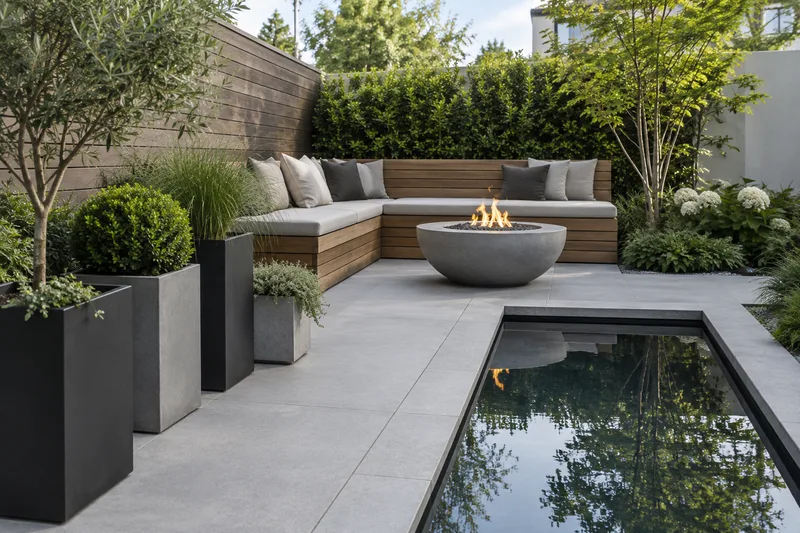
The best plants for a modern garden have strong, simple shapes that stay neat for most of the year. Think upright and mounding ornamental grasses, clipped evergreens, spiky plants such as yucca and agave, and one sculptural tree. Choose a short list, plant each kind in blocks or rows, and let shape and leaf color do most of the work.
This guide explains what makes a plant structural, then gives 14 plants with height, width, USDA zones and light, all from NC State Extension's Gardener Plant Toolbox. For the wider style, see our modern garden design guide.
What makes a plant right for a modern garden?
A plant suits a modern garden when its outline is clear and it keeps that outline through the seasons. Look for these traits:
- A strong shape. Upright, rounded, spiky or fountain-like, and easy to read from a distance.
- A neat habit. Plants that stay in their space need less cutting back and staking.
- Leaves that carry the color. Greens, grays and blue-grays, with flowers as accents.
- Interest after flowering. Seed heads, stems and evergreen leaves keep the structure in winter.
- The right size for the spot. A plant that fits its space never needs hard pruning to stay in line.
The Royal Horticultural Society (RHS) recommends a limited selection of plants and colors for a modern look. In practice, that means a handful of kinds, repeated, rather than one of everything.
Plants for a modern garden at a glance
All sizes, zones and light needs below come from NC State Extension. Zones are USDA plant hardiness zones. For switchgrass, the top of the height range is the flower plumes.
| Plant | Role and shape | Height | Width | USDA zones | Light |
|---|---|---|---|---|---|
| Feather reed grass 'Karl Foerster' (Calamagrostis x acutiflora) | Upright grass | 3 to 5 ft | 1 to 1.5 ft | 5 to 9 | Full sun to part sun |
| Switchgrass (Panicum virgatum) | Upright, columnar native grass | 3 to 7 ft | 2 to 3 ft | 5 to 9 | Full sun |
| Prairie dropseed (Sporobolus heterolepis) | Fine, arching mound | 2 to 3 ft | 2 to 3 ft | 3 to 9 | Full sun, some part shade |
| Blue fescue (Festuca glauca) | Blue-gray dome | 9 to 12 in | 12 to 18 in | 4 to 8 | Full sun, some part shade |
| Japanese forest grass (Hakonechloa macra) | Cascading mound for shade | 1 to 1.5 ft | 1 to 2 ft | 5 to 9 | Part shade to deep shade |
| Adam's needle (Yucca filamentosa) | Spiky evergreen rosette | 3 to 8 ft | 3 to 5 ft | 4 to 10 | Full sun or part shade |
| Red yucca (Hesperaloe parviflora) | Arching, spiky clump | 3 to 5 ft | 4 to 6 ft | 6 to 10 | Full sun |
| Parry's agave (Agave parryi) | Gray-green rosette | 1 to 3 ft | 1 to 3 ft | 6 to 10 | Full sun |
| Giant allium (Allium giganteum) | Bulb with round flower heads | 1 to 6 ft | 1 to 2 ft | 4 to 8 | Full sun |
| Salvia (Salvia nemorosa) | Upright flower spikes | 1.5 to 3 ft | 6 in to 2 ft | 4 to 8 | Full sun or part shade |
| Boxwood 'Green Velvet' (Buxus) | Rounded evergreen shrub | 2 to 3 ft | 2 to 3 ft | 5 to 8 | Sun or part shade, morning sun best |
| Japanese holly (Ilex crenata) | Dense evergreen shrub | 5 to 10 ft (many cultivars 3 to 4 ft) | 5 to 8 ft | 5 to 8 | Full sun to part shade |
| Yew (Taxus x media) | Evergreen, shrubby to columnar | 2 to 20 ft, by cultivar | 2 to 12 ft | 4 to 7 | Full sun to part shade |
| Paperbark maple (Acer griseum) | Small tree with peeling bark | 20 to 30 ft | 15 to 25 ft | 4 to 8 | Full sun to part shade |
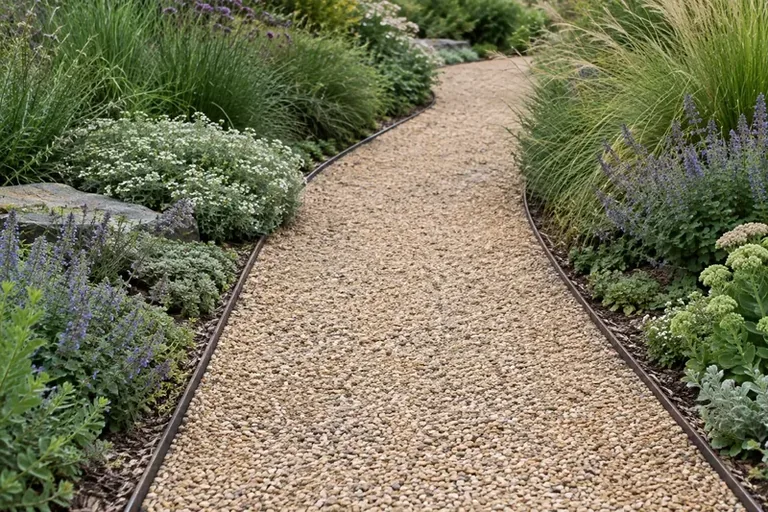
Ornamental grasses for modern gardens
Ornamental grasses bring movement to a design of hard lines. Upright grasses add height without bulk, and mounding grasses soften edges.
Feather reed grass 'Karl Foerster'
This is the classic upright grass for modern planting. It grows 3 to 5 feet tall but only 1 to 1.5 feet wide, so it fits narrow beds and rows. Its plumes turn golden tan in fall, and the stalks stand through winter. It is sterile and does not self-seed. NC State Extension notes that it tends to fall over in shade and can get rust in hot, humid or wet summers.
Switchgrass
A North American native that forms a dense, columnar clump. It usually grows 3 to 4 feet, with flower plumes reaching about 7 feet, and spreads slowly by creeping rhizomes. Give it full sun: in part shade it grows looser and may flop.
Prairie dropseed
A fine-textured, arching mound 2 to 3 feet tall and wide, hardy in zones 3 to 9. It is slow to establish but low maintenance once settled. Repeated along a path, it makes a soft, even edge.
Blue fescue
A small, blue-gray dome 9 to 12 inches tall, good for edging and gravel. It needs good drainage and does not tolerate wet soil. NC State Extension notes that it is short-lived, so plan to divide or replace clumps every two to three years.
Japanese forest grass
One of the few grasses for shade. It forms cascading mounds 1 to 1.5 feet tall in part to deep shade, in rich, moist soil that drains well. It grows best in cool summers and may not tolerate the heat of zones 8 to 9.
Architectural plants: spiky and sculptural
Architectural plants have outlines bold enough to stand alone, like a piece of sculpture. They are also called structural plants, because they give a planting its frame.
Adam's needle yucca
An evergreen rosette of stiff, sword-shaped leaves, hardy in zones 4 to 10. It handles clay, sand and rocky soil if drainage is good. Its leaves are sharply pointed, and NC State Extension lists it as a problem for cats, dogs and horses.
Red yucca
Despite the name, red yucca belongs to a different genus, Hesperaloe. It forms an arching clump 3 to 5 feet tall and 4 to 6 feet wide. Drainage must be excellent, because damp, heavy soil causes root rot. It flowers in spring and summer, and from summer into fall where winters are cooler.
Parry's agave
A clump of thick, gray-green leaves, each tipped with a dark spine, 1 to 3 feet tall and wide. Let the soil dry completely between waterings and do not water in winter. A mature plant sends up a flower stalk 10 to 20 feet tall. That rosette then dies back and is replaced by offsets. Plant it away from walkways, as NC State Extension advises.
Giant allium
A bulb with tall, upright stems topped by round flower heads in early summer, around June to July, lasting 2 to 3 weeks. NC State Extension gives a height range of 1 to 6 feet. Its globes repeat well in rows.
Structural evergreens for year-round shape
Evergreens hold the design together in winter, when grasses are cut back and perennials are dormant.
Boxwood 'Green Velvet'
A rounded shrub 2 to 3 feet tall and wide that takes shaping into balls, blocks and low hedges. Morning sun is best. Full sun can scorch the leaves and full shade thins them. Prune after the last frost, and avoid wet spots, where root rot can occur.
Japanese holly
A dense, small-leaved evergreen that can be sheared into hedges and topiary. It can slowly reach 5 to 10 feet, but many cultivars stay at 3 to 4 feet. It prefers acidic soil, and its leaves turn yellow in alkaline soil. NC State Extension also lists native alternatives, Ilex glabra and Ilex vomitoria.
Yew
Taxus x media comes in shrubby, columnar and spreading forms. 'Hicksii' is columnar and can reach 20 feet, which makes tall green pillars. 'Densiformis' stays 3 to 4 feet. Yew takes hard pruning but not wet soil. NC State Extension rates it highly poisonous: the bark, leaves and seeds are toxic. It is listed as a problem for dogs, cats, horses and livestock.
A sculptural tree
Paperbark maple
A slow-growing tree with an upright, oval form, reaching 20 to 30 feet tall and 15 to 25 feet wide in zones 4 to 8. Its bark peels in papery curls, cinnamon to red-brown, that stay on the tree. That gives it interest in winter, when a modern garden relies most on structure. For more trees, see Trees for Landscaping.
A few flowers, kept simple
Salvia nemorosa
Upright spikes of lavender to violet-blue flowers appear from June to September, in flushes. It grows 1.5 to 3 feet tall in zones 4 to 8. Cut spent stalks back to the basal leaves to encourage more flowers. Plant it in a long band or block rather than dotted around, so its color reads as one line.
How to plant for a modern look
- Pick a short list. Choose a few plants from the table that suit your zone and light.
- Plant in blocks or rows. Mass one kind together so its shape repeats.
- Repeat across the yard. Use the same plants in more than one bed to tie the spaces together.
- Layer by height. Low mounds in front, upright grasses or clipped shrubs behind, and one tree as a focal point.
- Group by water need. Denver Water advises grouping plants with similar light and water requirements.
- Mulch to match. Gravel mulch suits agave, yucca and blue fescue. Denver Water recommends rock mulch at least 2 inches deep, with no black plastic underneath.
- Use tall planters for single plants. A plain, square planter turns one plant into a feature. Pair a tall planter with an upright plant and a low bowl with a mound.
For planter and paving materials, see Modern Garden Materials: Concrete, Steel and Gravel. For using these plants at the front of the house, see Modern Front Yard Landscaping Ideas.
Plants to use with care
- Agave near paths. Its leaf spines are a hazard, so keep it away from walkways.
- Yew where pets or children play. Its bark, leaves and seeds are poisonous.
- Blue fescue in hot, humid areas. NC State Extension notes that it declines in hot, humid summers.
- Japanese forest grass in hot zones. It may not tolerate the summers of zones 8 to 9.
- Boxwood, agave or red yucca in wet soil. All three can get root rot.
- Non-native grasses near wild areas. Check your state's invasive plant list before planting any non-native grass.
Questions about plants for a modern garden
What are architectural plants?
Plants with a bold, clear outline that stands out on its own, such as yucca, agave, upright grasses and clipped evergreens. They give a planting its frame.
Which ornamental grasses stay upright in winter?
Feather reed grass 'Karl Foerster' is a reliable choice: NC State Extension notes that its flower stalks remain through winter. Switchgrass also forms an upright, columnar clump in full sun.
What plants suit a modern garden in shade?
Japanese forest grass for part to deep shade, boxwood 'Green Velvet' in morning sun or part shade, and yew in part shade. See Shade Garden Ideas for more.
Are these plants low maintenance?
Most of them are. NC State Extension rates most plants on this list as low maintenance. It rates Parry's agave and Japanese holly as medium.
For more low-water choices, see Drought-Tolerant Landscapes. For the whole style, see the Modern Garden Design guide.
Sources
- NC State Extension, Gardener Plant Toolbox: Calamagrostis x acutiflora 'Karl Foerster', Panicum virgatum, Sporobolus heterolepis, Festuca glauca, Hakonechloa macra, Yucca filamentosa, Hesperaloe parviflora, Agave parryi, Allium giganteum, Salvia nemorosa, Buxus 'Green Velvet', Ilex crenata, Taxus x media and Acer griseum.
- Royal Horticultural Society, Modern and minimal garden design.
- Denver Water, Xeriscape Principles.