
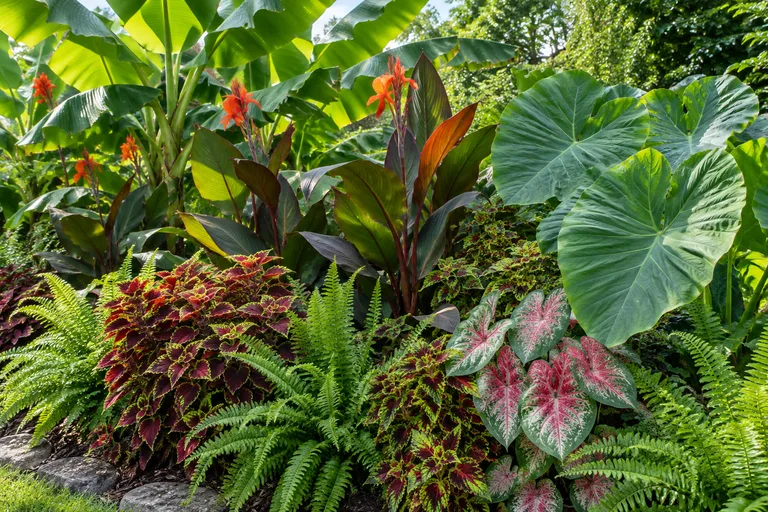
The best tropical foliage plants for gardens have leaves that are very large, boldly shaped or brightly colored. Bananas, cannas and elephant ears bring size. Coleus, caladiums and painted ferns bring color. Ferns and yuccas add contrasting texture. Mix all three and a garden looks tropical before a single flower opens.
This guide is about the look: leaf size, color and texture, and how to combine them. Several of these plants are tender, so if you want plants that survive winter in the ground, see Tropical-Looking Plants for Cold Climates. Sizes and light needs come from NC State Extension unless another source is named.
What makes foliage look tropical?
Fine Gardening, in an article by a horticulturist at Olbrich Botanical Gardens, puts it simply: the color and texture of foliage carry the tropical look. Four leaf qualities do the work:
- Size. Leaves a foot or more long read as tropical from across the yard.
- Shape. Paddles, hearts, swords and fans stand out against ordinary oval leaves.
- Color. Purple, near-black, chartreuse, striped and spotted leaves give color all season.
- Texture. Fine, feathery fronds next to broad leaves make both look bolder.
Big leaf plants for gardens
These plants have the largest leaves you can grow outdoors in most of the US. The "in cold zones" column shows how each is usually grown where winters freeze.
| Plant | Leaf size | Plant height | Light | In cold zones |
|---|---|---|---|---|
| Hardy banana (Musa basjoo) | Up to 6 feet long and 2 feet wide | 6 to 14 feet | Full sun to part shade | Hardy to zone 5 with mulch |
| Elephant ear (Colocasia esculenta) | Up to 3 feet | 3 to 6 feet | Best in part shade or filtered sun | Store the corms; hardy in zones 8 to 11 |
| Elephant ear (Alocasia) | 12 to 36 inches long | 2 to 10 feet | Dappled or part shade | Pot and bring indoors; hardy in zones 10 to 12 |
| Canna | Up to 2 feet long, 4 to 12 inches wide | 1.5 to 8 feet | Full sun to part shade | Lift and store the roots in zone 6 |
| Fatsia (Fatsia japonica) | Up to 18 inches across | 6 to 19.5 feet | Part to deep shade | Hardy in zones 7b to 10 |
| Pawpaw (Asimina triloba) | 6 to 12 inches long | 15 to 30 feet | Sun to shade | Hardy in zones 5 to 9 |
| Adam's needle (Yucca filamentosa) | Up to 18 inches long, about 2 inches wide | 3 to 8 feet | Full sun to part shade | Hardy in zones 4 to 10 |
The leaf is the reason to grow each of these, so give them room. NC State Extension lists elephant ear at 3 to 6 feet wide and hardy banana at 6 to 14 feet wide.
Canna and elephant ear: the classic pair
Canna and elephant ear are a classic tropical pairing, and they work well together. Cannas give height and upright, paddle-shaped leaves. Elephant ears give broad, drooping leaves lower down.
- Canna. Leaves come in green, reddish-purple, bronze, yellow-variegated or striped forms, some with a waxy blue coating. Flowers appear from July to October. Plant in full sun to part shade.
- Elephant ear (Colocasia). Grows best in part shade or filtered sun in moist, rich soil, and should not be allowed to dry out. It tolerates wet soil, so it suits damp spots and pond edges.
The Pennsylvania Horticultural Society names colorful cultivars of both. Canna 'Pretoria' has yellow and green striped leaves, and Tropicanna has burgundy and pink stripes. Among elephant ears, Colocasia 'Illustris' has black leaves with green veins, while 'Lime Zinger' and 'Maui Gold' are yellow or chartreuse.
In cold zones, both are lifted in fall and stored as roots. How to Overwinter Tropical Plants explains how to overwinter cannas and store elephant ear bulbs.
Colorful foliage plants
Colored leaves give steady color from spring to frost, where flowers come and go. These are the most useful:
- Coleus. Leaves in copper, gold, green, orange, pink, purple, red, white and mixed patterns. It grows best in part shade and may wilt in full sun.
- Caladium. Leaves in pink, red, white, green and variegated patterns, 1 to 2 feet tall, for part to deep shade.
- Japanese painted fern. Fronds of maroon, medium green and silvery gray. Too much sun washes out the color.
- Hosta. Blue, gold, green and variegated leaves for shade, hardy in zones 3 to 9.
- Persian shield and bloodleaf. Fine Gardening lists both among colorful tropical foliage plants. Both are rated for zones 10 to 11, so they are grown as annuals in most of the US.
Dark leaves deserve a place too. Fine Gardening suggests purple and near-black foliage as a contrast to hot-colored flowers and bright leaves. Its examples include Black Lace elderberry, hardy in zones 4 to 7.
Mix fine and coarse textures
A planting of only huge leaves looks heavy. Fine Gardening points to shape, texture and scale as the way to keep an all-green tropical planting interesting. Pair each big leaf with something finer:
- Ostrich fern, 3 to 5 feet tall, beside elephant ears.
- Japanese painted fern in front of hostas.
- Needle palm fans next to canna paddles.
- Spiky yucca leaves against rounded leaves.
Tropical foliage for shade
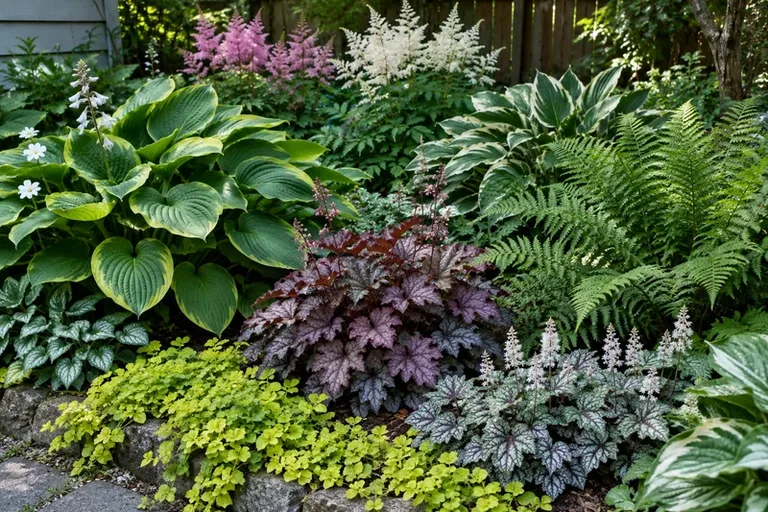
Many of the boldest leaves grow best out of strong sun, so a shady yard is a good place for a tropical look. Good choices for part to full shade:
- Hosta, from small edging plants to giants. NC State Extension notes 'Empress Wu' can reach about 50 inches tall.
- Fatsia, whose leaves can scorch in full sun or wind.
- Caladium and coleus for color in the ground layer.
- Alocasia, which prefers dappled or part shade.
- Ostrich fern, which likes constant moisture.
For more shade planting, see Shade Garden Ideas.
Tropical foliage for sun
In full sun, choose plants that hold up to heat and light:
- Canna and hardy banana, both listed for full sun to part shade.
- Yucca for sword-shaped leaves in full sun or part shade.
- Eastern prickly pear, a low cactus for full sun and dry, sandy or rocky soil.
Elephant ears can take some sun, but NC State Extension says Colocasia grows best in part shade or filtered sun.
Invasive and safety notes
Some popular foliage plants need care in certain places:
- Wild taro (Colocasia esculenta) is invasive in Florida. University of Florida IFAS lists it as "Invasive, No Uses". It forms dense stands along river and lake shores and crowds out native plants. UF/IFAS advises not buying it in Florida. Check your own state's invasive plant list before planting elephant ears near water in warm regions.
- Elephant ears are poisonous if eaten. NC State Extension lists both Colocasia and Alocasia as toxic to people, cats, dogs and horses, from calcium oxalate crystals. Alocasia can also irritate skin.
- Ostrich fern spreads. NC State Extension says its runners form new colonies that can be weedy.
A simple planting recipe
For one bed or one large container group, this order gives a balanced tropical look:
- One giant. A banana, a tall canna or a large elephant ear as the focal point.
- Two or three medium plants. Elephant ears, hostas or fatsia with a different leaf shape.
- A band of color. Coleus or caladiums in front.
- A fine texture. Ferns or a trailing plant to soften the edges.
- One dark leaf. A near-black elephant ear or a purple coleus for contrast.
For layouts and more ideas, see the main tropical garden ideas guide.
More guides on Yard and Soil
- Tropical Garden Ideas: the full guide to tropical garden style in any climate.
- Tropical-Looking Plants for Cold Climates: what survives winter in the ground, zone by zone.
- How to Overwinter Tropical Plants: store, rest or bring plants indoors.
- Tropical Backyard Ideas for Small Yards: patios and courtyards.
Sources
- NC State Extension, Extension Gardener Plant Toolbox: Musa basjoo, Colocasia esculenta, Alocasia, Canna, Fatsia japonica, Asimina triloba, Yucca filamentosa, Coleus, Caladium bicolor, Athyrium niponicum, Hosta, Ostrich fern and Opuntia humifusa.
- Erin Presley, Fine Gardening, Tropical Foliage for Sun and Shade.
- Pennsylvania Horticultural Society, 7 Small Tropical Garden Ideas to Try This Season.
- University of Florida IFAS, Wild Taro.