
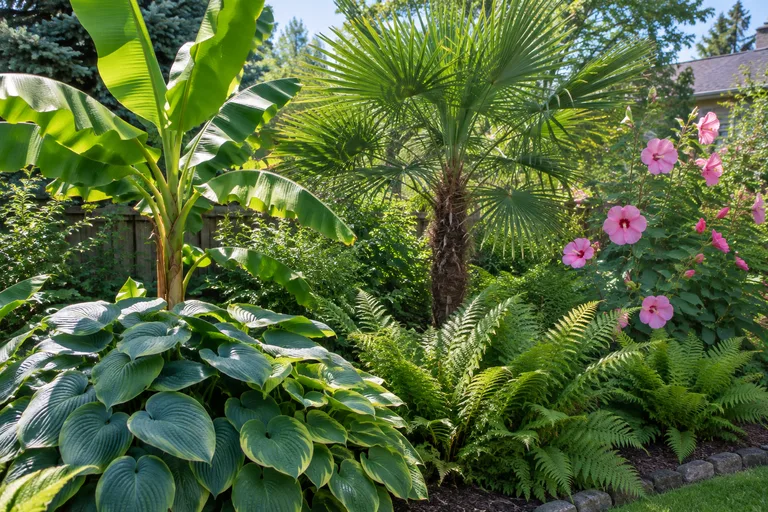
The best tropical plants for cold climates are hardy plants that only look tropical. Hardy banana, needle palm, rose mallow, yucca, hostas and big ferns all survive freezing winters in the ground across much of the US. True tropicals, by contrast, die at the first frost unless they are stored or brought indoors.
This guide lists hardy tropical looking plants with their USDA zones, heights and winter care. It covers what works in zone 6, how to find the warmest spots in a yard, and which plants spread too far. All zones and sizes come from NC State Extension's plant database unless another source is named.
How hardiness zones decide what survives
A plant's hardiness zone tells you the coldest winter it can usually survive. The USDA Plant Hardiness Zone Map, last updated in 2023, sets zones by the average coldest winter temperature. Each zone covers 10 degrees Fahrenheit and is split into "a" and "b" halves of 5 degrees.
- Find your zone on the USDA map for your address.
- Choose plants rated for your zone or a colder one if they are to stay in the ground all year.
- Treat a plant at the edge of its range as borderline. It may need a sheltered spot, mulch or wrapping.
Many plants listed as "cold hardy tropicals" only survive to zone 7 or 8. That is too warm for much of the Midwest and Northeast, so always check the zone before buying.
Hardy tropical looking plants at a glance
This table puts the hardiest tropical-looking plants side by side. Plants are listed from the coldest-hardy zone up.
| Plant | USDA zones | Height | Light | Note |
|---|---|---|---|---|
| Hosta | 3 to 9 | 4 inches to 2.5 feet | Part to full shade | Blue, gold, green or variegated leaves |
| Ostrich fern (Matteuccia struthiopteris) | 3 to 8 | 3 to 5 feet | Part to full shade | Likes constant moisture; spreads by runners |
| Rose mallow, hardy hibiscus (Hibiscus moscheutos) | 4 to 9 | 2 to 6 feet | Full sun to part shade | Flowers up to 8 inches across |
| Adam's needle (Yucca filamentosa) | 4 to 10 | 3 to 8 feet | Full sun to part shade | Leaves up to 18 inches long; needs good drainage |
| Eastern prickly pear (Opuntia humifusa) | 4 to 9 | 6 to 12 inches | Full sun | Needs sandy or rocky, well-drained soil |
| Japanese painted fern (Athyrium niponicum) | 4 to 9 | 1.5 to 2 feet | Part to full shade | Silver, green and maroon fronds |
| Hardy banana (Musa basjoo) | 5 to 10 | 6 to 14 feet | Full sun to part shade | Dies to the ground in zones 5 to 8; mulch the base |
| Pawpaw (Asimina triloba) | 5 to 9 | 15 to 30 feet | Sun to shade | Small tree with leaves 6 to 12 inches long |
| Maypop passionflower (Passiflora incarnata) | 5 to 9 | Vine, needs 12 to 24 feet of space | Full sun to part shade | Roots spread by suckers |
| Canna | 6 to 10 | 1.5 to 8 feet | Full sun to part shade | Lift the roots in zone 6; mulch in zone 8 |
| Needle palm (Rhapidophyllum hystrix) | 6b to 10 | 3 to 6 feet | Best in part shade | Mulch the roots; shelter from winter wind |
| Windmill palm (Trachycarpus fortunei) | 7 to 11 | About 10 feet in gardens | Full sun to part shade | Wind tears the leaves |
| Dwarf palmetto (Sabal minor) | 7 to 10 | 2 to 10 feet | Part shade to full sun | Hardy to zone 7 with winter protection |
| Hardy ginger lily (Hedychium coronarium) | 7 to 10 | 3 to 6 feet | Sun to dappled shade | Below zone 8, mulch heavily or store the roots |
| Fatsia (Fatsia japonica) | 7b to 10 | 6 to 19.5 feet | Part to full shade | Leaves scorch in full sun or wind |
For how these plants look together, by leaf size, color and texture, see Bold Foliage Plants for a Tropical Look.
Hardy banana plant: the biggest leaves you can leave outside
The hardy banana (Musa basjoo) is the plant most people mean when they talk about a jungle look in a cold climate. NC State Extension rates it for zones 5 to 10. It grows 6 to 14 feet tall, with leaves up to 6 feet long and 2 feet wide.
In zones 5 to 8 the stems die back to the ground each winter. NC State Extension says the roots are cold hardy to minus 10 degrees Fahrenheit if the plant is pruned and mulched. Its winter steps are simple:
- Wait until frost kills the leaves.
- Cut the stems back to about 2 feet high.
- Wrap the stems in burlap, bubble wrap or plastic wrap.
- Spread a thick layer of mulch around the base to protect the roots.
NC State Extension lists full sun or part shade for it, and the plant is evergreen only in zones 9 and 10.
Cold hardy palms
Only a few palms handle real winters. Of the three below, the needle palm is the hardiest.
- Needle palm (Rhapidophyllum hystrix). NC State Extension calls it the most cold-hardy palm on its list and rates it to zone 6b. It grows slowly to 3 to 6 feet tall. It prefers part shade and rich, moist soil. Mulch the roots and plant it out of winter wind.
- Windmill palm (Trachycarpus fortunei). Rated for zones 7 to 11 and about 10 feet tall in gardens. It may suffer in the coldest spots of its range. Without shelter from wind, the leaves tear.
- Dwarf palmetto (Sabal minor). Rated for zones 7 to 10 and 2 to 10 feet tall. It tolerates poorly drained soil, and NC State Extension says it is hardy to zone 7 with winter protection.
In colder zones, NC State Extension notes that windmill palms in containers can be brought indoors for winter.
Big flowers and bold shapes
Leaves set the tropical scene, but a few hardy plants add the large flowers and spiky shapes that finish it.
- Rose mallow (Hibiscus moscheutos). A hardy hibiscus for zones 4 to 9, with flowers up to 8 inches across from midsummer to early fall. Full sun gives the most blooms.
- Adam's needle (Yucca filamentosa). Sword-shaped leaves up to 18 inches long in a rosette, hardy in zones 4 to 10. It needs good drainage.
- Eastern prickly pear (Opuntia humifusa). A low cactus, 6 to 12 inches tall, hardy in zones 4 to 9. It needs full sun and sandy or rocky soil, and it does not tolerate wet ground.
- Maypop (Passiflora incarnata). A fast vine for zones 5 to 9 with fragrant white and purple flowers from May to July.
Hardy leaves for shade
Shady yards can look tropical too. Large leaves and tall ferns give the jungle-floor look under trees.
- Hosta is hardy in zones 3 to 9 and comes in blue, gold, green and variegated leaves. Some cultivars are much larger than the typical 2.5 feet.
- Ostrich fern grows 3 to 5 feet tall in zones 3 to 8 and likes constant moisture.
- Japanese painted fern adds silver, green and maroon fronds in zones 4 to 9. Too much sun washes out the color.
- Fatsia brings leaves up to 18 inches across to zones 7b to 10, in part to full shade.
For more shade planting ideas, see Shade Garden Ideas.
A tropical look in zone 6
Getting a tropical look in zone 6 is very possible with the right plants. Based on the zones above, a zone 6 garden can keep these in the ground all year:
- Hardy banana, cut back and mulched each fall.
- Rose mallow, yucca, prickly pear and maypop in sun.
- Hostas, ostrich fern and Japanese painted fern in shade.
- Pawpaw as a small tree with long, tropical-looking leaves.
- Needle palm in zone 6b, in a sheltered spot with mulched roots.
Cannas are borderline here. NC State Extension advises cutting them down right after the first frost in zones 6a and 6b, and lifting the roots to store indoors. Elephant ears (Colocasia) are rated for zones 8 to 11, so in zone 6 they are stored over winter or grown as annuals.
The simplest plan for zone 6 is a hardy frame of the plants above. Add tender tropicals in pots each summer, then store them in fall. How to Overwinter Tropical Plants explains each step.
Help borderline plants through winter
A plant near the edge of its range can often survive with a little help. These steps come from the plant guides above:
- Use warm spots. Beds by a wall or in a corner sheltered from wind stay milder. The Royal Horticultural Society advises finding warm, sheltered spots for tropical-look plants.
- Mulch the roots. NC State Extension recommends mulch for hardy banana and needle palm roots.
- Block winter wind. NC State Extension advises shelter from winter wind for needle palm, and notes that wind tears windmill palm leaves.
- Get the drainage right. Yucca needs good drainage, and NC State Extension says prickly pear does not tolerate wet, poorly drained soil.
Plants that need watching
A few hardy tropical-looking plants spread more than expected:
- Maypop spreads by root suckers to cover large areas, and NC State Extension warns the roots can spread aggressively.
- Ostrich fern sends out runners that form new colonies, which NC State Extension says can be weedy.
- Wild taro (Colocasia esculenta), one of the elephant ears, is listed as invasive in Florida by UF/IFAS. It is not hardy in cold zones, but check your state list in warm regions.
Give spreading plants room, or grow them in a bed edged by paving or lawn.
More guides on Yard and Soil
- Tropical Garden Ideas: the full guide to tropical garden style in any climate.
- Bold Foliage Plants for a Tropical Look: big, colorful leaves for sun and shade.
- How to Overwinter Tropical Plants: store, rest or bring plants indoors.
- Tropical Backyard Ideas for Small Yards: patios and courtyards.
Sources
- NC State Extension, Extension Gardener Plant Toolbox: Musa basjoo, Rhapidophyllum hystrix, Trachycarpus fortunei, Sabal minor, Hibiscus moscheutos, Yucca filamentosa, Opuntia humifusa, Hosta, Ostrich fern, Athyrium niponicum, Asimina triloba, Passiflora incarnata, Canna, Colocasia esculenta, Hedychium coronarium and Fatsia japonica.
- US Department of Agriculture, USDA Plant Hardiness Zone Map (2023).
- University of Florida IFAS, Wild Taro.
- Royal Horticultural Society, Plants for a touch of tropical foliage.