
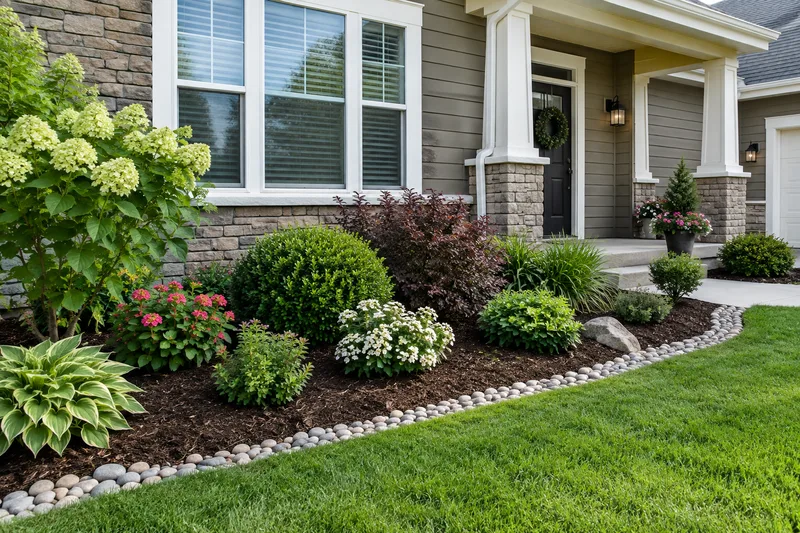
A good flower bed in front of a house is deep enough for layers and sets shrubs back from the wall. Its plants stay low enough to keep windows and the door clear. Evergreen shrubs at the back give it shape all year. Flowering shrubs and perennials in the middle and front add color. Choose each plant by its full-grown size, not its size in the pot, and the bed will need little pruning for years.
This bed along the house is often called a foundation planting. Below are the rules that make it work, a way to work out how deep your bed should be, plant picks for each layer, and seven ideas to suit different houses.
Foundation planting ideas start with three rules
Wisconsin Extension's guide to selecting landscape plants sets out three rules for plants along a house:
- Set shrubs back from the wall. Place shrubs slightly more than one-half their ultimate spread away from the foundation, so they can grow into their natural form.
- Space them by their full-grown size. Space shrubs so that, once mature, they just barely touch.
- Keep windows and doors clear. Choose plants that will not block windows or doors at their mature size.
Following these three rules avoids the most common problem with front beds: shrubs bought small, planted against the wall, and sheared hard every year to keep them off the windows.
How deep should a flower bed along the house be?
Deep enough for at least two layers: one row of shrubs and one row of lower plants in front. A narrow strip along the wall rarely has room for both. You can work out the depth from the plants you choose, using the set-back rule above.
| Back shrub's full-grown width | Shrub center from the wall (a bit more than half) | Shrub's front edge | Add a row of perennials about 2 ft wide | Bed depth, about |
|---|---|---|---|---|
| 3 ft | About 2 ft | About 3.5 ft out | Plus 2 ft | 5.5 ft |
| 4 ft | About 2.5 ft | About 4.5 ft out | Plus 2 ft | 6.5 ft |
| 5 ft | About 3 ft | About 5.5 ft out | Plus 2 ft | 7.5 ft |
These are worked examples, not fixed rules. If the bed must stay narrow, choose smaller shrubs or skip the shrub row and use perennials and grasses. A curved front edge that swings out into the lawn near the door and the corners of the house gives room where you need it most.
Layering a flower bed along the house
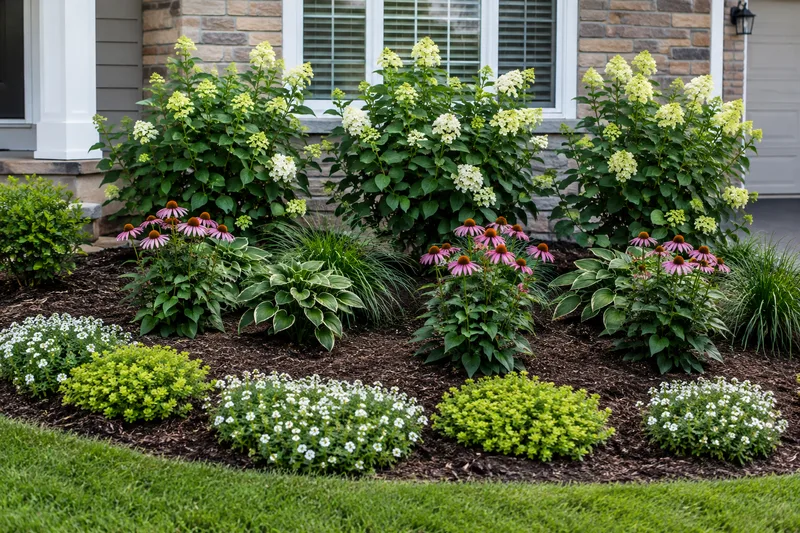
Think of the bed in three rows. The back row is the tallest and gives structure. The middle row carries most of the flowers. The front row is low and neat, so the bed's edge looks clean from the street. Sizes and zones below come from the North Carolina State Extension Gardener Plant Toolbox.
| Layer | Plant | Height | USDA zones | Light | Why here |
|---|---|---|---|---|---|
| Back | Inkberry 'Shamrock' (Ilex glabra) | 3 to 5 ft | 4 to 11 (species) | Sun to part shade | Compact broadleaf evergreen |
| Back | Panicle hydrangea 'Rensun' (Hydrangea paniculata) | 4 to 5 ft, 3 to 4 ft wide | 3 to 8 (species) | Sun to part shade | Blooms on new wood, so it can be pruned in late winter |
| Middle | Purple coneflower (Echinacea purpurea) | 3 to 4 ft | 3 to 8 | Sun to part shade | Summer flowers; drought tolerant once established |
| Middle | Blue false indigo (Baptisia australis) | 3 to 4 ft | 3 to 9 | Full sun | Late spring flowers; hard to move, so place it once |
| Middle | Meadow sage (Salvia nemorosa) | 1.5 to 3 ft | 4 to 8 | Sun to part shade | Flowers June to September in flushes |
| Front | Catmint (Nepeta x faassenii) | 18 to 24 in | 5 to 9 | Sun to part shade | Soft edge; shear for a second flush |
| Front | Coral bells (Heuchera) | 6 to 20 in | 3 to 9 | Sun or part shade | Colorful leaves, evergreen to semi-evergreen |
| Front | Creeping phlox (Phlox subulata) | 4 to 6 in | 3 to 9 | Full sun | Spring carpet at the bed's edge |
Zones marked "species" are for the plant species; check the label of the cultivar you buy.
7 flower bed in front of house ideas
1. Classic evergreens with hydrangeas
A row of compact evergreens along the wall, with hydrangeas at the corners and a low edge of perennials, suits most traditional houses. Boxwood is a common choice, but NC State notes it is susceptible to boxwood blight and leaf spot, so a compact inkberry is worth comparing.
2. A cottage-style foundation bed
Fill the middle row with many flowering perennials, such as coneflower, catmint and salvia, planted close enough to knit together. Keep one or two evergreens at the back so the bed still has shape in winter. For more on the style, see Cottage Garden Style.
3. Modern lines with grasses
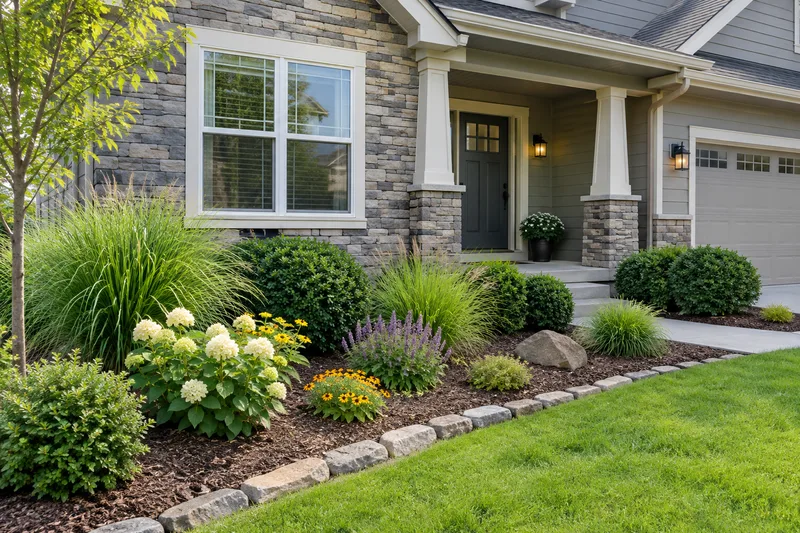
Repeat a few plants in clean rows or blocks. Native grasses such as little bluestem (2 to 4 feet, zones 3 to 9) and switchgrass (3 to 4 feet, zones 5 to 9) give height and movement, and both stand through winter after their fall color, according to NC State Extension.
4. A shady bed on the north side
A bed in the shade of the house suits hostas, coral bells and Lenten rose. NC State lists hostas for part to deep shade in zones 3 to 9, but notes that deer and rabbits eat the leaves. Lenten rose flowers in late winter in part to full shade and is listed as deer resistant.
5. A narrow strip by the driveway or walk
Where there is only a strip a couple of feet wide, skip shrubs. Use one low, tough plant repeated along the length, such as catmint in sun or coral bells in part shade, and add a large container by the door for height.
6. A four-season bed
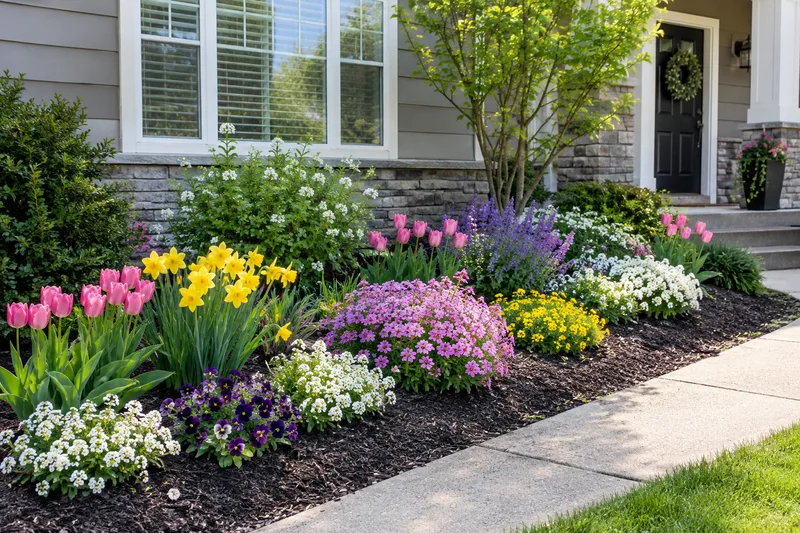
Plant daffodils for spring, perennials for summer, asters and sedum for fall, and winterberry for red berries in winter. NC State says daffodils are best planted in fall, 8 inches deep. Winterberry fruit ripens from August to December and lasts into winter, but female plants need a male nearby to set berries.
7. A bed that curves out to the walk
Instead of a straight strip, swing the bed's front edge out in a wide curve where it meets the front walk. The extra depth by the door is where the eye goes first, and it gives room for a small tree or a larger shrub. See Walkway and Entry Landscaping for planting along the path.
Front of house landscaping: practical details
- Drainage. Shape the soil so water runs away from the house, not toward it.
- Under the eaves. Soil under a roof overhang can stay dry even after rain. Check it before planting, and water new plants there more often.
- Mulch. University of Massachusetts Extension advises placing mulch over the root zone and never against stems or trunks.
- Access. Leave room to reach meters, faucets and windows for cleaning without stepping on plants.
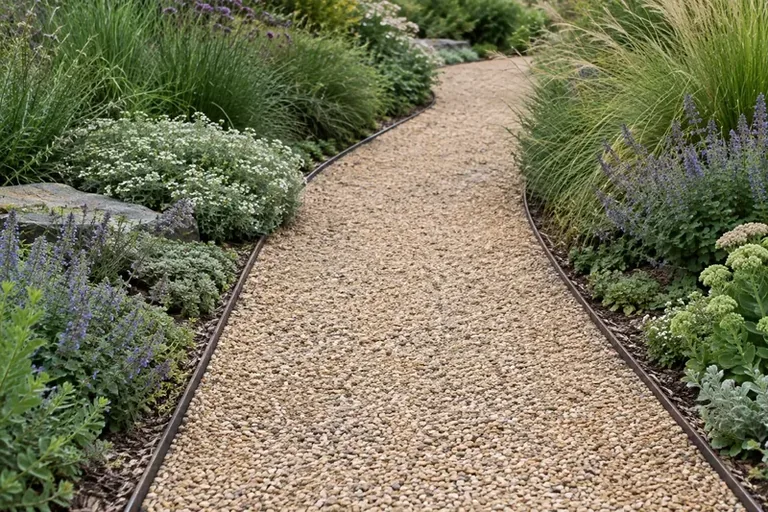
- Edging. A firm edge keeps lawn out of the bed. See Flower Bed Edging Ideas.
Mistakes to avoid in front of the house
- Buying by pot size. A small shrub in a nursery pot can grow many times larger. Read the label for full-grown height and width.
- Planting tight to the wall. Plants pressed against the house grow lopsided and block access for repairs and painting.
- Covering windows. Under windows, use dwarf shrubs or perennials that stay below the sill.
- Ignoring the light. The north side of a house gets far less sun than the south side. Choose plants for each side, not one list for the whole front.
- Too many kinds of plant. A few kinds, repeated, look calmer from the street than one of everything.
- A single row of identical shrubs. Add a lower row in front and some flowers, so the bed has depth and changes with the seasons.
How to plant a new bed along the house
- Measure the house front, mark the windows, door and downspouts, and note how many hours of direct sun the bed gets.
- Choose back-row shrubs first, then work out the bed depth with the table above.
- Mark the front edge with a hose, remove grass and weeds, and improve the soil with compost. Denver Water suggests 1 to 2 inches of organic material worked 6 inches deep for most soils.
- Set plants out in their pots, step back to the street to check, then plant.
- Mulch, keeping it off stems, and water regularly until the plants are established.
Common questions
What should I put in a flower bed in front of my house for year-round color?
Mix evergreens for winter, spring bulbs, summer perennials and fall bloomers. The four-season idea above and the season table in Front Yard Flower Beds give one plant for each part of the year.
Can I plant right against the foundation?
It is better not to. Wisconsin Extension's rule, slightly more than half the plant's mature spread from the wall, gives the plant room to grow and leaves space to reach the house.
How many shrubs do I need?
Divide the length of the bed by the shrubs' full-grown width. Wisconsin Extension spaces shrubs so they just barely touch when mature.
Should I use mulch or rock in a bed in front of my house?
Organic mulch, such as shredded bark, suits most flower beds because it keeps roots cool and breaks down into the soil. Denver Water gives a depth of at least 4 inches for organic mulch. It also notes that rock holds and gives off heat, so it suggests keeping rock off the sunny sides of the house. For more, read Front Yard Landscaping with Rocks and Mulch.
Related guides
- Front Yard Flower Bed Ideas: the full guide this post belongs to.
- Low-Maintenance Flower Bed Plants: easy shrubs, perennials and grasses.
- Best Shrubs and Trees for Front Yards: more shrubs for the back row.
Sources
- Wisconsin Horticulture, Division of Extension, Selecting Landscape Plants.
- Denver Water, Xeriscape Principles.
- University of Massachusetts Amherst Extension, Landscaping to Conserve Water.
- North Carolina State Extension Gardener Plant Toolbox: inkberry, panicle hydrangea, boxwood, purple coneflower, blue false indigo, meadow sage, catmint, coral bells, creeping phlox, little bluestem, switchgrass, hosta, Lenten rose, daffodil and winterberry.